The Ware Collection of Glass Models of Plants

20091018_GlassPlants_009by Chef Cooke

If you live in the Boston, Massachusetts area or are visiting Boston there is a great flower exhibition that you should not miss. This is an exhibition that you can visit at any time of the year; but not many people seem to know about it. This is The Ware Collection of Glass Models of Plants. The exhibition is located at the Harvard Museum of Natural History.  See here.

President & Fellows Harvard College, photo by Hillel Burger, showing 3 of over 3,000 glass models of plants on display at the Harvard Museum of Natural History.

This unique and stunning collection of nearly 4,400 plant models was created by naturalists and glass artisans Leopold Blaschka and his son, Rudolph whose studio was located near Dresden, Germany. They started creating the plant models in 1886 and worked on them through 1936. The life-size models include over 800 species of plants. The models replicate the tiniest details of plant anatomy with astounding precision and are made entirely of glass, reinforced internally with wire support when needed. This is one of the most amazing exhibits this Garden Lady has ever seen.

The history behind the creation of the models was that the founder of Harvard’s Botanical Museum wanted life-like representatives of the plant kingdom for teaching botany. At the time only papier-mache and wax models were available and these were either crude or could melt in hot weather. The project was financed my Mrs. Elizabeth C. Ware and her daughter, Mary Lee Ware, who presented the collection to the Botanical Museum of Harvard University as a memorial to Dr. Charles Eliot Ware, class of 1834.

Mt. Cuba Center: A Wonderful Woodland Wildflower Garden

Mt Cuba Center 1 by Larry Wilder

Spring is around the corner. I can’t wait. I look forward to visiting one of my favorite gardens called Mt. Cuba Center, in Delaware, known as the mid-Atlantic’s finest woodland wildflower garden. This 650 acre estate preserves and promotes an appreciation of plants native to the plateau between the coastal plain and the Appalachian Mountains that is called the Piedmont area. Mt. Cuba encourages the use of these native plants in gardens and supports their conservation in nature.

While at Mt. Cuba you can visit their woodland wildflower gardens and formal landscapes. Inside the garden you can walk in the woods, visit ponds, walk along the Dogwood Path, visit the meadow, see hundreds of trilliums in the Trillium Garden, see the trial garden, go to the lilac allee, visit the Round Garden where there are tulips and delphinium displays followed in the summer by heat loving annuals and native perennials, etc.

Trillium pusillum by dogtooth77

This estate was created by Mr. and Mrs. Lammot du Pont Copeland whose passion for native plants and naturalistic gardening led them to create the wonderful gardens, meadows, paths and ponds. Today these gardens include over 1900 plant species, varieties and cultivars. You can visit not only in the spring, but in the summer and fall. Contact Mt. Cuba and take a 2 hour tour-by calling for advance reservation. Their spring wildflower tours run from April 15 -May 28.

Helonias bullata by Illingworth

Mt. Cuba also has excellent Continuing Education programs. These inexpensive courses are extremely varied and include such topics as a Native Plant Buying Trip, to Bird Gardening to art and photography classes.

Garlic: The Stinky Savior

Garlic by riesling_76

TheGardenLady has invited people with horticultural interests and expertise to contribute posts to this blog.  The following post  was submitted by Christy Baker, a certified Family Herbalist and Consulting Herbalist.   Christy is currently pursuing a certificate in Horticulture Therapy and a second Master’s in Landscape Architecture.

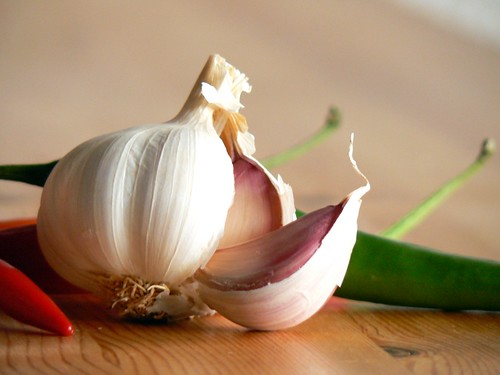
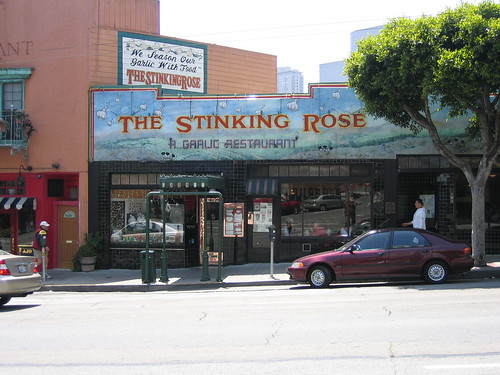
“Bronx Vanilla”, “Stinking Rose”, “Italian Perfume” or more commonly called today- garlic. Garlic (Allium Sativum) has been known by many names and has enjoyed its fair share of fame and rejection since its first recorded use in Mesopotamia by the Sumerians. In the 1550 BC Ebers Codex of Egypt garlic was included in 22 different medicinal formulas. Dating back to 3200 BC sculptures and paintings of the bulbous plant were found in Egyptian tombs while an Egyptian papyrus boasts of the benefits of garlic in the successful treatment for over 22 ailments of the time. In Korea, the six clove black garlic was given to women to bless them with supernatural powers and immortality. Interestingly, early Christians believed that when Satan left the Garden of Eden underneath his right foot sprang an onion and from his left garlic. The ancient Greeks and Romans used garlic to treat dog bites, repel scorpions, bladder infections, leprosy and asthma. In 1858 Louis Pasteur was able to prove that 1 mm of raw garlic juice was as effective as 60 mg of penicillin. The list of ways garlic has been used over the span of time humans have walked the Earth is plentiful.

The Stinking Rose garlic restaurant by Erwin Bolwidt (El Rabbit)

Due to its high antibacterial content, during World War II British and Russian soldiers used diluted garlic solutions to stave off infections and gangrene. Early Transylvanians used garlic as mosquito repellent (and to ward off more menacing blood suckers); but despite a long and distinguished history garlic was rejected by the American elite, who deemed this powerful bulb unfit for proper ladies and anyone who wanted to court them- however in the warm comfort of immigrant kitchens garlic never lost its place among revered culinary delights. It wasn’t until the 1940’s that Americans once again returned to the beckoning arms of this pungent culinary staple. Today, Americans alone consume 250 million pounds of garlic each year.

Continue reading “Garlic: The Stinky Savior”

The Soil Needs of Fangipani – Plumeria

TheGardenLady received this question from Paddy.

I have been given a Frangipani and the only fertilizer I have to hand (before planting in ground) is one for acid loving plants – can I use this?

How lucky to be given a Frangipani- Plumeria. When my children went to Hawaii they were so impressed with this small, flowering, fragrant tree. They asked me if I wanted one. Sadly, this GardenLady is at a stage in my life that I no longer am able to nurse plants that have such specialized needs since I have no greenhouse to pamper my plants. And my house is filled with less temperamental plants.

Sweet Summer Perfume by NatashaP

Frangipani grows well in zone 10. It likes slightly acid soil and sunny, hot weather when it is planted in the ground. It cannot tolerate any frost or it will die. Indoors it has to be kept in at least 60 degree temperatures and shouldn’t be taken outdoors until it is a minimum of 65 degrees. Then when the temperature drops back to 65degrees, it should be brought back indoors. Plumeria can be grown in a pot- which should be large enough – but it will be weaker and won’t grow as tall. It might need a little shade when in a pot.

Not knowing what type of acid fertilizer you have, I would be careful. If you know the company where your friend bought the plant, you should ask for the telephone number and call them to ask their advice. I phoned a really fine nursery that specializes in tropical plants called Logee’s Tropical Plants,  888-3308038 for advice on the fertilizer they use. They use and sell a product called Dyna-gro. They said you can use any fertilizer that is below 15-15-15.

There are three numbers on any container of fertilizer. The first number is for nitrogen, the second number is for phosphorus and the third number is for potassium. Dyna-gro has the numbers 7-9-5 meaning that it has more phosphorus to get more blooms. Logee’s only feeds the Plumeria when it is in active growth, when it is hot. They discontinue feeding the plumeria in the winter. When they feed the Plumeria they only use 1/2 tsp. of the fertilizer per gallon of water and use it only 1 time a week.

There is a Plumeria Society that has a website with answers to commonly asked questions.

According to the Cooperative Extension Service from the U of Hawaii, you should “Fertilize plumeria with 10-30-10 every three to four months at about 1 lb per inch of trunk diameter, distributing the fertilizer around the plant to 2 feet beyond the foliage line.”

Another good website on Plumeria care is this.

Good luck and send TheGardenLady a photo of your Frangiapani when it is in bloom.

Rain Gardens

A new concept in gardening that is ecologically and enviromnenally sound is called the Rain Garden. What is a rain garden?

“A rain garden is a naturally landscaped, shallow depression that allows rain and snow melt to be collected and seep naturally into the ground.” These are small gardens designed specifically to withstand extremes of moisture by taking advantage of rainfall and storm water runoff. These gardens are situated near the source of rain runoff from storm water like under a rain spout, driveway or sump pump. Rain gardens capture rainwater runoff to stop the water from reaching the sewer system and are designed to trap all the water that might possibly deluge the area; but plants have to be chosen that will tolerate both a lot or water as well as for times of drought and for all the times in between. To this end, mostly deep rooted native plants and grasses are planted- though one can find other plants that will work.  (See here)

The Rain Garden is a specialty garden that needs a special site- probably one place that you might have despaired of ever having a nice garden. Examples of rain garden design are here and here.

By building a rain garden you will not only enhance your landscaping with a garden that will attract native butterflies and birds but will help the water quality in your area and will provide storm water control.  (See here)

When looking for native plants to put in your rain garden check out your Native Plant Societies- each state has such a society.   Here or here and many states have a native plant public gardens.  See here.   In Pennsylvania a lovely native garden is Bowman’s Hill. These societies and native plant gardens can give you advice on perfect plants for your rain gardens and often have plant sales where you can buy these native plants. Bowman’s Hill has plant sales in the spring and in the fall and also sell seeds.  See here.

TheGardenLady would love to have photos of your rain garden. Please email photos.

Free Tickets for Botanical Gardens and Arboretums from Bank of America

Davidia involucrata by Jura Wanderer

When TheGardenLady learns of free tickets to gardens, she will share them with her readers. And she hopes that if TheGardenLady readers learn about free or reduced rate tickets to gardens, they will share this information with TheGardenLady blog.

The newest list is thanks to Bank of America.  See here.  Though it is ostensibly for museums, and most of the tickets are for museums, some of the places listed are for botanical gardens or arboretums. TheGardenLady also loves to visit museums, so I hope her readers do, too, and will take advantage of these wonderful offers.

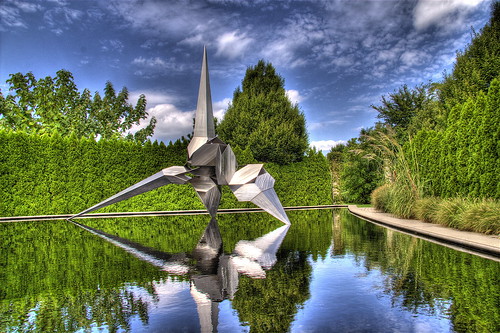
Dorion by Bruce Beasley by Kaldoon

In Hamilton, NJ one of the best places to visit both for the sculpture and for the grounds is Grounds for Sculpture. This Sculpture Park has 35 acres of beautifully landscaped grounds with interesting trees and shrubs as well as some flowering vines, perennials and annuals. There are two indoor museums, 250 outdoor pieces of sculpture, two shops, two restaurants- one modest priced and one called Rats which is one of the best restaurants in NJ and certainly one of the most beautiful restaurants in the world. I call Grounds for Sculpture the Garden of Eden; though the landscaper, Brian Carey, insists it is more like an arboretum. Take advantage of these free tickets. Plan on spending an entire day on the Grounds- you really need that much time. Then let the GardenLady know if you agree- should it be called the Garden of Eden or maybe Paradise?

Winterthur ~ A Country Estate by Diana827

In Deleware , you can get tickets to Winterthur and visit both the museum and the grounds which has one of the best outdoor plantings of Galanthus (snopdrops) and other minor spring bulbs. And if you are lucky, you might get there during the spring when the Handkerchief or Dove tree- Davidia involucrata is in bloom. This Handkerchief tree is located near the main buildings. It is one of the most unusual flowering trees TheGardenLady has ever seen. The flowers look like handkerchiefs fluttering in the breeze. I have seen more of these trees in European gardens than in American gardens; it is fairly difficult to find these trees in many nurseries in this country. It grows in zones 6 through 8. It likes a protected site that has rich, high organic matter in moist, well drained soil, a site that has shade in the afternoon. I understand it takes 15 years to bloom.  See here.

Cheekwood Botanical Gardens by rbglasson

In Nashville, Tennesee you can visit the Cheekwood Botanical Garden & Museum of Art. And then take in some Grand ole Opry- sorry I couldn’t find free tickets for that.

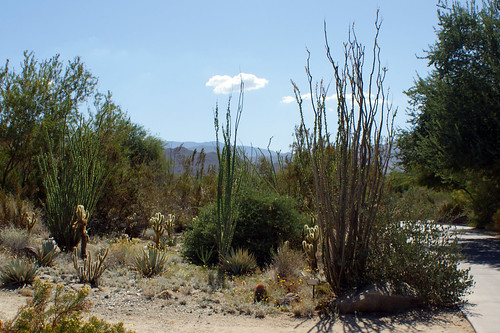
The Living Desert Zoo & Gardens by Fritz Liess

In Palm Desert, California you can visit the Living Desert which is a zoo and a botanical garden.

I didn’t check out every state to see where they are giving the free tickets. I will let my readers choose where they want to go. Have fun. And again, Thank You Bank of America.