The Boboli Gardens (Photos)

TheGardenLady loves to travel to visit gardens around the world.  One of the gardens TheGardenLady visited many years ago was the Boboli Gardens in Florence, Italy.  Unfortunately, TheGardenLady had not taken any photos. When my daughter had the opportunity to visit Tuscany this summer, I begged her to take photos of gardens if she had the opportunity.

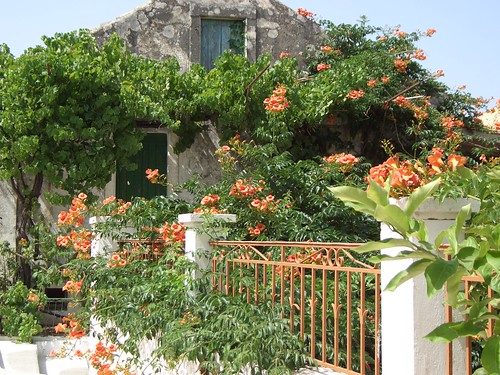
Below are some of her pictures of the Boboli Gardens, including the garden outside the Museo Porcellane, the grottoes at the Medici Villa, the Pompeii reconstructions, and the citrus garden.

A Knotty Impatiens Problem

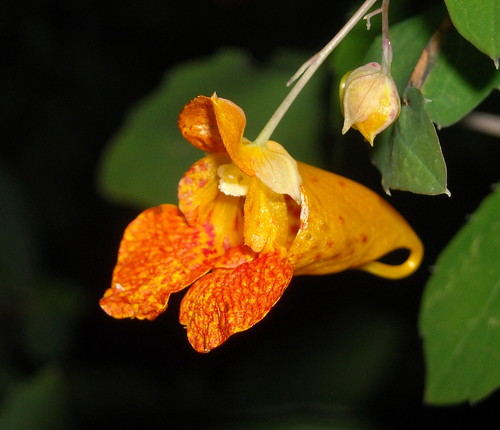
Orange Jewelweed – Impatiens Capensis by A. Walden

TheGardenLady received this question from Howard.

I have a North facing brownstone garden with partial sun here in Manhattan, New York City. Each year a good portion of the semi-shady part of the garden is planted with impatiens. They are the seedlings from the previous year so that I can enjoy them in the apartment during the cold months. When transplanted outside, the plants grow two to four feet tall and have volumes of flowers which produce large indefinite quantities of seedlings- continuing the cycle. I feed everything in the garden from my compost and that which I clean from the Koi Pond filter. At three AM the entire garden gets automatically rained upon daily for 15 minutes with sprinkler hoses wired to the top of all three fences. Recently this year (all I can describe them as) ‘Knots’ have formed on the tops of the plants. (I have a photograph to show upon your request.) It is the stunting of both leaves and buds. Lower leaves are browning. I, sadly, just cut all the plants back to about 18 inches and put the cuttings in the compost. At this time of year I usually have a mound of flowers so thick that the plants are barely seen. Now, I have a miniature forest of green sticks with few leaves. So far, I think nothing else is affected: potted house plants, ivy, basil, rosemary, lemon balm, Japanese maples, and the usual shade plant varieties. Please, tell me what the knots are if you can, how to prevent them from coming back, or what to plant next year in their place if I must. I will be most appreciative for your help as will all my neighbors who look down into my garden.

Impatiens are such bright cheery flowers that seem to have so few problems, I can understand how disappointed you must be to have unhealthy plants. This GardenLady plants impatiens around my front lawn to brighten the shady areas – this year I planted 200 impatiens plants, alternating white and red impatiens. I know how I love my impatiens as you and your neighbors appreciate your impatiens-filled back yard. So to make sure that I gave you the best, most up to date answer, I contacted the person whom I think of as the Guru of Impatiens, Derick Pitman.

Derick Pitman, known as Mr. Impatiens, lives in Sacramento, California, where he has been collecting and studying Impatiens for nearly 20 years and has been amassing scientific and horticultural information on this one plant. He was the founder of the, sadly now defunct, International Impatiens Society. He works with the Strybing Botanical Gardens in San Francisco (see here) with Impatiens species and has given many Impatiens species to Kartuz’s Greenhouses and Annie’s Annuals so people can buy these species to grow in their gardens. Derick Pitman loves to “talk Impatiens” with anyone who is interested. Derick has his own Impatiens website where you can contact him about your serious Impatiens problems.

Here is Derick’s response to your problem:

“My guess would be that the problem are mites, more likely Cyclamen mites. These mites are almost impossible to see but they like tips of new growth. I would trim off the tips and start a pest control program. You can use any solution for mites but stay away from oil based sprays; Impatiens don’t respond well to oil sprays. It could have been the heat that caused the mites to take off since they really multiply in hot climates. “


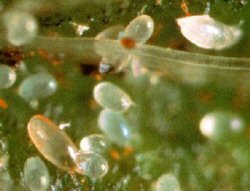
Adult cyclamen mites with eggs Image source: Manitoba Agriculture and Food

Another site with suggestions of Impatiens problems and treatment is this.

Howard, you offered to send a photograph of the ” knots.”  TheGardenLady would love to have your photo or photos to post on TheGardenLady.org. Please send the photo/s of the problem Impatiens plants so that we could all see what the knots look. We would also like you to send a follow up on your treatment and success rate.

Buying Plants from Nurseries When It’s This Hot


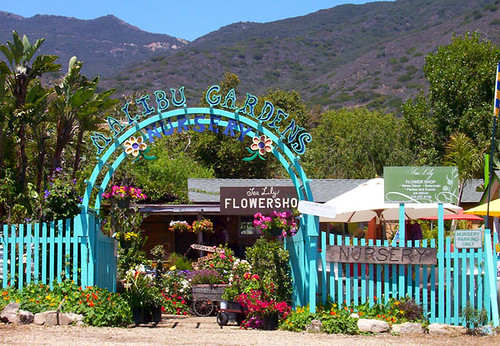
York Restoration Corporation Building Restoration Local Nursery by York Restorations

TheGardenLady feels sorry for plant nurseries in this heat and drought. Not only do they have to do frequent watering, but TheGardenLady can’t imagine many people buying right now. So the nurseries are putting their plants on sale and some prices are almost so low that it seems like the nurseries are giving away the plants or just barely covering costs. Russell Gardens Wholesale has some perennial and herb plants on sale for $1.  So you can pick up some bargains.

But buyer beware!

Another reason for these sales is that gardeners know that one should avoid planting in hot, dry weather, because this weather can easily stress plants. If you must plant in summer, plant in the cool of the morning.

And unless you have enough water to give to your plants, you will have a lowered success rate of the plants surviving. All new plants, that includes trees and shrubs, like to be watered well the first year to get their root system established. Even the drought-tolerant plants need to be watered well when first planted to establish their roots.

Proper watering becomes the most important part of plant survival because transplanting causes a certain amount of shock to a plant due to the loss of roots, transportation and handling, and a change in growing conditions. So don’t think that if you have a landscaper do the work of planting for you, that your plants will survive without your watering adequately.  See here.

And when shopping for plants at this time of year, again buyer beware. It is always advisable to shop at reputable nurseries where they know their plants, can give you advice on proper care of the plant and who know how to care for the plant in their nursery. Most places get fresh plants at the beginning of the summer, but if the plant has been in the nursery for a long time, it had to be properly cared for at the nursery before you buy it. Good nurseries know what they are doing. Some of the chains hire people who don’t know how to care for the plants. A good nursery will have watered its plants properly and shouldn’t sell you something that won’t live out the week.

When you buy the plant and bring it home, since the plant has been sitting in a small pot for the summer season, at this time of the year it is probably root bound. To get the plant out of the pot, you may have to cut some of the roots off that have grown out of the holes and you may even have to cut the pot off the plant.

Sometimes soaking the plant for an hour will help get the roots more able to absorb water. And then you will probably have to make cuts in the roots – this is called root pruning – so that they will grow outward when put the plant in the ground. This cutting will help to free the roots.  See here.

Getting Ready for the Monarch Butterflies

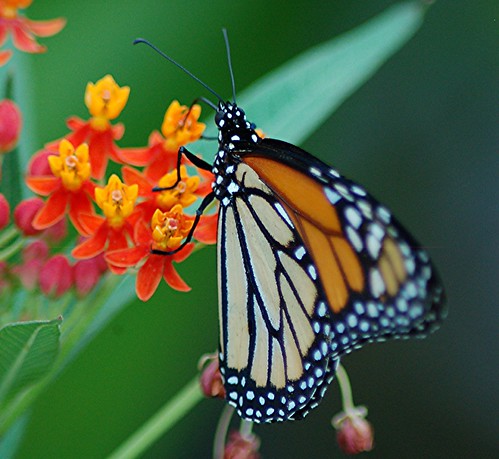
Caterpillar to Butterfly… just emerged from its cocoon, Monarch is feeding on orange and gold flowers of a regrown milkweed by jungle mama

Are you, like TheGardenLady, getting ready for the Monarch Butterflies?


Yellow Swallowtail and Black Swallowtail in TheGardenLady’s Garden

My garden has lots of butterflies including the beautiful Yellow Swallowtail and Black Swallowtail butterflies enjoying the nectar. But as lovely as these butterflies and the other butterflies are in my garden, for some reason in my mind, the siting of the Monarch seems to let me know that all is right with the world. So I eagerly look forward to the Monarchs arrival.

A great computer site for following the Fall migration route of the Monarch butterflies is this.  This site will be posting Monarch butterfly sightings every Thurs. starting on August 26th and continuing through Nov. The Monarch Butterfly Journal is a fun and fact-filled site for adults and kids that is interactive so you can both report your sightings of Monarch butterflies flying South as well as find out where others have seen Monarchs flying.

Growing Plants Under Conifers

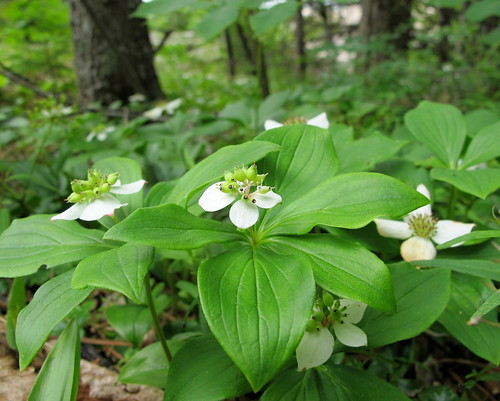
Bunchberry (Cornus canadensis) by ann j p

TheGardenLady received this question from Bronwyn.

I’m trying to find a low growing plant (20cm max height) for planting under my conifers.  The garden is extremely bare under the conifers. Do you have any advice please?

It can be tricky to grow plants under your conifer because a) you need something that likes the acidic soil the conifer grows in b) you need something that doesn’t need much sunlight and c) in your case, you are asking for something that is under 8 inches tall. Your choice will depend also on whether your soil is dry or moist under the conifer.

Here are a few suggestions:

Cornus canadensis Bunchberry is about 6 inches (15 cm) tall zones 2 to 7  See here.

Gaultheria procumbens wintergreen (15cm) zones 3 to 8  See here.

Maianthemum canadense Canada Mayflower (up to 25cm) zones 3 to 7  See here.

Mitchella repens Partridge berry (8cm) zones 4 to 9  See here.

Sunshine Farm is a great source to buy some of these plants. The owner is very knowledgeable about the plants he sells and could advise you on the best choices. Let TheGardenLady know what you chose and how it is doing. A photo would be lovely.

Monochromatic Gardens: Creating an Orange-Themed Garden

Orange flower garden by happysoul81

Anne in Chicago had once asked me what plants she should use in her front yard. Because I knew that orange was her favorite color, I gave her a list of orange flowers that bloom throughout the season that she might like to try. I thought it would  be exciting for her to create an orange garden.

I suggested orange Hemerocallis fulva aka Day lilies, Orange Asiatic lilies and other lilies like the Tiger lilies,  geums, orange zinnias and marigolds, orange Lucifer crocosmia, even orange roses like Livin’Easy, one of my favorites, or Arizona – there are a lot of orange flower choices.

Anne’s husband isn’t that fond of a one color theme for his flower beds so my list was never used.  I am disappointed that it was never used. I think an orange garden would have been Hot, Hot, Hot. I wish I had enough sun on my property to have an orange themed garden.
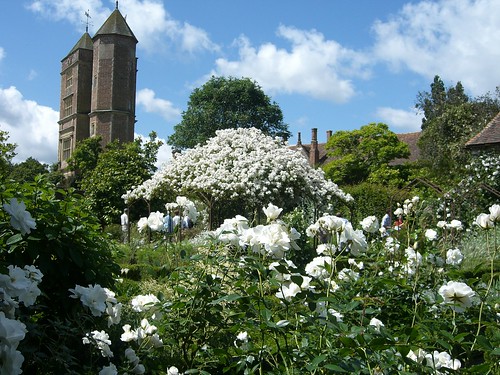
White Garden, Sissinghurst by pillager

People have designed monochromatic or one colored gardens. I visited a garden in Holland where the owner had only yellow flowers in it. A one color themed garden that has a worldwide reputation is in England and is called Sissinghurst. See here.   You must understand that the Sissinghurst garden is NOT an orange garden.  It has only white flowers. But Vita Sackville-West may have been the first person to create a one colored garden. And the Sissinghurst white garden is lovely.

But I have never seen an all orange garden. Perhaps TheGardenLady readers know of one. Of course, if one doesn’t like just orange one can add other colors to the orange garden palette, colors like yellow, red, green and even white would still be hot.

Back to the orange theme. Besides the orange plants that TheGardenLady had recommended that were mostly nonnative, there have recently been new hybrids of a plant that is native to the prairies; so they would be great in the heat of Chicago as well as the rest of the country that is suffering from this heat wave. In fact one of the two main breeders in the United States is the Chicago Botanic Garden, the other is Saul Brothers of Atlanta, Georgia so you know these plants will tolerate heat – up to Zone 9.

These plants thrive in harsh climates and once established they are drought tolerant.  However they will grow in cooler Zones 3 or 4 .They are easy maintenance plants, disease resistant, deer don’t like them, they have a very long summer bloom time – sometimes more than 3 months – with big showy flowers that can  be up to 5 inches – and some say they have  some fragrance. These plants like  well-drained, preferably dry soils in raised beds with average to low nutrients. (TheGardenLady’s are not growing in raised beds.)  Butterflies, bees and hummingbirds love them.
Continue reading “Monochromatic Gardens: Creating an Orange-Themed Garden”

Can You Eat Vegetables Grown Near Agapanthus?

Nerine bowdenii by Eric in SF

TheGardenLady received this question from Zanele.

Is it safe to eat vegetables grown near the roots of agapanthus? I have green beans growing close to agapanthus and am wondering if it is safe to eat them.

This is a very interesting question. All the websites do speak about the sap, bulb and the roots of agapanthus  as capable of causing stomach problems and skin dermatitis.  See here.

TheGardenLady did not think that there would be a problem but did not think she was enough of a poison specialist to say this without consulting an authority. So I phoned the US Poison Control number  which is 1-800- 222 -1222.

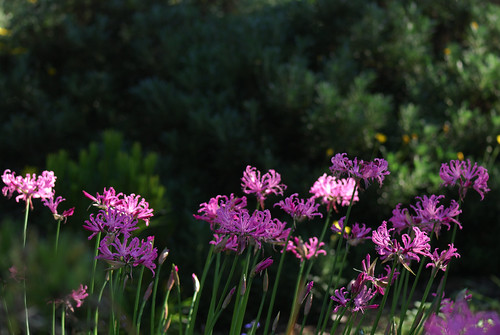
The person with  whom I spoke went on his data base. His first question was “what color is your agapanthus?” This was not mentioned in your email. The more toxic agapanthus is the pink agapanthus Nerine Bowdenii. The person I spoke to seemed to say that it was the bulb that was the really toxic part of Nerine Bowdenii.
He did not feel that the other agapanthus would cause more than stomach problems. And from his database,  he did not think any of the toxins from any agapanthus would enter into another plant. So he felt that your green beans were safe to eat.

I always err on the side of safety. I would wash and eat one. You will see that you are fine so then you can go ahead, wash the rest thoroughly, prepare them as you like and enjoy your harvest.

A list of the relative toxicity of all plants is here.

Royal Horticultural Society Garden Hyde Hall Flower Show: Aug 13-15, 2010

Blue stemmed thistle – RHS Hyde Hall by Scootzsx

Are readers of TheGardenLady blog going to be visiting England this month or do you live in England? Lucky you! because you have the opportunity of attending the RHS Garden Hyde Hall first-ever flower show this August 13 through the 15.  See here.

It sounds fabulous. Besides the displays there will be experts answering questions, plants and shrubs for sale besides garden items for sale. Wish I were there. If you attend, could you send TheGardenLady some photos and write something about what you thought of the show?

While at the show, if you have any time, you can also explore Hyde Hall which is a 360-acre estate with a diverse range of self-contained garden areas.  Because Hyde Hall is located in one of the driest places in England, a highlight is their Dry Garden featuring more than 4,000 plants representing 730 species and cultivars, developed to promote sustainable gardening techniques.  With the drought in so many parts of the globe this summer, it would be interesting to learn what Hyde Hall recommends.  TheGardenLady would love to know what is included in the 4,000 plants in this Dry Garden other than cactus.

Affecting the Color of Endless Summer Hydrangeas

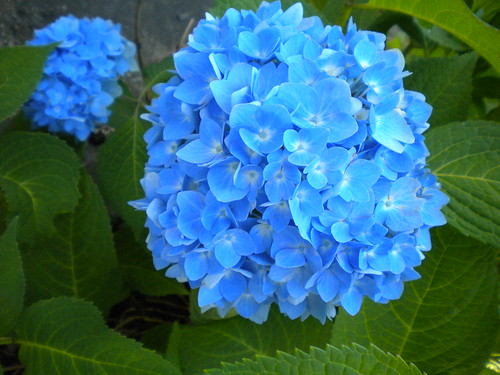
Endless Summer Hydrangea by geekstogardeners

TheGardenLady received this question from Kathy.

I live in Fenwick, Old Saybrook and have always had a yard full of beautiful, brilliant blue Endless Summer hydrangeas. However, this year is the exception!! I have tried deadheading since the blooms are  overly abundant but the color is still lackluster, pale blue.  I have tried adding hydrangea acid based fertilizer and watering with the hose daily.  Any suggestions?

First of all you should check the pH of the soil where the hydrangea is growing. If your soil is highly alkaline, you will have problems maintaining the blue flower no matter what you do. The pH of the soil should be 5.2 to 5.5.  Sometimes if your hydrangeas are planted near cement, like a sidewalk, the alkaline can leach into your soil. And sometimes your water is alkaline. Get test strips to test the water and the soil, or have the soil in your hydrangea garden tested at your state agricultural extension or through your local Master Gardener office.

If you have the proper pH, next Spring, water the plants really well and then add a solution of 1/2oz (1Tbsp) aluminum sulfate to each 1 1/2 gallons of water and feed this carefully to your plants- it can burn the roots. This should be applied in the spring when you see the buds forming- about 6 weeks before the flowers come.

Readers who have new hydrangea plants should NEVER use aluminum sulfate until your plants are about 3 years old. The addition of the aluminum sulfate seems to be the most reliable method of keeping the hydrangea flower blue.

It is good that you used a hydrangea fertilizer that is high in potassium. But most authorities do not think that this will help change the color.

An excellent site that goes into details of how to keep your hydrangea blue or pink is this.

Pest Problems Related to Indoor Plants

Mealy bugs by mpshadow2003

TheGardenLady received this question from Ben about pests problems with indoor planting.

I know you have answered a few questions on dormitory planting before, and I have settled on starting with an Aspidistra and branching out once I’m comfortable with what seems to be a relatively easygoing plant. I’m simply looking to spruce up my room aside from the obvious posters and lights, so a plant and a small fish tank are on my to-do list this summer.

However, no one seems to address any kinds of pest problems related to indoor planting. Are there any major bug issues I should watch out for when dealing with dorm room plants? I have a room to myself as a Resident Advisor next year, so a south-facing window sill will be available year-round in Midwest temperate weather.

I like to keep the window open during the day so stagnant air should not be a problem, but I worry that circulation will increase the risk of infection either to or from the plant(s).

If I have missed anything or made some kind of gross assumption, your input would be much appreciated. Thanks!

You want to be prepared. Though you are correct to be concerned about raising plants indoors, most people have plants indoors and get away without serious problems. Raising plants indoors would not be such a popular hobby if there were that much to worry about.

Since all living organisms can have problems, I hope you are aware that fish can have health problems in their tank.  I remember how sad we were when our fish developed a disease known by its abbreviated name, ich.  We knew something was wrong in our first aquarium when we saw all those white spots on the fish. But raising fish is still popular and fun. You just have to be vigilant to see that everything in the tank is healthy.

Continue reading “Pest Problems Related to Indoor Plants”