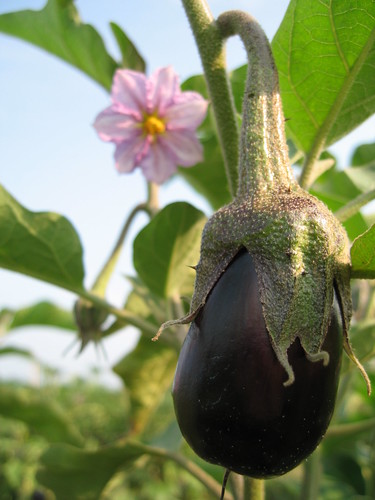
Eggplant by Gare and Kitty
Why does the eggplant blossom dry up instead of producing a vegetable?

In depth gardening advice from an expert gardener

Eggplant by Gare and Kitty
Why does the eggplant blossom dry up instead of producing a vegetable?
Japanese White Pine Bonsai Tree (Pinus parviflora) by Steve Greaves
TheGardenLady received this question about her Bonsai tree from Judy.
I just bought a Bonsai tree which has needles and not leaves and I am not sure what kind it is. How can I tell the type it is? Also I would like to know, when watering do I water at the soil or water from the top to get the needles wet?
There are so many evergreen trees (trees with needles) that are made into Bonsai trees that without a good clear photo of the needles, it is impossible to tell what type of tree you bought. TheGardenLady attempted to bonsai what is known as a red cedar tree but is really in the Juniperis family. It was used because it is supposedly an easy tree to learn how to make a bonsai. Yours might be a juniperis because it is also one of the cheaper evergreen trees. See here.
Without seeing your Bonsai tree, no one can guess what kind of tree it is. Most stores selling trees usually tell you what type of tree it is. Also, the store should have given you instructions on the care, which includes watering of the tree. If this is a reliable store, you should go back to the store if possible to get the type of the tree and at least basic care information, including watering information.
If you were sold a true bonsai, you should treat it like a tree, not a plant because true bonsai are not really indoor houseplants. It should be kept outdoors all year round. TheGardenLady thinks this is a fairly difficult plant to maintain for a beginner. Most die because of improper care, especially improper watering.
Please read this link for information on the care of Bonsai. Evergreen Gardenworks tell you that when you water, the plants must be watered thoroughly when they become slightly dry. You must test the soil to see if it is dry by sticking your finger in the soil. Watering should be done from the top (of the soil), not by submerging the plant, and the bonsai should be watered until they are saturated. You will see water pour from the drain holes when they receive enough water. This method of watering helps to prevent salt buildup in the soil. Since you will be leaving the plant outdoors all year round, it will get some rain as well. In times of drought you may have to water more than once a day. You can bring the Bonsai tree indoors when you have company or to admire its beauty and then return it to the outdoors.
People who are really bonsai enthusiasts take care of them like babies, some even taking their bonsai trees on vacation with them to be sure that they get the proper care
Moss Acres
TheGardenLady received this question from Bob on her post “Create a Moss Garden”.
Any suggestions for keeping weeds out and killing the new ones? Will broad leaf weed killers harm moss? Any feed suggestions other than buttermilk?
One of the best resources for technical support on raising moss is Moss Acres. Their website is this. It’s one of the best sites this GardenLady knows about for buying moss and learning how to raise moss. I contacted Moss Acres with these questions.
First one should check the pH of the location where you want to have your moss garden. For success the pH should be between 5.0  or lower and  6.0 Any higher a pH number and you are asking for trouble.
Buttermilk helps but if the soil doesn’t have the proper pH, the soil for the moss can easily be amended with liquid sulfur or aluminum sulfate that is sold by Moss Acres to lower the pH to the desired range.
Moss Acres tells you to get rid of weeds BEFORE the weeds set seed. If the weeds you want to pull are tall you can carefully use a weed whacker. See here. Just be careful to  whack only the weeds, not the moss.
Early in the year you can try using Preen vegetable garden organic preemergent weed killer. Once the weeds emerge it is too late to use Preen.
If weeds do come up, it is recommended that you pull them out with tweezers when they are small- before they set seed. Hold the moss around the weed so that you don’t pull moss with the weed.
You can try using a broad leaf weed killer like Weed be Gone or Round Up, but experiment first by using the weed killer on a small spot to see if it works or if it will hurt the moss. TheGardenLady is against using weed killer whenever possible because of the chemicals that are worrisome. For example, Denmark bans the use of Round up.
If you are really interested in moss gardens, Moss Acres has just started giving workshops on how to do one. They had their first workshop in May and have two other workshops planned. The workshops will be for all levels from beginners to landscaper professionals.
Moss Acres sells moss to gardens all over the US and Canada. They will also answer any moss questions even in areas where they don’t sell moss. They will answer questions even if you don’t live in the US. Readers from anywhere in the world can contact them for advice.
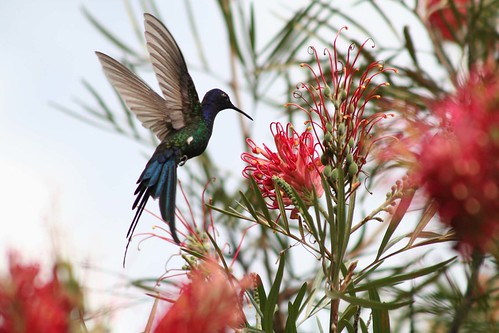
Beija-flor (Eupetomena macroura) – Swallow-tailed Hummingbid 2 592 – 2 by Flávio Cruvinel Brandão
My heart leaps up when I behold
A rainbow in the skyby William Wordsworth
So does my heart leap up when I behold an animal, bird or beneficial insect that has returned or come for the first time to my garden.
For example, I have a number of birds nests but only one seems to have a resident each year. I know that size of opening is a major factor that determines which bird will use a certain bird house. But I also read that birds seem to like pretty bird houses and this birdhouse that has had birds build nests every year is the prettiest birdhouse on my property. I had also been told that bird houses should be cleaned out yearly because birds can have lice and that the inhabitants need it clean. This bird house was filled so high with twigs that I couldn’t believe another bird could fit into it. So last fall I cleaned out all the all old twigs only to be entertained by this year’s birds filling the nest back up with twigs piled so high. I didn’t think anything could fit in besides the twigs but I hope they know what they are doing and lay eggs on that pile.  Check out this video clip.
I have lots of birds on this property because I have lots of shrubs for them to hide or build nests and have a stream for them to drink water. I plant flowers that I believe will encourage birds, butterflies and good insects. My soil has been amended so that I have lots of healthy worms. Robins love the worms. I have yellow flowers for the goldfinch so it is a special delight when they return. One has been tap-tap -tapping on the window.
And of course, I do everything I can to encourage hummingbirds. This year I added a honeysuckle that they love Lonicera sempervirens – coral red honeysuckle. Hummingbirds are always such a delight to see in the garden. ( I also have hummingbird moths. See here. )
I have so many birds singing at daybreak that I don’t need a rooster to wake me up each morning.
I have been spraying Liquid Fence on the plants so that deer won’t eat the ones I planted. My heart leaps up even when I see deer but there is enough wild greens for them to eat without eating dessert all the time – like my hostas are to them. This year I have so many hostas in bloom that I hope all the black swallowtail butterflies will see them and return. I have been counting those swallowtail butterflies that I see but there haven’t been that many. I always had a lot of hosta flowers before deer became so prevalent and decimated these flowers. Liquid Fence has been my garden’s savior.
As I sit and write TheGardenLady post, I am often entertained by a bird resting on a branch outside in my backyard. I especially love to see the colorful ones, like the cardinals that always build nests in shrubs around the house.
I almost stopped using my front door because a delicate paper wasp nest was built. I am leaving it up for now unless someone gets stung. As much as I believe this is a beneficial insect, at the end of the year, sadly, I will have it removed.
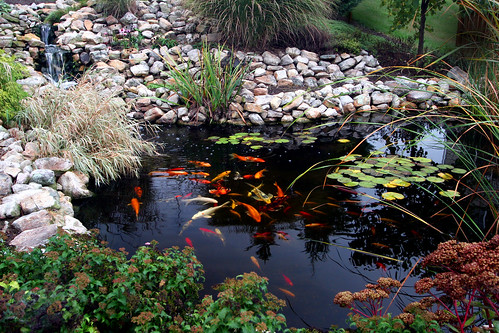
Back Yard Water Garden by ranhar2
Have readers of TheGardenLady blog ever wanted to build a pond or water garden on your property? Or are you someone who has a pond or a water garden and wants to see what others are doing with theirs? Or are you, like TheGardenLady, someone who just loves to visit gardens of all types?

Daybreak on the 4th by mike@bensalem
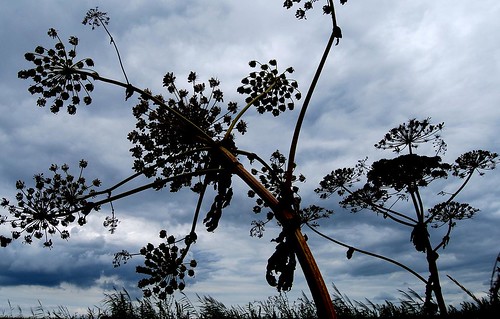
Giant Hogweed (Heracleum mantegazzianum) by sillie_R
Most reports of giant hogweed turn out to be Cow Parsnip, Angelica, or some other [member of the carrot family]. See here. People can distinguish giant hogweed from other species of the carrot family, not only by its gargantuan size, but by its purple-splotched, hairy stems.
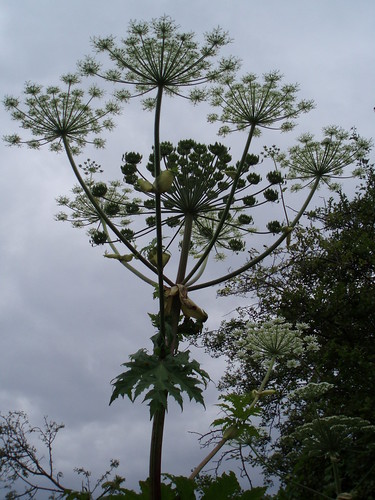
Giant Hogweed by Limbo Poet
“Cow parsnip stems have a more ‘furry’ look to them, whereas the hogweed has long, white hairs which are most pronounced at the base of the leaf petiole (stem). But the foliage of cow parsnips and giant hogweeds before they send up flower stalks is so similar it’s almost impossible to tell them apart.†This statement comes from the U.S. Department of Agriculture’s National Noxious Weed Program on Giant Hogweed, where you can get some bulletins with photos and information on Giant Hogweed.
Here’s another website that has a photo of the Giant Hogweed so that you can see if this is indeed the plant you wrtie about. It looks like a Queen Anne’s Lace flower on steroids because the plant can grow up to 20 feet with a flower that measures up to 3 ft across and leaves that can be 5 feet wide. Giant Hogweed
Continue reading “Giant Hogweed: Identifying and Disposing It”
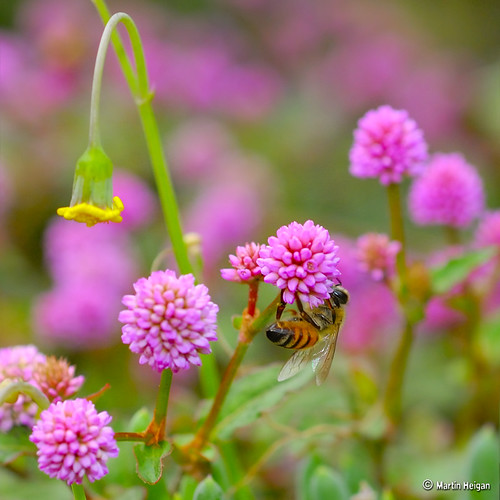
Bee pollinating a flowering ground cover by Martin_Heigan
I have read that it has been calculated that one out of every three to four mouthfuls of food we eat and beverages we drink is delivered to us by pollinators. There are thousands of native pollinators. I believe the figure is something like 20,000 worldwide. See here.
Because of the dwindling honey bee population (honey bees are nonNative to the US), everyone must do as much as one can to insure that we do not lose our native pollinators. Those in the US and around the world are also dying off because of pesticides being used. See here. To insure that TheGardenLady readers help the native pollinators, this post is about some things you can do.
Pollinated! by Durotriges
The week of June 21st through June 27th was National Pollinator week.
There is an organization called Pollinators. org that encourages people around the world to create a pollinator habitat in your garden, school, farm, etc. This site will tell you which plants in the US zones will attract these beneficial insects. If you are from out of the US perhaps you could email the Pollinator.org site to find out if they can recommend a similar organization in your country.
TheGardenLady finds that many of the plants in the mint family or herbs are especially attractive to pollinators in her garden. For example, one would never try to smell any of the oregano, lavender, agastache, or monarda flowers for fear of inhaling some type of pollinator- mostly bees- they are so prolific. Though I have only seen 2 or 3 honeybees, I see hundreds of other bees sucking up nectar in a frenzy and covered in pollen. Pollinator.org has free Pollinator friendly Planting Guides for your area of the US and you can join the Pollinator Partnership. I hope TheGardenLady readers do join and do your part in saving pollinators.
A reader from Chicago found an exciting pollinator on his echinacea plants. See here.
miracle-gro potting soil by Rakka
TheGardenLady received this question from Jennifer.
Is there anything I can do after I used too much Miracle Gro to save the plants?
If you put too much Miracle-Gro in a potted or container plant, you can pour a lot water into the pot until the water flows out the bottom of the pot and keep adding water for a few more minutes. This will flush the excess Miracle- Gro out of the pot. After this, in the future, you will just water the plant normally. Or you can repot the plant in new soil. If you repot the plant in new soil, you will then water the plant normally.
If you put too much Miracle-Gro on plants that are in your garden, give the soil around the plant a good watering to dilute the fertilizer. Do not overwater or flood the plant. Flooding would do more damage to the roots of the plant.
You did not tell me which type of Miracle- Gro you used. If you used spikes remove the spikes from the ground. If you used granular Miracle- Gro, try to remove extra granules around the plant. After removing the spikes or granules, give the plant a good watering one time to dilute the fertilizer. Do not flood the plant.
Should you continue to have problems, call the Scotts Miracle-Gro Help Center at 1-888-270 3714
A little while ago TheGardenLady had the opportunity to shop at Pleasant Run Nursery – a strictly wholesale nursery in Allentown, NJ that opens one day a year for the Allentown Garden Club who then invites other plant related people to join them to buy plants wholesale. If you are part of a garden club see if you can find out when this event will take place next year and then see if you can get invited.
Pleasant Run Nursery is a nursery for the best retail nurseries and landscapers in the tristate area to buy their plants. Wow. With 70 greenhouses this is a plant lover’s paradise. TheGardenLady was able to buy two fragrant Korean spice bushes (see here). Viburnum carlessii and Viburnum carlessii ‘Diana’- shrubs that will grow under black walnut trees. Walnut trees exude a toxin that kills many other shrubs and plants. (I will write more about this toxin in another post.)
When I parked my car, I met John Brandauer who was there as a volunteer to help the nursery with all the plant lovers who were taking advantage of this great opportunity. John has a website called Weeds for Wildlife whose mission is to enhance backyard habitats for wildlife and to make the world a better place. It seems like a noble mission so I want to share this website with my readers for all the information on it and for the wonderful photos and links. See here.
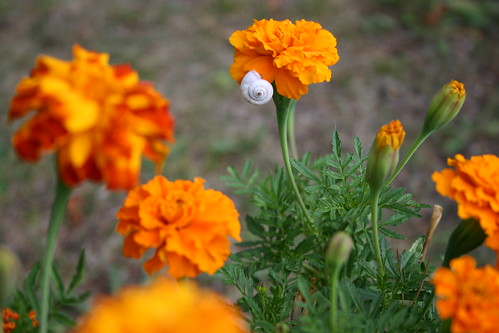
Marigolds avec Snail by MosaicMarj
TheGardenLady received a question from Lou about protecting marigolds from snails and slugs.
Marigolds love dry hot weather. If they are happy, they self seed and thrive, as those in my garden do. I haven’t planted them for a few years and they are coming up all over the place.
That being said, slugs and snails do love them. But garden snails and slugs enjoy wet or damp dark places where they can hide then come out in the dark night to eat. See here. You wouldn’t see them unless you went out at night with a flashlight. If you have a lot of snails and slugs, you can lose all your marigolds.
So, the first thing you want to do is clean up any and all the debris that is around the plants so that there is no place for the snails and slugs to hide and for air to circulate to dry the environment where the plants are. You really don’t want mulch to retain moisture around the base of the marigolds. This is more difficult when your marigolds are in planters that are tightly packed with flowers and when you create a planting environment with different kinds of plants that need different types of care. The marigolds don’t want or need a lot of watering as some other plants might need. Marigolds like dryness. Snails and slugs like damp soft soil and darkness.
Continue reading “Protecting Marigolds from Snails and Slugs”