The 2012 Burpee Seed Catalog – Part II

Queen Sophia French marigold closeup by OrganicNation

In the last post, TheGardenLady discussed  some of the flower part of the Burpee Seed Catalog.   In this post, TheGardenLady will talk a little more about Burpee’s flowers, but more about their vegetables.

In the vegetable part of the catalog you will find sweet corn that is red, tiny golden colored peppers, bright orange tomatoes, white tomatoes and swiss chard that is rainbow colored – all Burpee Exclusives. Together with the regular colored vegetables and such vegetables as the purple carrots or blue potatoes, your harvest can decorate your house as fancifully as any bouquet of flowers. You have to see this catalog to believe what is being offered for this year’s garden.

Continue reading “The 2012 Burpee Seed Catalog – Part II”

Identifying Shrubs


Recently a reader of TheGardenLady asked if I could identify some shrubs that grow in her area. TheGardenLady believes she knows the genus of plants they are but is not quite sure of the species. 

Bridalwreath Spiraea by louisa_catlover

The white flowered shrub is in the spirea family. And I believe the species is Spiraea prunifolia. Check out these two sites to see if the photos look like the plant you have seen. See here or here. 


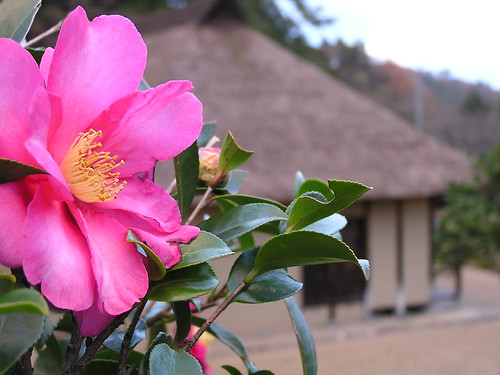
camellia by tamaki

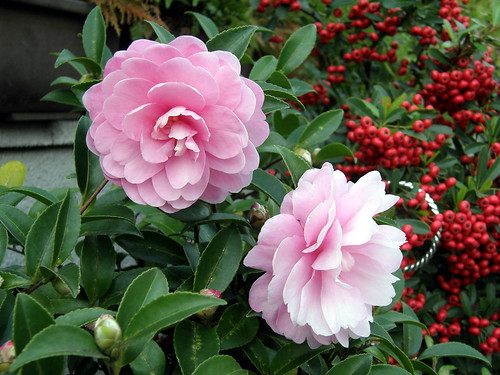
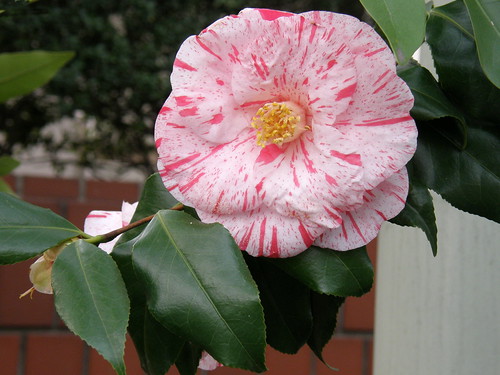
The shrub with the pink flower is in the genus Camellia (see here) which is the largest genus in the plant family Theaceae. One site says that “more than 400 species have been named and published “. I believe the photo you have sent is of a Camellia japonica. But because there are so many, this may not be quite the correct one.  See here. 

Camellia japonica (ヤブツバキ) #5286 by Nemo’s great uncle

Camellia japonica (ツバキ) #5481 by Nemo’s great uncle

If readers of TheGardenLady blog know the correct name of the shrubs, please don’t hesitate to send in your identification.

Native Plants are the Wave of the Future. Ask Ed Toth

Greenbelt Native Plant Center by Flatbush Gardener

Recently, an article appeared in the New York Times about Ed Toth, the director of the Greenbelt Native Plant Center (see here) on Staten Island, who is running a project to turn one of the world’s largest landfills  into one of the largest parks in the US using native plants and seeds. Then I heard that this same Mr. Toth was giving a speech at The D & R Greenway Land Trust (see here). Since this GardenLady believes that native plants is the wave of the future and since I enjoy attending lectures on plants, gardens, etc., I decided to attend this lecture.

If you want to visit the D & R Greenway in Princeton, NJ, it has a park to walk around and a lovely building that houses what looks like a nature photography workshop so the inside of the building is filled with lovely photos of nature. In the spring they have a native plant sale.

The lecture Mr. Toth gave was about the work that he is doing creating a seed bank of native seeds and the work he is doing to create the mammoth park and restoring other NY parks using native grasses, plants and shrubs. His group works with D & R Greenway where they are harvesting  bulk quantities of native seeds. After D & R Greenway finishes harvesting enough seed for the Fresh Kills park, they will be able to sell large quantities of native seeds for other big projects- I don’t know whether they will sell to small groups, but one can always ask. D & R Greenway will then be the second largest bulk native seed harvester in the nation.

Continue reading “Native Plants are the Wave of the Future. Ask Ed Toth”

Outdoor Designer Garden Furniture

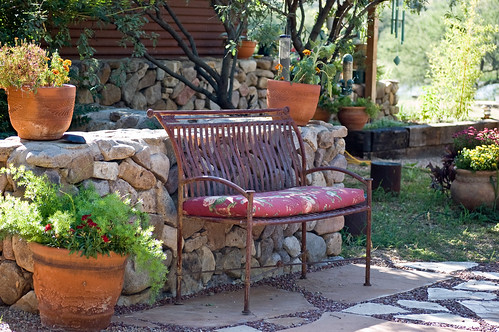
Garden bench for Kai by kretyen

Part of preparation for winter, now that fall is seriously with us, is storing outdoor furniture. That is a major problem for me since storage space is at a premium. The other problem, as I look at my garden furniture while stowing it, is that it looks so shabby. I cannot even call it Shabby chic.

I would love some clever outdoor furniture that is funky or interesting but can stay out in all weather. I have two pieces of furniture that I like. My favorite bench is an old park bench, the kind that is made of such heavy wrought iron that you cannot budge it. It used to sit on my grandmother’s front porch- so you know it is an antique. I took off the rotting wood and repainted it to match my front door and front of the house which is a silvery gray and fuschia. I love the look. This bench can weather any season.

The new piece that I treated myself to this year is a bench made from concrete. I bought it because it was on half price sale at my local nursery. I worried that it might look like it belonged in a cemetery. But it looks like it fits in a garden. And I don’t have to store it for the winter.

Still I wish I had really nice outdoor designer furniture.

Continue reading “Outdoor Designer Garden Furniture”

Growing up on the farm

TheGardenLady’s House on the Farm

We were poor when I was a child growing up on the farm. But so was everyone else in my community and the surrounding communities, so no child felt the poverty. That was how things were. Yet my parents worked hard. Hard physical labor. Especially my mother, who not only worked in the fields and had a small dairy that she took care of by herself, she had two small children at the time and took care of the house.

TheGardenLady’s Mother

My parents worked hard so that we always had food on the table. All summer we had an abundance of fresh fruits and vegetables and for the rest of the year Mom canned everything. No one had a freezer. The cellar was a dirt hole so it was cold like a root cellar. Foods like potatoes and onions could last a long time down there. And the shelves around the walls were filled with Mom’s canned food in glass jars. The jars looked as beautiful as any stained glass window any artist created.

In spite of all this labor, Mom loved flowers. I never thought to ask who planted the roses, the spirea bushes, the deutzia bush, the ornamental quince bush, the yucca, the apple tree, the lilacs, rose of sharon bushes, the gooseberries, weeping willows and other shrubs and trees that surrounded the house- they were just there. Yet this was a question I regret not having asked.

You see, my parents were the second family household to ever live on the farm. Before that the land belonged to Native Americans. The Leni Lenape Indians lived in New Jersey. And they must have spent time on the property that eventually became our farm. We bought the farm from a family who must have somehow bought it from the Leni Lenape- I wish I could learn more of that history.

Continue reading “Growing up on the farm”

Box Elder Tree

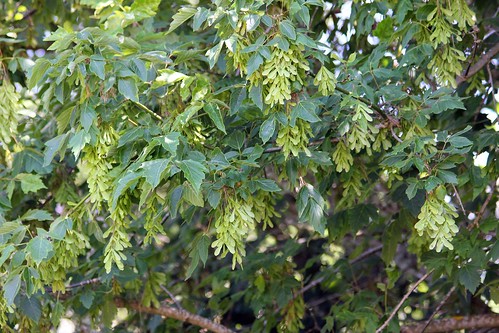
Acer negundo ssp. californicum California Box-elder by davidhofmann08

When people walk by my yard, they often stop to ask me the name of a shrub, tree or perennial. I believe that seeing something growing in my yard has encouraged others to plant it.

One tree that people have asked me about is one that I did not plant. It grows near the stream at the edge of my property and looks suspiciously like poison ivy with its three leaves. I have even heard this tree referred to as the poison ivy tree though it has many other more common names. While the leaves may resemble poison ivy, the tree can have 5 or 7 leaves but rarely 11 leaves; so if you count the leaves you can feel confident that this isn’t poison ivy. And the tree has a profuse number of hanging seeds that look like a maple tree’s seeds. This native North American tree is really in the maple or Acer family. The Latin name is Acer negundo and is referred to in my area as a Box Elder tree, Boxelder Maple or Maple Ash. In Canada it is known as the Manitoba Maple.

Continue reading “Box Elder Tree”

Rose Thorns Can Be Dangerous

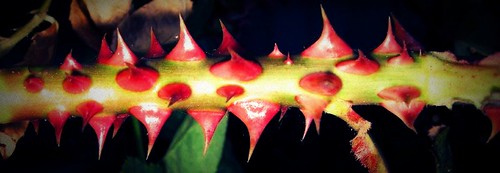
Rose thorns by DRB62

TheGardenLady received this question from Sandie.

Funny thing happened to me today. I was pruning roses and got a brief stick in the knuckle over my pinkie by a very large thorn. I bled a little, but being a tough gal, I went on with my task at hand. A few hours later, I have slight swelling, but can hardly move my finger. It is extremely painful up the pinkie and down the outside of my palm. Any idea what’s caused this?

There is nothing funny about getting an infection. I hope you go to your physician immediately for him or her to be sure the infected site is cleaned properly and to give you some proper medicine, if required. This is a warning for all gardeners. Even if you are a “tough gal” or guy, when working in a garden there is always the possibility of picking up germs or bacteria. That is why one should always wear gloves when you are touching your plants or the soil.

For other posts by TheGardenLady on getting pricked by a rose thorn see here and here.

Visiting White Flower Farm Nursery

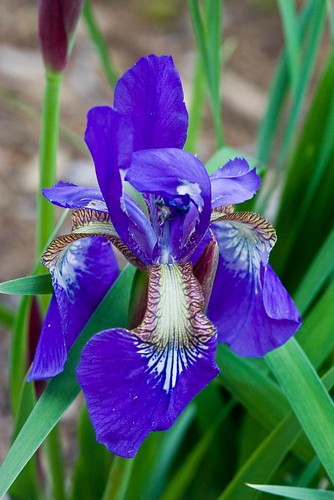
Japanese Iris by eclectic echoes

As I mentioned in my last post, this past weekend, I convinced a gardening friend to visit some of the gardens I have written about on TheGardenLady.org blog and other gardens or nurseries I wanted to visit to enable me to write about them.  I also wrote about visiting Cricket Hill Farm on the first day of my two day garden trip.   But this wasn’t the only garden I visited on this day.

The second garden I wanted to visit was part of one of the best known and, I always thought, most beloved plant nursery in the US. I have been getting the catalogs of The White Flower Farm nursery since the 1960s.  Even though the early catalogs had illustrations not photos of the flowers, I used to think that their catalogs were as good as any of the early plant books that were published in their early years- they were really informative. But in all the time I have known about the nursery, I had never visited it.

Some garden aficionados had warned me that they were no longer as outstanding as they used to be; that their selection at the store was not as extensive as they used to have because most of their plants were mail order plants. After all, they have changed ownership. Since I had never been to White Flower Farm before, I did not know what to expect. But I was not disappointed. In fact, the opposite was the case. This GardenLady was “blown away” with the nursery. First of all, they are worth traveling to visit for their display gardens alone. There are acres filled with show gardens. And their plants are of excellent quality and the newest varieties on the market.This is not a place to get bargains or inexpensive plants like Russell Gardens Wholesale. But White Flower Farm is an excellent plant nursery to visit just to see what is available. And I cannot imagine anyone leaving empty handed.

Continue reading “Visiting White Flower Farm Nursery”

TheGardenLady’s Spring Garden

This GardenLady loves Spring- when the world looks so lovely with all the flowers emerging from their sleep. l would like to share photos of some of the flowers that are in bloom in TheGardenLady’s spring garden.

(1) Hellebores with Brunnera and Greater Celandine (see here and here) Greater Celandine is becoming invasive in some areas (see here)

(2) Hellebores

(3) Korean Spice Bush or Mayflower Viburnum Viburnum Carlessi (see here)

(4) Virginia bluebells Mertensia virginica (see here)

Continue readingTheGardenLady’s Spring Garden”

Indoor Insect Killer that Kills Stinkbugs and More

How to Kill Stinkbugs, One of the Newest Pests in the U.S., Without Releasing Their Odor

Halyomorpha halys, or more commonly known as the stinkbug, is a fairly new pest to the United States. First appearing in September of 1998, it’s believed to have entered the country in packing crates from China or Japan. Since then, the stinkbug has multiplied at an astonishing rate, and the infestation is at critical levels throughout the Mid-Atlantic region. Many consumers are finding it hard to keep these pests out of their homes. These bugs can enter houses in a variety of ways … by hitching a ride in on clothes, crawling through unsealed cracks in doors, flying in through open doorways, and more.

As part of the Pentatomidae family, stinkbugs get their common name from the vile odor they emit through holes in their abdomen. This foul smell is a defense mechanism that makes the bug less appealing to birds and lizards. It also makes them especially nasty to get rid of. No matter how carefully you try to kill stinkbugs, any jostling, cornering, injuring or removing can “set them off”. As the infestation continues to rise, more and more people are looking for an effective way to kill stinkbugs. One of the best solutions is an indoor insect killer that can eliminate them on contact, without releasing the bugs’ odor.

Continue reading “Indoor Insect Killer that Kills Stinkbugs and More”