Castle Rock State Park – Part IV

This is the fourth and final post in a series about Castle Rock State Park, submitted by a reader named Jonathan.  In the first post, Jonathan explained why he chose to write about Castle Rock State Park and he also showed where it’s located.  In the second post, Jonathan discussed the geologic history of the park.  In the third post, Jonathan discussed Castle Rock and surrounding outcroppings.  In this fourth and final post on Castle Rock State Park, Jonathan discusses the Falls Overlook, outcroppings along Saratoga Gap Trail and Ridge Trail, and Goat Rock.  Jonathan also makes some concluding remarks.

Figure 15

Approximately 1 mile from the Park’s main entrance is Castle Rock Falls and the Falls Overlook (figure 15). According to the Park’s brochure, this formation is roughly 100 feet tall. This sheer wall of Vaqueros Sandstone is somewhat of an anomaly because it doesn’t contain any of the pockmarks of tafoni found on most other formations. Since the formation is located in the Kings Creek Canyon, perhaps it is better protected from dry winds that might otherwise wick absorbed water to the rocks’ surface and bring with it the dissolved carbonic acid and calcium carbonate.

Along the roughly 2 mile stretch of the Saratoga Gap Trail, between Castle Rock Falls and Russell Point,  there are multiple outcroppings that tower over the San Lorenzo Valley (figures 16 and 17).

Continue reading “Castle Rock State Park – Part IV”

Castle Rock State Park – Part III

Figure 7                                                                                  Figure 8

This is the third post in a series about Castle Rock State Park.  It was submitted by a reader named Jonathan.  In the first post, Jonathan explained why he chose to write about Castle Rock State Park and he also showed where it’s located.  In the second post, Jonathan discussed the geologic history of the park.  In this post, Jonathan discusses Castle Rock and surrounding outcroppings.

Castle Rock (figure 7) is one most popular outcroppings, or bosses, in Castle Rock State Park. The Park’s brochure claims the formation is roughly 50 feet tall with caves that are as much as 15 to 20 feet wide, 10 to 20 feet high, and 8 to 10 feet deep. These caves, or tafoni (figure 8), are so large that in the late 19th century, when the Castle Rock School opened in this area, the first teacher, Miss Ida M. Jones, lived in a cave for 6 weeks as her cabin was being built.

Three processes of weathering play important roles in shaping these rocks: chemical weathering, mechanical  weathering, and biological weathering.

The tafoni are a product of chemical weathering whereby carbonic acid in rainwater seeps into the interior of rocks where it dissolves calcium carbonate, which cements together the grains of sand that make up Vaqueros Sandstone. Dry summer winds then wick this water to the rocks’ surface, bringing with it the dissolved carbonic acid and calcium carbonate. As the water evaporates, dissolved calcium carbonate is left to form a hard crust at the exterior of the rock. The interior of the rock continues to erode as the cementing calcium carbonate is removed, allowing for caves, cavities, or pockets to form when the outer crust is broken by a falling tree branch, hail, windblown debris, passing animals, etc (mechanical weathering).

Tafoni appear as both caves (figure 9) and intricate honeycomb-shaped latticework (figure 10). So unique are these formations that they inspired John Steinbeck to write in his short story, “The Murder,” “This happened a number of years ago in Monterey County… At the head of the canyon there stands a tremendous stone castle, buttressed and towered like those strongholds the Crusaders put up in the path of their conquests. Only a close visit to the castle shows it to be a strange accident of time and water and erosion working on soft, stratified sandstone.”

Figure 11
Mechanical weathering also impacts the structure of Castle Rock and its surrounding outcroppings. Take, for example, a Pacific Madrone that split an outcropping in half as it rooted itself in the rock’s cracks (figure 11). Finally, biological weathering is seen where lichens (combinations of fungi and algae) live on rocks and slowly eat away at the rocks’ surface (figure 12).

Figure 12

Chemical, mechanical, and biological weathering processes result in jointed outcroppings that sometimes appear as if they are not bedrock, but erratic boulders transported to their current locations by unknown forces (figure 13).

Some of these cannonball-like formations are likely the result of the same chemical process that form tafoni; the collection of calcium carbonate at a rock’s crust creates better-cemented areas called concretions (figure 14).

Castle Rock State Park – Part II

Climbing at Castle Rock State Park by ...Rachel J..

This is the second post in a series about the geology of Castle Rock State Park.  It was submitted by a reader named Jonathan.  In the first post, Jonathan explained why he chose to write about Castle Rock State Park and he also showed where it’s located.  In this post, Jonathan will discuss the geologic history of the park.

According to geologist Richard Stanley, the rock formations of Castle Rock State Park are a component of the tertiary strata of La Honda basin, a “marine embayment that persisted through much of Tertiary time in the area of the modern Santa Cruz Mountains.” In his paper, ‘Evolution of the Tertiary La Honda Basin, Central California’ (1990), Stanley summarizes the history of this area:

The complicated geology and geologic history of the La Honda basin reflect the fact that, throughout its history, the basin has been located at or near the tectonically active plate boundary between the North American continent and various oceanic plates of the Pacific basin. The La Honda basin originated during the Paleocene, perhaps during an episode of wrench tectonism associated with oblique subduction and arrival of the Salinia terrane. Major restructuring of the basin during the Oligocene—including uplift and erosion of the basin margins, movement along the Zayante-Vergeles fault, and deposition of two sand-rich deep-sea fans—apparently resulted from the approach of the Farallon-Pacific spreading ridge and its collision with the California continental margin. During the late Oligocene and early Miocene, widespread volcanism and marine transgression accompanied an episode of regional transtension along the San Andreas fault system. Deposition of shallow marine sandstones and deeper-water siliceous mudstones occurred during much of the Miocene and Pliocene but was interrupted at least three times by brief episodes of uplift and erosion associated with transpressional wrench tectonism along the San Andreas fault. Marine deposition ended and uplift of the modern Santa Cruz Mountains began during the late Pliocene in response to the most-recent episode of regional transpression.

Stanley refers to ‘sand-rich deep-sea fans,’ which, in ‘A Dictionary of Earth Sciences’ (A. Allaby & M. Allaby, 1999) is defined as a “fan-shaped body of sediment that accumulates at the lower end of a submarine canyon, either at the foot of the continental slope or on the continental rise” (figure 4). In other words, a deep-sea fan can be thought of as an underwater version of alluvial fan.

Figure 4

According to Stanley, the sandstone, mudstone and conglomerate that were deposited by these deep-sea fans formed sedimentary rock, which was uplifted in the Santa Cruz Mountains as Vaqueros Sandstone that we see today in Castle Rock State Park.

Geologic maps of Castle Rock State Park and the surrounding region indicate that most of the Park’s outcrops are Vaqueros Sandstone (figure 5).

Figure 5

Additionally, because fossils contained within sedimentary rocks vary from the bottom to the top of layers, fossils found within the Park’s outcrops allow geologists to date the rock to be approximately 23 million years old (figure 6).

Figure 6

Castle Rock State Park – Part I

"Easter at Castle Rock" 28. by Madonovan

This is the first post in a series about the geology of Castle Rock State Park.  It was submitted by a reader named Jonathan.  In this post, he explains why he writes about Castle Rock State Park and where it’s located.  In the next post, Jonathan will discuss the geologic history of the park.

I chose to write about Castle Rock State Park because of its unique rock  formations, including the Park’s namesake, Castle Rock.  These formations are most dramatic near the Park’s main entrance where, in addition to Castle Rock, you can find Castle Rock Falls and Goat Rock. The Park’s attractions are not limited to its geology; its 35 miles of trails for hiking, rock climbing, camping, and spectacular views of the San Lorenzo Valley and Pacific Ocean are also major draws. Moreover, the Park’s close proximity to Stanford and the Greater San Jose Area makes it a regular destination for afternoon visits.

The Park’s most popular hike—a 6-mile loop along the Saratoga Gap Trail and Ridge Trail—pass and climb over the above-mentioned formations as well as numerous other outcroppings. The following review of Castle Rock State Park’s Geology covers 5 general regions of the park (figure 1):

1. Castle Rock and Surrounding Outcroppings

2. Castle Rock Falls and the Falls Overlook

3. Outcroppings along Saratoga Gap Trail

4. Outcroppings along Ridge Trail

5. Goat Rock

Where is Castle Rock State Park:

Castle Rock State Park is sandwiched between CA-35 and CA-9 in Los Gatos, CA; roughly 20 miles south of Stanford University (figure 2).  From Stanford, travel approximately 11.5 mile south on Page Mill Road to CA- 35/Skyline Blvd, and then travel just under 9 miles south on CA-35/Skyline Blvd to the Park’s main entrance, which is on the west side of the road. Many of the Park’s trails and dirt roads are also accessible further north on CA-35 and along CA-9.

Castle Rock State Park is adjacent to several other parks, including—from east to west—Sanborn Skyline Country Park, Saratoga Gap Open Space Preserve, Long Ridge Open Space Preserve, and Big Basin Redwoods State Park. Accordingly, many of Castle Rock’s geologic features are similar to those in nearby parks.

The featured 6-mile loop hike along the Ridge and Saratoga Gap Trails covers the western and central parts of the park (figure 3). The elevation of this region ranges from 2,600 feet to 3,200 feet above sea level.

Butterflies in Space – Monarch Watch

Did you ever wonder what would happen to butterflies if they were put in conditions with practically no gravity?  Scientists at the University of Kansas and Bioserve Technologies did.  And they learned that when there’s basically no gravity catepillars will turn into butterflies, but butterflies won’t be able to fly well.  Check out these videos.

Bowman’s Hill Wildflower Preserve

Untitled by dmalantic

Bowman’s Hill Wildflower Preserve, New Hope, PA

Are readers of TheGardenLady looking for lovely gardens to visit or tour? Would you love someone to give you a holiday or birthday present of an IOU promise to take you to a wonderful garden? Or are readers interested in excellent lectures on plants or gardening? Or are the readers just interested in buying plants for their gardens- native plants, that is?

Well, if you are living in the Pennsylvania area or visiting the Pennsylvania area, consider going to a magical place called Bowman’s Hill Wildflower Preserve.  Bowman’s Hill is “the premier destination for seeing and learning about the native plants of Pennsylvania. The 134-acre Preserve features more than 800 species of native plants in a naturalistic setting.” You can ask for a list of the wildflowers that are in bloom when you are there. Then you can walk around the preserve and try to find as many of the listed flowers as you can. Or ask if you can get into a docent led tour. The Bowman’s Hill address is New Hope, PA. Their telephone number is 215 862 2924.

Continue reading “Bowman’s Hill Wildflower Preserve”

Eliminating Pests in an Organic Garden

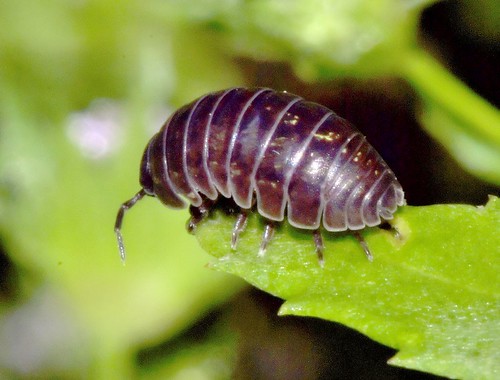
The Pill Bug by dragonseye

TheGardenLady received the following question.

I liked your site very much and would like to ask you what do I need to do to eliminate pests in an organic garden? I dont want to use any chemicals since the whole point is to eat what we grow and stay healthy. Do you have any good ideas?

TheGardenLady is pleased to know when readers enjoy the site.

What to do to eliminate pests in an organic garden is an excellent question. The answer is not short because there are many good ideas for keeping organic gardens pest free. Since fall is here, I will begin this answer now but will continue answering your question during the gardening year.

The first thing one should do in the fall is to get your gardens ready for the spring planting. Insects hide and breed in old, sick and dead plant material. So now is the time to clean your garden. Cut back leaves of perennials. After a heavy frost, remove all blackened plants such as zinnias, petunias, marigolds, etc.

Be absolutely sure that you clean diseased material from your garden. Remove and destroy plant stems on any perennials which may have had diseased foliage. Peonies, lilies, roses are some examples of plants that get diseases. Never compost any diseased material. THROW IT OUT! Good sanitation now will result in fewer problems next spring.

It is best to get rid of all the old dead plant material in the fall making it easier to start gardening in the Spring. But to pull out all the dead plants or not to pull out all the dead plants- that is the question. Insects will overwinter in dead plants- good insects as well as bad insects and birds and other wildlife will enjoy some of the plant material. If you are planning a vegetable garden in a certain location, TheGardenLady recommends cleaning out all the dead vegetable plants. However, if you leave some dead Native plants that offer berries and seeds in your flower beds, you might encourage some good insects to overwinter and help feed birds and wildlife in the winter.

Continue reading “Eliminating Pests in an Organic Garden”

Gaillardia and California Poppy, Still Blooming

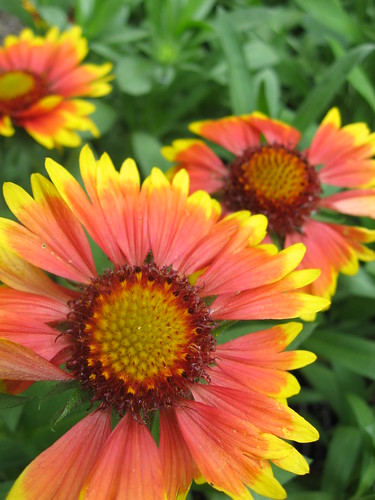
Gaillardia Arizona Sun by poppy2323
aillardia 'Arizona Sun' by poppy2323

We haven’t had a strong frost yet in my area to kill all the perennials in the garden. So it is interesting to see the last blooming plants of the year. Of course, there are some chrysanthemums and also the pansies that are still blooming.

But as I look around at the plants in flower I am amazed that the Gaillardia flowers are still opening on the stem. I have Gaillardia Arizona Sun. The plant is reputed to have lots of 4” blooms, incredible form, and survivability in harshest of conditions. I guess that means cool as well as hot conditions. It won both the America Selections (AAS) award and the European Fleur select Gold Medal! It likes sun but grows in average soils and is hardy from Zone 3 to zone 9.

Papoila da California // California Poppy (Eschscholzia californica) by Valter Jacinto Algarve

Another flower that is blooming in my neighbor’s garden is their orange California Poppy, Eschscholzia californica. If I can find the package of seeds I bought, I hope to plant these poppies in the garden now. These poppies grow from seed and self seed. They are said to grow in zones 3 to 9 but grow best in zones 5 and higher. Broadcast the seeds (to broadcast is to just throw the seeds on the top of the soil and hope the birds don’t eat the seeds) on cultivated well drained soil where you want the plants to grow because the seedlings don’t transplant well. Sow in fall in mild-winter areas, in spring in colder regions. If rain is absent, water to keep ground moist until seeds germinate. These poppies need full sun but will grow in poor soil as long as there is good drainage. The pH can be anywhere from 5.5 to 8. The plants are drought tolerant. Deer don’t like these poppies nor do many insects or diseases. The only thing to remember is that the poppies must get lots of sun because they hate shade. They naturalize in the garden. If they get enough water in the summer, they seem to bloom all summer long. And it was such a surprise to see the brilliant orange flowers blooming at this time of year.

The Cranberry and Recipes with Cranberries

all those anti-oxidants by Vilseskogen

Thanksgiving is almost here again. And one of the favorite sides for this Garden Lady is the cranberry sauce. The cranberry (Vaccinium macrocarpon) is said to be one of three fruits native to America (this includes blueberries and the Concord Grape), so the original colonists were smart to learn how to use cranberries from the native Indians.  See here. The plant lies so low to the ground and the fruit is so small, I imagine that children must have been the gatherers. Fortunately for us, improved harvesting methods today make it much easier to collect cranberries today.

High Bush Cranberries by ebergcanada

A tour of the cranberry bogs, cranberries grow in swamp areas, is an interesting outing for groups and/or families. Visiting the cranberry bogs and attending the cranberry festival during The Chatsworth Cranberry Festival was an eye opening experience for TheGardenLady. This is located in what is called the New Jersey Pinelands and this area in itself is interesting to explore.  See here.

In NJ,  Massachusetts and Wisconsin the harvest is usually done in October or early Nov., but check in your area to see if there is still some harvesting going on and if it is too late this year, plan a trip next fall.  See here.

Since today scientists have discovered antioxident properties of this fruit (see here), it is an added bonus to eat cranberries.

Continue reading “The Cranberry and Recipes with Cranberries”