7 Easy to Care for Flowering Shrubs

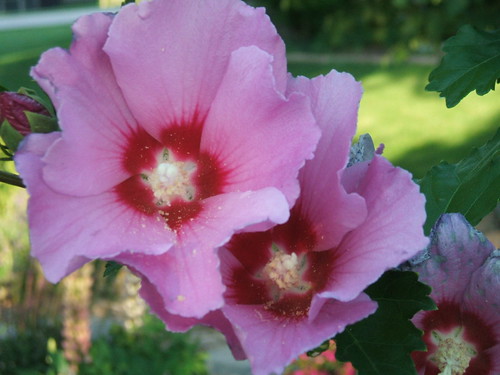
Hibiscus syriacus, “Rose of Sharon” by ConanTheLibrarian

TheGardenLady was asked to recommend some less commonly known flowering shrubs that are easy to care for and will create a hedge or shrub border between two houses in temperature zone 6. “Easy care: to TheGardenLady means that the shrubs are pretty much pest free including pesty deer as well as needing little maintenance after planting. Nothing is completely pest free, deer will try tasting anything and when starving will eat just about anything. And one may have to prune dead or broken branches even if you aren’t interested in shaping the hedge. Though there are other shrubs, here are 7 of TheGardenLady’s favorites that grow fairly quickly, fairly densely and easily.
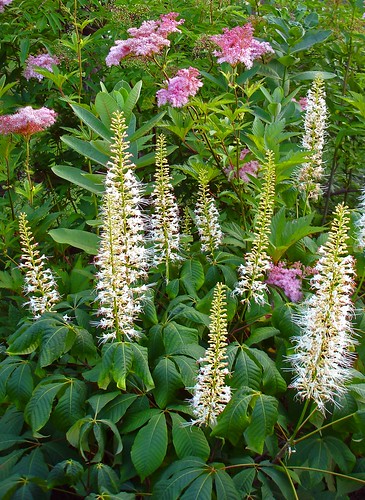
Bottlebrush Buckeye by Calendar Garden

Aesculus parviflora Bottlebrush Buckeye is a deciduous shrub that will grow 9 to 12 feet tall and up to 15 feet wide -you may get away with planting just one plant. It likes sun to part shade in zones 5 -8. It likes Acidic, well-drained organic soil . This is a deciduous shrub with interesting flowers. It has received the Pennsylvania Horticultural Society’s Gold Medal award.
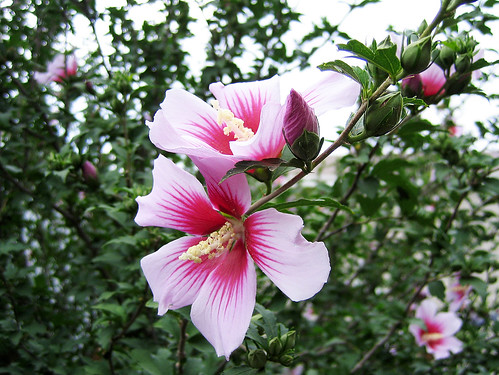
Rose of Sharon hibiscus by heart in hawaii

Hibiscus syriacus Rose of Sharon cultivars (Be sure to ask for the noninvasive types ). These deciduous shrubs grow in zones 5 to 9 in full sun. They grow to 10 feet tall and about 5 feet wide. They like almost any soil but prefer neutral to alkaline soil, sun and heat. These bloom late in the summer. Some of the selections that might not be so invasive are ‘Aphrodite”(dark pink), ‘Diana’ (pure white and a Pennsylvania Horticultural Society award winner) , ‘Helene’ ( white with a red “eye” ), ‘Minerva’ (lavender with a red “eye”) and ‘ Blue Satin’ which is a “proven winner.”  See here.

Japanese Andromeda / Pieris japonica by carsten de

Pieris japonica Japanese Pieris will grow to 12 feet and up to 8 feet wide. It will grow in zones 5 -7 and will take full sun in the North and part shade in the warmer zones. They like well-drained organic, acidic soil. This is an evergreen shrub with up to 6 inch long panicles of what looks like lily of the valley flowers. Flowers can be either white or pink. You can get more compact sized shrubs.

Continue reading “7 Easy to Care for Flowering Shrubs”

Getting Pricked by a Rose Thorn

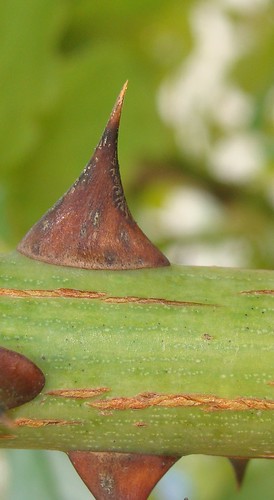
Serious rose thorns by Martin LaBar

TheGardenLady received this question from Donna:

My sister-in-law was stuck by a thorn from a Knock Out Rose. The area is very red and swollen. Are the thorns poisonous? What to do?

When gardening, it is always advisable to USE gloves.

One can get an infection from any cut. However, in all the reading and lectures on plants, TheGardenLady has never heard that rose thorns in Knock Out Roses or any other roses are poisonous. But rose thorns can give a nasty cut. Because one can get cut when out in the garden and any cut can become infected, it is best to do any type of gardening – even cutting flowers – with gardening gloves on. And then after gardening you should always wash your hands. See here.

Besides cuts, thorns can give what are called “puncture wounds.” A puncture wound goes deeper into the skin and can push dirt and bacteria into the skin. Because it’s not on the surface and not an open cut, washing doesn’t clean out the wound as well, so it can become infected more easily.  As well, when you’re gardening outside, you’re exposed to all the dirt and bacteria out in nature, so there’s a wide range of what could be causing an infection.  Read this.

If an area is still red and swollen after getting a cut, one should consult a physician. Tell the physician how the area became infected so that one can get the best treatment to remove the infection.

The Debate over Naked Gardening

Naked Garden by LORENA CEJUDO

To garden with or without clothes (or a minimum of clothes) that is the question that even Shakespeare hadn’t pondered. But we gardeners will have to wait ’til April for the sages in the City Council in Boulder, Colorado to find out what they decide.

Check out this article: Topless gardening: A human right or wrong? Neighbors’ complaints prompt rule change; thong-clad couple vows to fight

Now I don’t think the radishes or tomatoes care what one wears to plant or harvest them. Or is that why they are red? Because they are blushing. So perhaps you can only go about in minimal or no garb when planting lettuce and spinach.

I had read that Ruth Stout, the guru of easy gardening “The Ruth Stout No-Work Garden Book: Secrets of the year-round mulch method” liked to garden in the buff.

So readers, let TheGardenLady.org blog readers know what you think on this most important horticultural issue. Will this gardener use the argument that she does wear more than meets the eye? That she wears mosquito repellent and/or suntan lotion.

Companion Planting for your Garden

Photo of Marigolds planted next to Cucumber plants by Ellen Sousa at Turkey Hill Brook Farm

When planning your garden this year, consider companion planting.  What does it mean to do companion planting? Companion plants are the plants you should grow next to plants that you want in your garden. These companions assist because they have natural substances in their roots, flowers, leaves, etc. that can either repel and/or attract insects. The companions can also provide nutrients to the soil to help enhance the growth rate and flavor of the plants they are near. Companion planting has been used since the 14th century in small gardens as a way of helping to get rid of pests. Then in the 1970s organic gardeners started using companion planting to raise their plants without commercial pesticides. Companion planting is now included as one tactic in what is called Integrated Pest Management.

Why is Integrated Pest management also referred to as IPM? IPM is using a variety of methods that are benign and safe to get rid of plant pests. Companion planting is not the final solution to gardening problems; it is just one means of safe, benign pest elimination. So add it to your arsenal instead of just using synthetic pesticides, insecticides, or weedicides that can be dangerous to the user as well as the environment.

Continue reading “Companion Planting for your Garden”

Raising Plants in the Desert

Tomato Plants in the Negev

It may be winter here and across most of the US, but I think back to the terrible drought that Texas and other parts of the Southwest had this past summer and the potential for water problems in these areas and the West in the future.

I recently read an interesting article about new desert technology that is coming out of Israel.  There at the Center for Experiments in Desert Farming “researchers joined with scientists from the Ben-Gurion University, the Vulkani Institute, and the Hebrew University to figure out how to grow tomatoes using brackish water. At the experimental station, organic tomato plants are all irrigated with salt water mixed with floodwater and recycled waste water. Using sophisticated technology, researchers carefully monitor the plants to determine the correct percentage of salt needed for each species to thrive. ” Israel produces “15,000 tons of ‘Desert Sweet’ tomatoes in 250 acres of hothouses in the desert, ranging from organic tomatoes to especially small strains of cherry tomatoes that are sold at a high price to restaurants and hotels throughout the world.”

“In addition to preserving precious freshwater in this thirsty desert region, growing tomatoes with brackish water has a pleasant, if unintended, side effect: as a reaction to the pressure that the salt exerts on its cells, the tomato plants produce more sugar, making their flesh even sweeter than those grown in central and northern Israel.”

At the Yair Agricultural Research Station in Israel’s desert they are using what they call “popcorn” soil which is ” actually a stone that gets heated to 5,000 degrees, causing it to pop and act like a sponge. When wet, it can irrigate the plant continuously and is therefore much more efficient than sand.” In Israel’s desert, “an area with an average rainfall of only 20 millimeters a year, farmers manage to raise 60%” of Israel’s produce for export.”

I think it is important to learn from other country’s successes in agriculture so that we can improve our growing methods. If readers read about new agricultural improvements coming out of other countries, please let the readers of TheGardenLady blog know about them, too. We learn by sharing ideas.

Lavender-A Purple Panacea

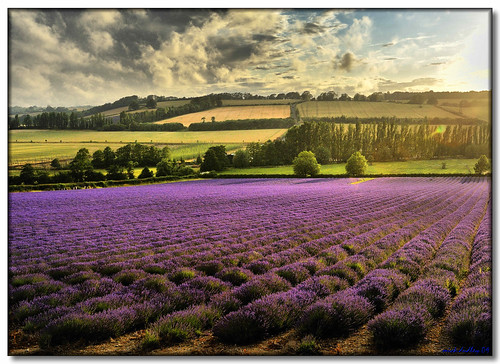
EVENING LAVENDER by mickeydud

TheGardenLady has invited people with horticultural interests and expertise to contribute posts to this blog.  The following post  was submitted by Christy Baker, a certified Family Herbalist and Consulting Herbalist.   Christy is currently pursuing a certificate in Horticulture Therapy and a second Master’s in Landscape Architecture.

Lavender, Lavandula Angustifolia, is a widely used plant with a long and rich history. Recorded use of the herb goes back 2500 years; first arriving in North America during the 1600s. Regardless of the age and time Lavender is renown worldwide for its medicinal and therapeutic value, at the very least its heavenly refreshing signature scent separates it from the rest.

The Egyptians used it to make perfumes, to scent their baths, and in humidification processes.

Continue reading “Lavender-A Purple Panacea”

The Cranberry and Recipes with Cranberries

all those anti-oxidants by Vilseskogen

Thanksgiving is almost here again. And one of the favorite sides for this Garden Lady is the cranberry sauce. The cranberry (Vaccinium macrocarpon) is said to be one of three fruits native to America (this includes blueberries and the Concord Grape), so the original colonists were smart to learn how to use cranberries from the native Indians.  See here. The plant lies so low to the ground and the fruit is so small, I imagine that children must have been the gatherers. Fortunately for us, improved harvesting methods today make it much easier to collect cranberries today.

High Bush Cranberries by ebergcanada

A tour of the cranberry bogs, cranberries grow in swamp areas, is an interesting outing for groups and/or families. Visiting the cranberry bogs and attending the cranberry festival during The Chatsworth Cranberry Festival was an eye opening experience for TheGardenLady. This is located in what is called the New Jersey Pinelands and this area in itself is interesting to explore.  See here.

In NJ,  Massachusetts and Wisconsin the harvest is usually done in October or early Nov., but check in your area to see if there is still some harvesting going on and if it is too late this year, plan a trip next fall.  See here.

Since today scientists have discovered antioxident properties of this fruit (see here), it is an added bonus to eat cranberries.

Continue reading “The Cranberry and Recipes with Cranberries”

The Deciduous Burning Bush

Winged Spindle (Euonymus alatus) by Wez Smith

TheGardenLady received this question from Mary.

I just planted a Burning Bush this summer. It did turn a beautiful red but I noticed this morning it looked a little limp. When I returned from work, most of the leaves were on the ground and the bush is almost bare. Is this supposed to happen? If not will it come back next year or did it die?

Burning Bush, Euonymus alatus, is a deciduous shrub.  Deciduous means that a shrub or tree sheds all its leaves in the fall. This happens every year. The leaves will return in the spring.  See here.

Send a photo of your burning bush when it’s a beautiful red.  TheGardenLady would love to show it on her site.