Beginning a Gardening Business in Mongolia

Winter Palace, Ulaan Baatar, Mongolia. aPICT0136 by VicWild

TheGardenLady received this question from Odmaa all the way from Mongolia.

I am writing this from Mongolia, Ulaanbaatar. My country is in Asia, between China and Russia. Winter is harsh and lasts more than 4 months.  I am intersted in planting room plants and help people to have them in their homes. I have more than 15 different room plants in my rooms. I am not a specialist in this area. Could you give me an advice to begin my business? During winter in my contry it reaches minus 30-35 degree centigrade. We who live in houses and apartments during this time do not face cold because we have central heating system. So room temperature is usually between 17 to 30 centigrade degrees.

How exciting to know that TheGardenLady.org column is read around the world in Mongolia. Though I have never been to your beautiful country, a good friend spent her summer vacation visiting Ulaanbaatar and other parts of Mongolia. I enjoyed viewing her photographs. Much of her vacation was spent on horseback.

and then winter came (II) by Arriving at the horizon

I have read that Ulaanbaatar is the coldest capital city in the world. But your indoor temperature is perfect for certain plants.

TheGardenLady also has been interested in Genghis Khan and recommends a book called “Genghis Khan and the Making of the Modern World” by Jack Weatherford. He was a fascinating person.

TheGardenLady does not really know that much about starting a business venture and is not quite clear on the type of advice you are seeking.

My suggestion would be to study as much horticulture as you can. See what plant books are available in your libraries or book stores. Or go on line to read as many gardening sites about the plants that you are interested in growing.

In Eastern Ulaanbaatar there is a botanic garden, The Botanic Garden of Mongolia. See here.

Continue reading “Beginning a Gardening Business in Mongolia”

For those of you who responded to the Michigan State University potential budget cut because of TheGardenLady’s column, a big Thank You.  Michigan State University extension was spared the budget cut this time.

But readers, please still remain vigilant in Michigan- as well as in all states.

MSU extension spared the budget ax, this time

from American Vegetable Grower e-magazine-
MSU Extension Spared In Budget Cuts – For Now
Last week we reported that Michigan State University (MSU) Extension was jeopardized by a potential funding cutoff. Governor Jennifer Granholm spared the program by including funding in the state’s new budget. But what happens if MSU Extension is eliminated a year or two from now? Read more

Growing Food Plants in the Dorm Room

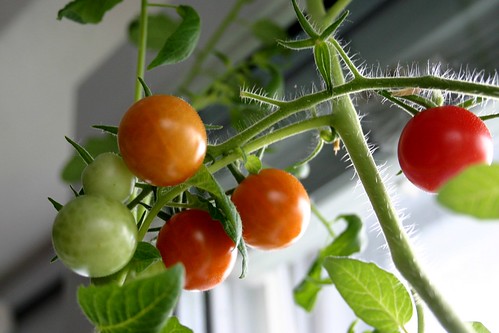
Indoor tomatoes, 2nd part by tillwe

TheGardenLady received this question from Daniel:

I would like to grow a food plant of some sort in my dorm room. I was wondering what kind of plant you would suggest. I don’t have a lot of time or gardening skill, so an easy to care for plant would be ideal. Also, our room has a window, but does not get direct sunlight. It stays around room temperature year round. Finally, it would be nice to be able to harvest something before the year is over. I don’t know if anything fits the bill, but suggestions would be great!

Wouldn’t it be wonderful if we could grow our own food in our home or dorm room? I think most of us would convert a floor to a garden just to have fresh produce year round. I know that I would create a garden in my lower level which has lots of windows that are on the West and North sides of the building so they get no sunshine. And to have harvest fresh vegetables at the end of the year, for Christmas dinner, would be a gourmet’s delight. But alas, this dream has not quite been realized in my lifetime. Many of the Dick Tracy comic book inventions have come true (Dick Tracy, a popular comic strip in the 1940’s and 1950’s) and I imagine that some day growing vegetables or food easily in a dorm room will also come true. But today one really needs a green house to have success. Food plants want lots of SUN to produce food- usually at least 6 hours of sun. That is how nature created them. People who have a glass or plastic greenhouse can attempt to raise food indoors. But without that sunlight indoors, you are asking for difficulties.

I am not sure what temperature you say your dorm room is when you say “it stays around room temperature year round.” People regulate the amount of heat in their rooms and it can usually be from approximately 68 degrees to 78 degrees in the rooms. Some plants like it warmer that is why they grow in the hot summer though plants like lettuce prefer a cooler environment. And also, because a plant is in a pot, you will have to be sure that you water the plants enough. Some plants might even need humidity around them as well as to be watered. To get added humidity, put the pot in a tray with water and stones. Site the pot above the water, on the stones not in the water. In many cases the plants will need a pollinator to produce fruit. People do help pollinate when insects aren’t available to do it.

Continue reading “Growing Food Plants in the Dorm Room”

Red Plants at the Perennial Plant Conference

Helianthemum ‘Hartswood Ruby’

At the Perennial Plant Conference held at Swarthmore College TheGardenLady enjoyed seeing and learning about red plants

The nursery Green Leaf Plants have a Helianthemum ‘Hartswood Ruby’ that is new. It has a red flower with a yellow center and grows in zones 6,7 and 8. Check out the look of this flower on the Green Leaf Plants site and call them to find out where it can be bought.

Hibiscus Red Flyer
Hibiscus 'Red Flyer'

Beverly Fitts an instructor at Longwood Gardens recommended a Hibiscus called ‘Red Flyer.’ She said the flower is so spectacular that people stop to comment on it or to ask her what the plant is.  See here. This is a monster plant, towering to 12′ in height, so you need room to have it. It is resistant to insects and is a vigorous plant that starts flowering in mid-July and continues until frost. Plenty of nutrition and moisture will produce the best results. It won’t become invasive because it is a sterile plant.

Another red flowering plant that appealed to me was recommended by Carrie Wiles of North Creek Nurseries. This was a honeysuckle, Lonicera sempervirens ‘Major Wheeler.’

Lonicera sempervirens Major Wheeler Trumpet Honeysuckle
Lonicera sempervirens 'Major Wheeler' Trumpet Honeysuckle

Many honeysuckles have become very invasive. They say that this lonicera will not become invasive because it is a native honeysuckle. And the reason the nursery recommends ‘Major Wheeler’ is because of its red flowers -the plant is COVERED in red trumpet flowers in late spring and keeps producing flowers all summer long, especially with a post-bloom trim. Carrie Wiles said that hummingbirds will find it from miles around.

These are some of the wonderful recommendations of plants for your garden from people in the know.

Echinacea – The Purple Coneflower

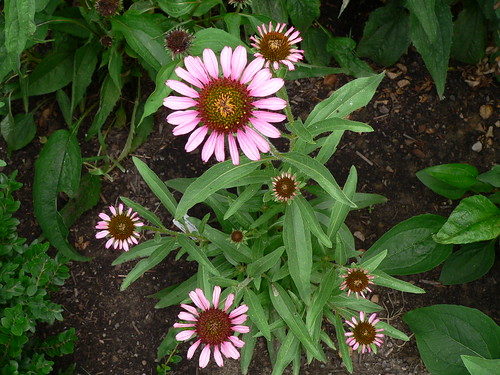
Echinacea Pixie Meadowbrite by fdr2164

Every year one of the best plant conferences on the East Coast is the Perennial Plant Conference held in the fall at Swarthmore College. This conference is co-sponsored by Chanticleer Garden, Longwood Gardens, The Hardy Plant Society/Mid Atlantic Group, The Pennsylvania Horticultural Society and The Scott Arboretum of Swarthmore College.  (If you haven’t visited Chanticleer, Longwood Gardens and The Scott Arboretum, you should. Each garden is fantastic in its own right.)

This year on October 16th a group of friends and this Garden Lady joined what looked like a sell out crowd for this 2009’s excellent, informative conference. I hope to be writing about what some of the excellent speakers had to say in future posts.

Right now I want to talk about one of my favorite features at the conference and that is what is called the Promising Plant Forum. Five people who are either from top nurseries or who work at top gardens give a 7 minute presentation of 3 of their favorite choices for best new plant or underused excellent plant for your garden.

It was interesting that of the 15 plants recommended, 4 were Echinacea plants. Echinacea which are commonly called purple coneflowers are native to eastern and central North America, where they are found growing in moist to dry prairies and open wooded areas. Echinacea are generally long lived plants that have large, showy flower heads and are in bloom from early to late summer.

Continue reading “Echinacea – The Purple Coneflower”

Whiteflies are Annoying Plant Pests

whitey the whitefly =) by ProDigi

In the last post, TheGardenLady explained one reason why this time of year makes her sad.  Here’s another reason, the fear of bringing in plant pests.

Whitefly is of special concern.  See here.  Whitefly can get on your plants when they are outdoors. But it is a major problem of greenhouses or homes. One of the plants that I bring in for the winter is my Brugmansia or angel trumpet. This is a plant that  is prone to whitefly. Friends have thrown out their Brugmansia plants because of the infestation of whitefly on them. Sometimes one has to get rid of plants when the infestation is extremely large but there is no room to properly care for the plant. My house is not very large and some of these plants have become enormous trees which I can’t really spray indoors should they have an infestation. Or you might have to get rid of a pest ridden plant if you fear the infestation will spread to other plants. This is also a fear I have with two dozen other plants in my relatively small place. I have been lucky. In all the years that I have had plants indoors and in the three years I have been bringing my Brugmansia indoors, my plants have never had any pests.

Continue reading “Whiteflies are Annoying Plant Pests”

Why this Time of the Year Makes TheGardenLady Sad

sad plants and glitter platforms by A.J. Kandy

The flowers in my garden are still blooming their heads off. It is amazing to see the garden at this time of the year as cold weather is coming. The impatiens are spectacular; I think this has been one of the best years for impatiens. The roses seem to look loveliest at this time of year. Is it because these are the last roses of summer? The chrysanthemums are filled with flowers. I usually like to see flowers with leaves. But to see all the chrysanthemum flowers covering the plant, the leaves are not much needed. My daughter thinks the flowers at this time of year are the prettiest of the entire flowering season. So why does TheGardenLady feel so sad when she looks at her garden?

As I brought my indoor plants indoors, I thought how much this GardenLady dislikes this time of the garden year.

Every year in the spring when the leaves are formed on the trees, in this area that is the month of May, TheGardenLady can’t wait to take the indoor plants outside where they are left on the deck or planted in the ground and remain all summer and part of fall. The plants are not brought back into the house until a week or so before the heat in the house is turned on. The plants seemed so happy when they were taken outside in the spring. I felt that I could hear them thanking me.

But now in the Fall the plants seem to know that they will have to go back indoors where the light is so much dimmer and the forced air heat will be drying. I believe my plants are not happy to have to come in. Oh yes, they know they will be warm and cared for. But their freedom is over.

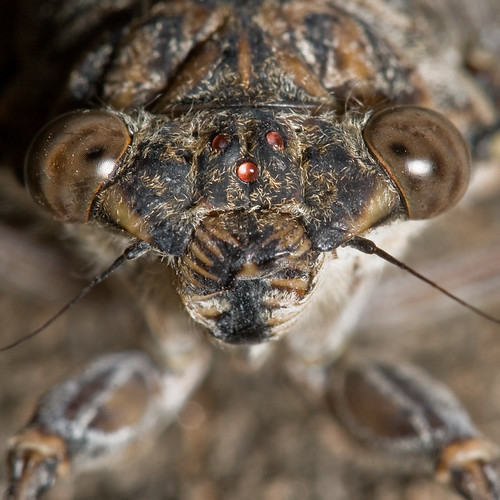
Cicada portrait by macropoulos

Now the work of caring for plants really begins for TheGardenLady. All those pots of plants have to be carried in. And after a summer in the sun and rain, they have grown a tremendous amount. Some of the plants are quite large. Finding spots for them, let alone good spots, is a major challenge. And before they get placed in the house all the plants have to be cleaned off. There are leaves that have fallen into the pots or maybe nuts buried there by the squirrels. The pots are muddy from water splashed onto them from summer rains. TheGardenLady hopes that no pests are carried in with the plants. Last year a cicada had buried itself in the soil and emerged from the pot in the warm house. It was so surprising to hear cicada noise in the winter and to find a cicada gripping a branch of the plant. Many years I have brought in plants with tiny crickets- crickets with the shrillest, high pitched screeching. These little black crickets are relatively tiny and difficult to find even with all the noise they make.

Autumn is ideal for Encore Azalea planting

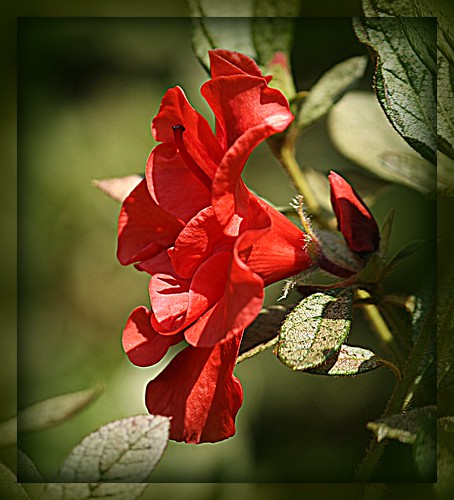
Encore by Carol (Nona)

The following is an update from Encore® Azalea.

Gardeners know fall is a great time of year to plant trees, shrubs, and flowering bulbs.  But did you know autumn is an ideal time for Encore Azalea planting, too?

Planting Encore Azaleas in the garden before winter’s frost gives gardeners double benefits. First, you’ll enjoy their vibrant blooms until first frost and then Encore Azaleas will enjoy a period of dormancy to become established before next spring’s arrival.

Even after the fall blooms fade away on Encore Azaleas, the evergreen foliage provides a beautiful backdrop for the winter garden with lush, year-round hues of green. During the dormant period, the branches may stop growing; but underneath the soil, the roots are developing a healthy support system – fortifying the Encore Azalea to produce beautiful new growth the following spring.

When planting Encore Azaleas, remember that Encore Azaleas tolerate more sunlight than traditional azaleas.

Unlike traditional azaleas, Encore Azaleas perform best in sun to partial shade, preferably afternoon shade. Encore Azaleas must receive 4-6 hours of direct sunlight per day for optimal blooms.

Encore Azaleas will also tolerate full sun, but care must be taken to prevent damage from exposure to drought or other heat-related conditions. To find a retailer near you, please visit www.EncoreAzalea.com.

Happy gardening,

From your friends at Encore® Azalea

Fall is a Great Time to Buy and Plant Plants, Shrubs and Trees

Colorful Fall Planting by Don3rdSE

The GardenLady just returned home from another buying spree of perennials and shrubs. This is TheGardenLady’s favorite time to buy plants. At Russell Gardens Wholesale, I got the Jackmanii Clematis that I wanted to plant next to my new arbor. I also bought 9 good sized hosta plants plus 6 other perennial plants. The price for everything came to just a little over $50. I couldn’t fit another plant in the car. Today I bought the Buddleia davidii Pink Delight that I decided I needed when I saw the wonderful long pink spikes it has. This buddleia looked magnificent in the Coastal Maine Botanical Garden. I bought it in a gallon pot at half price.

When you are driving around this fall, I hope the readers of this blog notice the huge signs at most nurseries that say SALE. And like TheGardenLady, I do hope that you are taking advantage of these sales. Unless you are shopping for a new plant that is being featured in the spring or you are looking for a plant that absolutely must be planted in the spring, FALL is the time of the year to buy and plant your garden. Why? Because this is the time of year that nurseries and gardens are having sales. The nurseries want to get rid of inventory so that they don’t have to keep all those plants in pots over the winter. And they want to make room for new plants that will be coming to them in the spring. And it is not just nurseries that are having the sales, plant catalogs and websites are having their sales. So you, the gardener will reap the benefit of these sales. Fall is a buyers market for perennial plants, shrubs and trees.

Continue reading “Fall is a Great Time to Buy and Plant Plants, Shrubs and Trees”