Flowering Plants Speed Post-Surgery Recovery

TheGardenLady had recently written a column about some of the benefits
of plants.

She recently read, in Science Daily, the results of a study done at Kansas State University published in the October 2008 HortTechnology that  showed that hospital ” patients with plants in their rooms had significantly fewer intakes of pain medication, more positive physiological responses (lower blood pressure and heart rate), less pain, anxiety, and fatigue, and better overall positive and higher satisfaction with their recovery rooms than their counterparts in the control group.”

TheGardenLady feels that plants in one’s house or rooms has beneficial
effects on their owners and those living with them whether they have had surgery or not. So, bring potted plants into your rooms!

Gardening to Cope with Tough Times

TheGardenLady wants to wish all her readers a Happy, Healthy New Year.

These are trying times – especially because of the economy. Remember that gardening can reduce stress. Many articles point this out. Going outdoors to garden you will be working in the sun so that you are getting extra Vitamin D for free while you are getting some exercise both to reduce stress and  to save on your gym bill.

Buy packets of seeds. They are the cheapest way to go.

Johnny’s Selected Seeds

Thompson & Morgan

Burpee Seeds and

Park Seed are just a few of the excellent companies where you can go online to read what they have or they will send you a catalog.

With the strange winter we are experiencing, you may want to start planting seeds indoors (see this previous post). For example if you have a sunny window, you may be able to start your own herb garden. Buying herbs in the supermarket can be pricey and fresh can be better.  By buying packets of seeds, each seed that germinates potentially can grow into a plant so that you can grow many plants, enough to plant outdoors when the weather in your area is right or enough plants to harvest and dry or even enough to give as presents. Or you can use the extra seeds to plant outdoors when the time is right.

Continue reading “Gardening to Cope with Tough Times”

Biblical Garden Foods for the Winter Holidays

Allium Cepa by Bambo

It is December and many of TheGardenLady‘s readers are celebrating either Hanukah or Christmas. The  house is decorated in the appropriate way for the holiday you celebrate and food will be a main part of the festivities.

So this year TheGardenLady is suggesting that her readers try to cook with some of the herbs (Bible herbs) or foods that are  mentioned in the Bible.

While friends and family are seated at the dinner table enjoying the special holiday treats, talking about the foods in the Bible might even add to your discussion – after all these celebrations are related to the Bible plus TheGardenLady‘s readers are those who are interested in plants, even ancient ones.  And these dinner discussions might encourage some readers to grow the Biblical favorites in their own gardens.

Some of the Biblical foods mentioned are garlic and onions. Onion, garlic or shallots are all in the allium family of plants, relatives of the Lily. The common onion is the allium cepa (see photo above), the garlic is allium sativum and the shallot is Allium ascalonicum named for the city, Ashkelon in Israel  from which it was supposedly brought to Europe by the Crusaders. (Alliums are now becoming a popular flowering plant for the garden; Allium giganteum is a particular favorite in TheGardenLady’s ornamental garden. Though ornamental alliums are not for eating.)

Lentils – Lens culinaris is another food mentioned in the Bible. Lentils are thought to be the oldest cultivated legume.

Some other foods mentioned in the Bible are honey, olive oil, and cinnamon.

This holiday you might try a Baked Honey Lentil Casserole as part of your menu. This casserole is composed of herbs, spices and vegetables that were eaten during Biblical times.

  • Baked Honey Lentil Casserole for 6 as a side dish.

Cook 1/2lb red lentils as directed on the package. (Do not add salt when cooking lentils.)

Make a mixture of 1 tsp. dry mustard (optional), 1/2 teaspoon cinnamon, 1 small onion in small dice, 1  clove garlic minced, now add salt- 1 tsp or to taste.

All the above items are mentioned in the Bible. (You can add ground black pepper to taste.) Mix this mixture into the cooked lentils and taste to see if you want to add more of any herbs or spices.

Put 2 Tbsp Olive oil on bottom of casserole- olives and olive oil were used in the time of the Bible.

Then pour the cooked lentil mixture into the casserole and pour 1/4 to 1/2 cup of honey on top. It depends on your sweet tooth. (Honey is another food that was used during Biblical times.)

Cover the casserole tightly with the lid or with aluminum foil.  Put casserole in a preheated 350 degree oven and bake until tender- start checking after 1/2 hour- it could take up to 1 1/2 hour. When tender, take the lid off and let cook uncovered for another 10 minutes and serve.

Happy Holidays

Do you know what espalier means?

For those who don’t subscribe to a website called Wordsmith which has definitions and etymologies of all sorts of words, TheGardenLady wants to direct readers to this week’s words and photos. This week the words are related to trees: espalier, topiary, pleach, bonsai and pollard.

TheGardenLady has only cut and pasted the first word of the week-espalier– so that the reader has to enter the “A Word A Day” Wordsmith website for the other words.

A.Word.A.Day with Anu Garg

A few months back I featured this quotation from the journalist Hal Borland (1900-1978): “You can’t be suspicious of a tree, or accuse a bird or a squirrel of subversion or challenge the ideology of a violet.”

Astute linguaphile Mark Germer wrote in response: “Recent work on information processing (even kin recognition) in plants suggests that there may be more going on there than we now understand; as for birds and mammals, it has long been appreciated that they are perfectly capable of deception and subversion. For my part, I don’t find these things odd or disturbing, as it’s the continuity of all life that intrigues me most. Humans are not alone in their baseness — though a few may be alone in their desire to rise above it.”

Mark said it well. There’s more to trees and plants than we think (see nature.com). So next time you pluck an apple from a tree or trim that hedge, be aware that it may not be as oblivious as you think.

This week’s words relate to what we do to the trees: chopping, trimming, twisting, bending, and stunting as we shape them.  espalier

PRONUNCIATION:
(i-SPAL-yuhr, -yay)

Chinese Garden Tour

TheGardenLady just received an email about a garden tour in China.  She knows nothing about the organization nor the people running this group so she cannot endorse the group. But she thought TheGardenLady readers might be interested in the following information.

China – Flower Blossoms & Peony Festival Tour April 7 – 21, 2009

Thinking of what to give yourself as a Christmas Present this year? Then think no further as this trip is the perfect answer!

We visit some of China’s most incredible gardens, sights and cities including Beijing, Xian, Luoyang, Suzhou and Shanghai.  Gardens that are thousands of years old beckon you to stroll through to capture
cherry blossoms and peonies in their full glorious bloom.   Gardens that will become your memories!

Continue reading “Chinese Garden Tour”

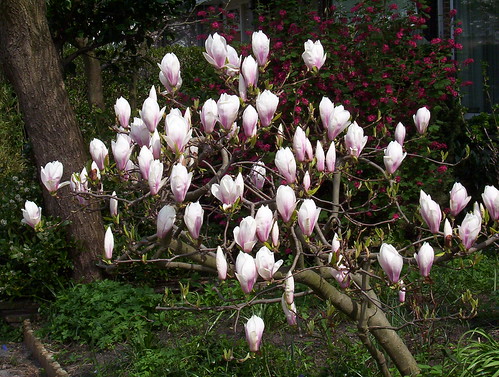
When to Plant a Magnolia Bush

Photo by Fadadomar

TheGardenLady received this questin from Betty:

When is the best time of year to plant Magnolia bushes?

TheGardenLady never heard of a Magnolia bush; but since there are about 80 different species of magnolia that are native to the eastern United States and southeastern Asia as well as hunderds of named hybrids, there might be a plant that has the common name of Magnolia bush.

One difference between a bush and a small tree, TheGardenLady was told, is the height- a bush is under 20 feet tall and a tree is over 20 feet tall. So you can see how arbitrary the word bush can be in a plant name. That is why it is imperative to ALWAYS give the Latin name of a plant when asking a question about a plant. With the Latin name, the person answering your question knows exactly which plant to talk about.

Continue reading “When to Plant a Magnolia Bush”

Chrysanthemums In Japan

TheGardenLady has just returned from a two week tour of Japan with an artist who was raised in Fukuoka but now lives in the US.  She knows Fukuoka very well and takes small groups with her to visit the area around Fukuoka which included Nagasaki and Kyoto. TheGardenLady was most interested in the flora and gardens of the area and to this end took many photos; but since the tour was not specifically plant oriented, ThisGardenLady would love to return to Japan some day to visit the botanical gardens as well as more of the formal gardens.

This time of year is the chrysanthemum festival. Many of the gardens or shrines have displays of chrysanthemums for visitors to gaze at.

According to Wikipedia “Chrysanthemums were cultivated in China as a flowering herb as far back as the 15th century BC.  An ancient Chinese city was named Ju-Xian, meaning “chrysanthemum city”. Then, according to the chrysanthemum society “around  the 8th century A.D., the chrysanthemum appeared in Japan. So taken were the Japanese with this flower that they adopted a single flowered chrysanthemum as the crest and official seal of the Emperor. The chrysanthemum in the crest is a 16-floret variety called “Ichimonjiginu.”

Continue reading “Chrysanthemums In Japan”

Conifers

Fall is a good time to attend gardening lectures. Not that there isn’t a lot of work still left to do in the garden: harvesting if you have vegetable gardens, putting your plants to sleep for the winter if you have flowers, bringing in summer bulbs like gladioli,  planting next spring’s bulbs like daffodils, etc.  But since there are many good lectures going on in the Fall, like the Perennial Plant Conference on Friday, October 17th at Swarthmore, when readers have free time, they should make every effort to attend.

To that end of going to lectures to learn more, TheGardenLady attended a lecture entitled “Conifers for Your Garden” given by Steven Kristoph who has taught about conifer trees at Rutgers University for over 25 years. He also owns Steven Kristoph Nursery and has a website. 

Steven opened his lecture by saying how pleased he was that so many people attended his lecture since so many excellent websites can be Goggled up on conifer trees that one can find out just about all there is to know about conifers without leaving home.  Conifer trees are defined as a grouping of trees with needle or scale-like leaves (e.g. pine, spruce, cypress) and bear cones. They are usually, but not always, evergreen. A website that he recommends is The American Conifer Society.  This website lists all the conifers with photos as well as tells the readers where there are lectures or symposium on conifers.

Continue reading “Conifers”