Walking and Wildflowers

                                                Photo by Jakob.Enos

This Columbus Day weekend TheGardenLady’s daughter came home and wanted to go for a walk. TheGardenLady has her usual 1/2 mile each way walk that goes along a wooded and wildflower route near a stream. Each time, in every season TheGardenLady walks this route, she discovers different and interesting plants or flowers or  colorations of leaves. TheGardenLady is not someone who walks blindly. Her favorite mantra is to check every blade of grass along the way. And with another pair of eyes walking alongside, TheGardenLady discovers even more.

When TheGardenLady first moved to this area, one May, she found one of  the best stretches for wild strawberries Fragaria virginiana and it was along this route. Because most people who didn’t grow up in a rural area don’t know which foods are edible- even this GardenLady doesn’t know all the edible plants and ALWAYS takes precautions, better to be safe than sorry-  this wild strawberry “patch” was a Mother Lode for TheGardenLady.

For those who have tasted them, wild strawberries are the  most delicious of all the strawberries.  Wild strawberries are one of the fruits TheGardenLady considers ambrosial. But, sad to say, the township mowed this strawberry area down a few years in the running, so that not one wild strawberry plant remains. (Wild strawberry plants do not transplant.)
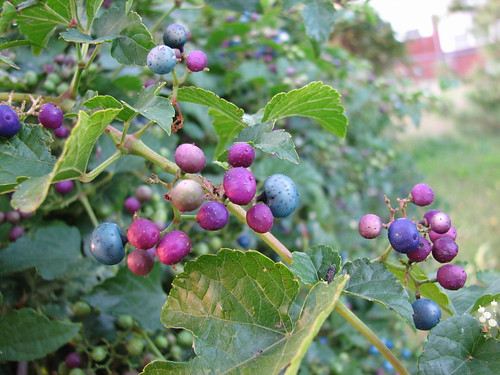
                                               Photo by weretable

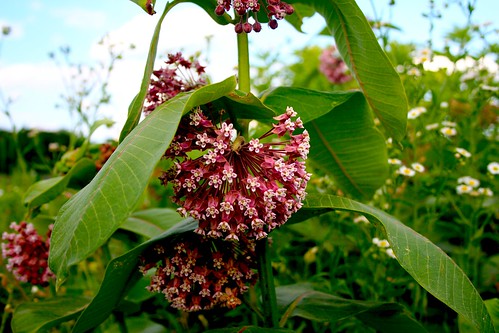
But still there are plants for other animal, bird or insect species to enjoy. Along this walk there is the common milkweed, Asclepias syriaca. There is a rather large clump of them – about a dozen or so plants. Hopefully the township mowers will leave this area unmowed to enable the Monarch butterfly catterpillar to feed on the plant. And on this Columbus Day weekend, the Milkweed seedpods were breaking open and the feathery seed carriers were being blown about. This is one plant that gardeners who want to grow native plants should encourage in your gardens. The plant has a globe lilac to pinkish flower from August through Sept. and an unusually shaped seedpod that cracks open in the fall to allow the seeds to blow. These are easy to grow wildflowers that should bloom in the second year. You can buy the seeds out or gather them now as they are blown about.

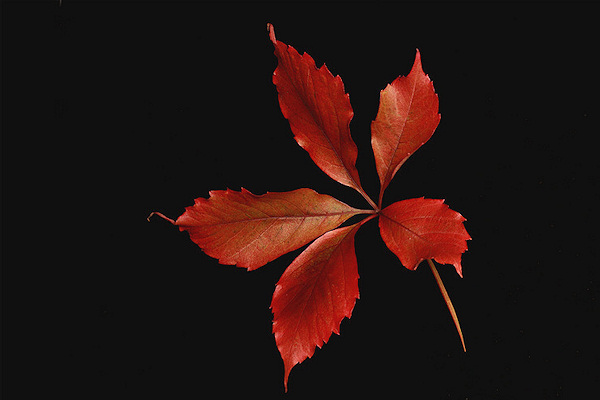
The Virginia Creeper was brilliant red as it climbed up the tree trunks; it is one of the earliest plants to turn color in the fall. TheGardenLady’s daughter sometimes confuses Virginia Creeper with poison ivy because poison ivy also turns a brilliant red. But remember that Virginia Creeper has 5 leaves but Poison Ivy only has 3 leaves.

And on  this Columbus Day weekend, TheGardenLady’s daughter noticed, among some other plants that TheGardenLady had never in her 30 some odd years of walking this same route, seen. One plant growing there was Ampelopsis brevipendiculata or Porcelain Berry Vine with its lovely pale lilac, purple, blue and green berries. This plant is spread easily by birds and small animals that feed on these colorful berries. Sadly this lovely vine has become a major invasive plant because it spreads so easily and grows so fast that it strangles trees and native wild plants.  Because it has some of the prettiest fall berries it was brought to this country to be cultivated around the 1870s as a bedding and landscape plant and in spite of its aggressiveness in some areas, it is still sold by the horticultural trade. Be wary if you fall in love with this  vine. Check your state’s invasive plant list before you buy it.
This is just a small listing of all the plants one sees while walking or hiking. Discovery has got to be one of the great joys of life.
How To Reduce Fall Deer Damage

                                                   Photo by Worldman

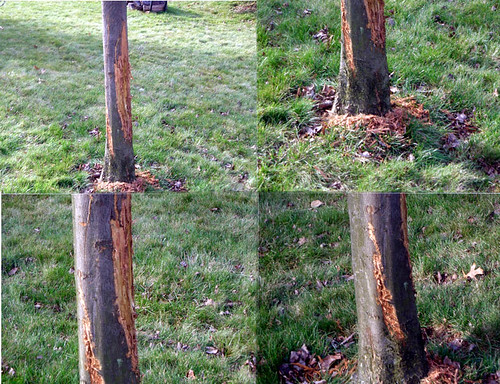
Because male deer’, the bucks, antlers reach full growth in the fall, they want to get rid of the soft velvet that protected their antlers while they were growing. Early in the fall you may see a buck rubbing his antlers on the trunk of a tree or see evidence of the rubbing. Besides rubbing off the velvet on the antlers, later in the fall the deer can be marking his territory by rubbing trunks of trees. Bucks use glands in their foreheads to make scent markers on the trunks of trees. These rubbings are called  “buck rubs.” Look for buck rubs on trees, usually one to two feet high off the ground, from September to December.

Though most trees are resilient to the buck rubs, it can be bad for the tree, especially if it is a young tree- losing bark on the tree trunk can kill a small tree. Damage that completely encircles the tree’s circumference is more deadly than damage up and down because the tree’s vascular system is just under the bark. Young trees have very thin bark that offers no protection from such damage.

You should surround the tree with a sturdy fence or barrier that can keep the male deer away from the tree trunk. A 6-foot-tall barrier of welded wire mesh, supported by 8-foot-tall rebar pounded into the ground at regular intervals around the circumference is one suggestion to keep bucks from rubbing on young trees. Another option is corrugated plastic drainpipe that has been slit along its length and placed around the trunk.  While deer repellents can help prevent deer browsing, they are not very effective in controlling buck rubs.

Continue reading “How To Reduce Fall Deer Damage”

Open House for Carolyn’s Shade Garden

                                         Photo by Will Stuart

This is an invitation for an open house to a beautiful shade garden owned by a woman named Carolyn.  It is this Saturday, September 27, from 10 to 2, rain or shine (checks and cash only).  Directions are below.  If you can’t come that day, please feel free to schedule an appointment during the preceding week, 9/22 to 9/26.

Carolyn has some beautiful plants available to transform your fall garden with showy flowers and ornamental leaves.  Don’t forget that fall is the best time to plant because soil temperatures are elevated into December, but new plantings don’t have to contend with hot weather.  This is the year that your fall garden will be as beautiful as your spring display!

This open house will offer blooming, specimen size:

  • Pink turtlehead/Chelone lyonii ‘Hot Lips’ (native)
  • Red and blue lobelia/Lobelia cardinalis & siphilitica (native)
  • Toad-lily/Tricyrtis ‘Sinonome’, Miyazaki’, ‘Samurai’, & ‘Taipei Silk’
  • Garden phlox/Phlox paniculata ‘Laura’, ‘Nicky’, Starfire’, ‘David’, ‘Blue Paradise’, & ‘David’s Lavender’ (native)
  • Japanese anemone/Anemone x hybrida ‘Pamina’, Honorine Joubert’, ‘Queen Charlotte’, & ‘Robustissima’
  •  White and pink hardy begonia/Begonia grandis, B. g. ‘Alba’, and B. g. ‘Heron’s Pirouette’ (selected as a superior form by Heronswood nursery in WA)
  •  Unusual ferns—Autumn fern, Tassel fern, and Japanese holly fern
  • Purple, peach, caramel, and lemon coral bells/Heuchera ‘Citronella’, ‘Crème Brulee’,  ‘Peach Melba’, & ‘Plum Pudding’ (native)
  • Foliage plants like bear’s breeches (acanthus), silver-leafed brunnera, native Jacob’s ladder ‘Stairway to Heaven’, pulmonaria ‘Bertram Anderson’ & ‘Diana Clare’, and the golden-leafed St. John’s Wort ‘Brigadoon’
  • Hellebores– large specimens of ‘Pink Lady’ and ‘Ivory Prince’
  •  Butterfly attractors—Tartarian aster ‘Jindai’, Ironweed (Vernonia, native), Hardy ageratum ‘Cory’ (native), ‘Little Lemon’ goldenrod (native), and Joe Pye Weed ‘Little Joe’ (native)
  • Chinese astilbe ‘Visions’—late-blooming, drought tolerant, and covered with buds
  • And many more!

Reusable Plant Crates, Boxes, and Pots:  If you took a plastic crate at a previous open house, don’t forget to reuse it on Saturday.  Please continue to bring cardboard boxes–we always need more.  I am happy to reuse my pots and similar sizes.  Please don’t drop off any pots that aren’t black or contained shrubs, trees, houseplants, or annuals.

Questions:  Carolyn’s catalogue is an excellent resource for information about the ornamental characteristics and cultural requirements of the plants I offer.  Carolyn often finds incorrect information on the preprinted plastic plant tags and recommend that you go to my catalogue first.  Printed copies will be available at the open house.  If your question is not covered in the catalogue, please feel free to consult one of her knowledgeable open house “volunteers” in the yellow hats.

Continue reading “Open House for Carolyn’s Shade Garden”

Trilliums

                                                Photo by ER Post

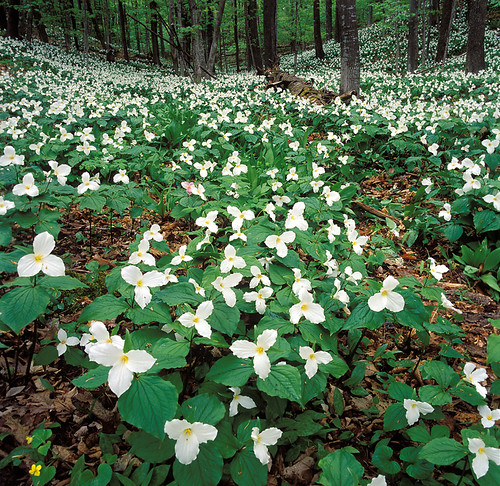
Is there anyone who doesn’t love Trilliums?

When I planted one in my son’s garden and it bloomed the next spring, my granddaughter phoned me to ask what the fairy flower was that was blooming. A friend with a wonderful woodland garden told me that it was her love of Trilliums that started her gardening.

Towards finding out more about Trilliums, TheGardenLady recently attended a lecture given by John Gyer entitled “The Secret Life of Trilliums.” It turns out that if you want to plant Trillium seeds and get flowers from those seeds, you have to wait 8 years.  It takes 2 years just to make a first leaf.

So Mr. Gyer studied what was going on during those 8 years in the life of the plant both underground and when it sent up the stems and leaves that finally led to the plant putting forth flowers. If any gardening group would like to hear this fascinating talk, you can contact John Gyer at fernhill@voicenet.com

Continue reading “Trilliums”

American Goldfinch

                                             Photo taken by Bill Leaman

American Goldfinches, Carduelis tristis, have been sighted recently in TheGardenLady’s garden and other local gardens. The Goldfinches have been sighted on TheGardenLady’s sunflowers – those sunflowers in my garden that the squirrels, in their eagerness to eat the seeds, haven’t knocked down.

Goldfinches live much of the year in most of the country – going to warmer areas in the winter. Since they breed in late summer and fall, the males now have on their beautiful bright yellow feathers that must make them especially attractive to the female and are busily gathering seeds for their females and chicks. This late breeding may be related to the abundance of seeds in the late summer months.

Continue reading “American Goldfinch”

Musings on the Benefits of Gardening

                                            Photo taken by crawfor3

TheGardenLady has read numerous articles about the many health benefits from gardening.  Gardening is said to provide the regular physical exercise necessary in the prevention of heart disease, obesity, adult-onset diabetes and high blood pressure as well as the strength training important in the prevention of osteoporosis. 

Gardening doesn’t allow for boredom; there is something one can be doing all year round, in the garden or planning for the next year’s garden. It is a social activity. Gardeners enjoy each other’s company. They enjoy discussing plants and sharing garden tidbits or even visiting one another’s gardens.

Gardening and having plants reduces stress – the dreary days of winter are relieved by the plants you grow in your house while these plants give a fresher more oxygenated breathing environment. 

Continue reading “Musings on the Benefits of Gardening”

Plants for Sale

                              Photo taken by Celine

In case readers hadn’t noticed, this is a great time to buy plants. Most nurseries have already started their sales. One can purchase plants from 25% off the retail price to much more off. Nurseries want to get rid of most of their plant stock so that they can start planning for purchasing next year’s plants. They want to have room not only for garden favorites, but also for the newest hybrids that are going to come to market in 2009 and also for plants that are winners of plant awards, like The Perennial of the Year or the All American Rose. So now smart buyers can reap the benefits.

Continue reading “Plants for Sale”

EncoreAzalea’s Advice on Fertilizing Azaleas


                                                    Photo taken by wdbrad52

TheGardenLady received this from the EncoreAzalea company and is passing this fertilizing information on to those who grow azaleas.

If you didn’t fertilize your Encore Azaleas this spring or summer, or if you think your azaleas could use a little extra burst of energy, now is the time to fertilize.

Fertilizing promotes new growth, which can be damaged by cold weather. For this reason, we suggest that gardeners do not fertilize their Encore Azaleas after August. If you fertilize now, your Encore Azalea’s new growth should have time to establish itself before the threat of winter.

Continue reading “EncoreAzalea’s Advice on Fertilizing Azaleas”

Identifying Invasive Species Workshop at the EARTH Center

                          Photo taken by urtica

One of the subjects TheGardenLady has been planning on writing about is invasive plants. Today she received this notice of a seminar at Rutgers on this very topic. If you are interested in learning how you can help in preventing foreign plants and insects from crowding out our natives, please contact the number below to see if you are eligible to attend.

On Saturday August 23rd, Middlesex County’s Extension Agricultural Office will be presenting a Garden Workshop from 10:00 AM to 1:00 PM at the EARTH Center in Davidson’s Mill Pond Park, South Brunswick. The workshop will be on “Invasive Species”, and how homeowners can do their part in helping prevent foreign plant & insect species from crowding out more desirable native species in their landscape. While some of the more nationally know invasive species include, the snakehead fish, fire ants, nutria, and kudzu, in the Northeast we have been impacted by organisms like the Asian Longhorned Beetle and the Hemlock Wooly Adelgid.

This workshop will be hosted by Bruce Barbour, Environmental Program leader for Rutgers Cooperative  Extension of Morris County. Coming from graduate schooling in weed science he served as Chair of the Department of Agriculture & Resource Management Agents at Cook College and serves on two committees of the NJ Invasive Species Council.

Continue reading “Identifying Invasive Species Workshop at the EARTH Center”

Dorm Plants to Eat

                                            Photo taken by dinesh_valke

TheGardenLady received this question from Elena:

I want to spruce up my college dorm with something living, but I would also like to spruce up my dining hall meals. Last year I tried pepper plants, which unfortunately suffered because I was unable to change their soil. I was hoping for some general herbs- basil, rosemary or fennel. Preferably something that wouldn’t require special lighting, frequent soil changes, or religious watering. I am good at caring for plants, in general, but cannot guarantee that I won’t be absent for up to 4 days at a stretch. … For decoration, I usually keep cacti for this reason. I’m also at school in Cleveland, so light quality in the winter can be very poor, aside from artificial light.

Once again, with school comming up soon, students want to decorate their dorm rooms with flowering plants or herbs. Some of TheGardenLady’s suggestions are in the articles What Flowering Plant is Good to Grow in a Dorm Room? and Growing plants in your dorm room.  Most of the plants that grow in low light don’t have flowers such as

  • Chinese Evergreen
  • Cast Iron Plant
  • Calathea
  • Prayer Plant
  • Button Fern
  • Creeping Fig
  • Pothos
  • Philodendron Vine
  • Remember that flowering plants like lots of light and/or sunlight besides their special temperature needs when they are grown indoors.
  • Herbs, especially, need sunlight to manufacture the oils in their leaves that make them so tasty. That is why grow lights were invented for indoor plant growing. Most rooms do not have enough light for flowering plants.

Continue reading “Dorm Plants to Eat”