Readers know that ThisGardenLady relies on a product called Liquid Fence to protect my plants from the deer and rabbits who either live on my property or visit frequently.   TheGardenLady does not get any money from telling people that I use this product. However, if I find a product that works for me, I want others to know about it.
But what happens if a product you love comes in a container that doesn’t work? If you bought Liquid Fence recently, you might have been as frustrated as I recently was with the nozzle. The nozzle did not allow the Liquid Fence to spray onto the plants. Presently my garden looks beautiful because it is loaded with late summer blooming flowers, flowers that are delectable especially to deer. I sprayed it recently, so I know nothing will eat the plants now.  My concern was how long these flowers will last if I cannot spray them again soon.
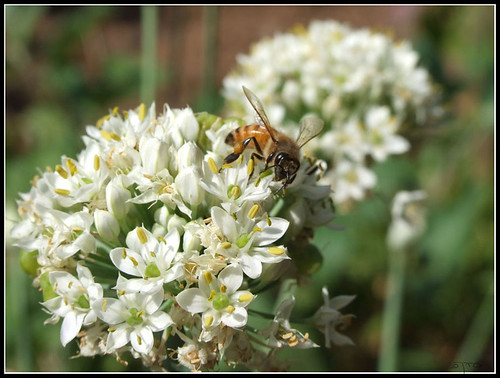
A few mornings ago, as TheGardenLady did her daily walk in the garden to see which flowers had newly opened and what butterflies were nectaring, I was astounded to see the number of bees on many of my flowers. There seemed to be more bees than ever and all were so concentrated on what they were doing, you could tell their lives depended on it.
I am so pleased to be able to meet the bees’ needs. So many of the bees on my flowers this summer have been bumble bees. I like bumble bees because they are excellent pollinators. In fact, bumble bees are among the bees that pollinate most of the flowers. There is a Bumble Bee organization where you can learn about the importance of bumble bees. Bumble bees pollinate but they do not share their honey.
But I love to look for honey bees. My prayer is that scientists will solve the problem of the sick honey bees and that my garden, that never uses chemicals, will play a small part in helping honey bee health. Honey bees pollinate a lot of the food or crop plants AND they give us honey. If you can’t tell the difference between bumble bees and honey bees, check out this Canadian website.
When visiting me this past weekend, my children were excited to see a huge yellow and black spider in my garden. My daughter took the above photograph of the spider.
I have noticed what seems to be a larger than usual number of spiders in my garden. I didn’t know if I were imagining this but learned that because of the earlier hot weather this year, which had the flowers bloom about 3 weeks early, spiders are also in the garden earlier. They are out and about a month earlier this year.
The beautiful, huge yellow and black spider in my garden is an Argiope aurantia spider. This is a beneficial spider that catches such insects as the Asian tiger mosquito, the eastern yellow jacket, the carpenter ant and the Virginia Pine sawfly in its orb web. Unfortunately even beneficials, like the garter snake, do not discriminate between the bad and the good. The garter snake eats some good guys in the garden like the toads and the argiope spider also eats some good or beneficial insects. But the beneficial work it does outweighs the bad, so we have to protect these beneficial insects and beneficial snakes.  For more on the argiope spider read this.
ThisGardenLady was just out raking leaves- not the first time this summer. (In another post, I will write more about the trees on my property that make raking a year round endeavor). Just as I was about to start cursing the trees, what looked like a fresh young Monarch butterfly flitted around in front of me, going from flower to flower, to take me out of my evil frame of mind. It was so fresh looking, it must just have emerged from its chrysalis. This Monarch stayed near where I was raking for quite a long time so that I could enjoy its beauty. Then an Eastern Tiger Swallowtail joined in.
Butterflies are one of the joys of having a flower garden. I do not have as many zinnias in my garden as this YouTube lady has, but you can see how butterflies love zinnias if you watch the video above.
Did you know that the Monarch butterflies on the East Coast of the United States fly to Mexico to over winter? And before they fly over the ocean, these butterflies must fill up with food to be able to make this journey. Watch this video to learn more.
Cape May seems to be the last stop for the Monarch butterflies on that big flight. So if readers want to see this amazing migration stopping point, drive down almost to the tip of the peninsula and island in New Jersey to the town called Cape May Point- 12 minutes south of Cape May. Stop at the Cape May Bird Observatory in Cape May Point. Go to the Cape May Point State Park. In this area there is a monitoring program where people are tagging, counting and now weighing the Monarchs. You might be able to join in. This tagging started on Sept. 1 and will continue through October 31.
I was told that they are seeing huge numbers of Monarchs this summer. If you walk around Cape May Point, you will see a lot of houses with signs that say the house has an award winning garden. You might even see people counting the butterflies in some of these gardens. If the owners are outside, you can ask if you can see what makes the Monarchs so happy in these gardens.
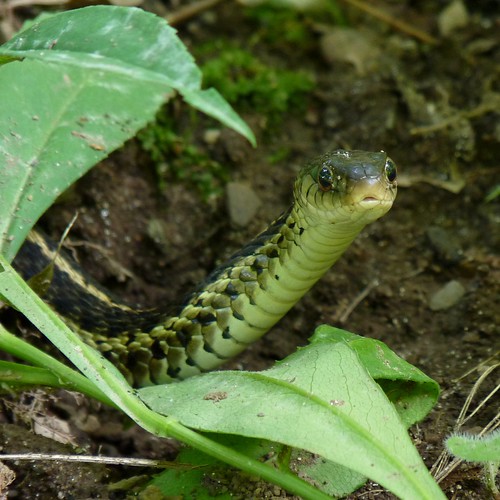
Face to face with a garter snake by Dendroica cerulea
While dead heading Queen Anne’s Lace/Daicus carota plants- a weed that I have loved since childhood so that I allow it to flower in my garden beds- a woman walking by stopped to talk about my garden. Then she asked me about snakes. She was visiting from out of state and her host said that there were snakes living on my property because of the stream. I have written about this stream that dissects my property and have talked about the wildlife that is on my property because of the water. Yes, I assured her, there were snakes on my property. But they were all beneficial snakes. Yes, all snakes bite if they feel attacked. But the snakes that live near me are non-aggressive creatures- they do NOT ever attack people and will never bite unless stepped on, picked up or forced into a corner or threatened with imminent injury. Even then, all snakes would much rather get away than risk a fight. And the snakes that live near me are not very poisonous, dangerous ones.
Outside our office in south Florida we have a planter that is entirely in the shade of an overhang. We have placed plants there and all have died. Can you suggest some plants that would survive and add beauty to building.
Before you plant anything in your planter, check to see if it has drainage holes. Plants MUST have good drainage to survive for any length of time. If there are no holes in the planter, you should either bore holes on the bottom of the container or buy new planters with holes. (see here)
Then use good potting soil. Organic matter is always best. If your office has a gardener maintaining lawns around the building, see if he could start a compost spot for your building to use. This might be a first- creating an office building compost site. You might even be able to compost lunch leftovers in it for a savings to the building. Barring that, TheGardenLady likes to recommend buying soil with slow release fertilizer already in the soil. If you do buy potting soil with fertilizer added to it, check to make sure the bags are not wet and that the potting mix doesn’t look like it has been sitting around a really long time. For adding your own slow release fertilizers to your potting soil, my friends like the Osmocote brand.
There are a few other vegetables or fruit that I want you to consider when creating your vegetable landscape.
One is the tomato- especially the miniature tomatoes, the cherry and grape type of tomatoes. The fruit of these plants look like jewels and come in red, yellow, orange, purple, chocolate, black, white and of course green fruits (see here). Some of these tomato plants bear 100s of fruits per plant- one claims to have over 650 tomatoes per plant- for a spectacular show. Some tomato plants hang down and others are upright. Some are great for container growing.
red small tomatoes by Martin LaBar
Another vegetable to look at for your landscaped garden is cauliflower. Everyone knows that there is white cauliflower. But did you know that Cauliflower comes in yellow and almost orange, green as well as purple heads? (see here) My favorite cauliflower look is the green Romanesco Cauliflower.The shape of the head is unique.
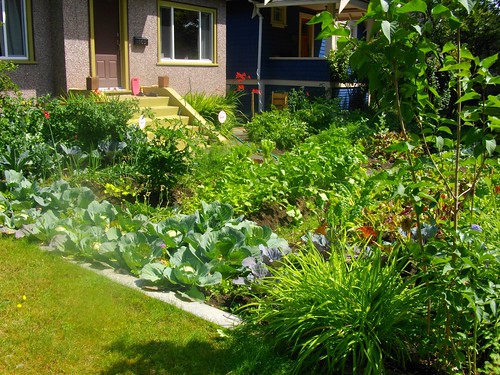
Landscaping a garden in your front yard whether you want to plant vegetables or flowers is enhanced by garden structures, containers and other items. It’s nice to have small garden areas and raised beds outlined with interesting rocks, but the vertical structures add interest to the landscaping and give vines a place to grow or another height for positioning plants.
Now if you are handy and can build your own structures, lucky you- there are lots of online directions. You might also be lucky to know someone who is handy who can build garden structures for you. I saw some wooden structures used for climbing pole beans at a local historical house with garden and museum. Volunteers make these structures. I asked if they would build two for me- the money I will pay for these towers will be a donation to the historical house. They agreed to doing it; but I await the approval from the people in charge.
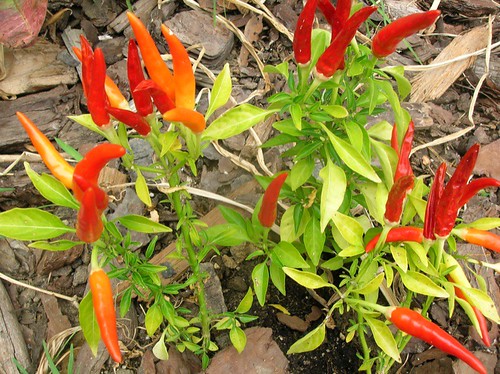
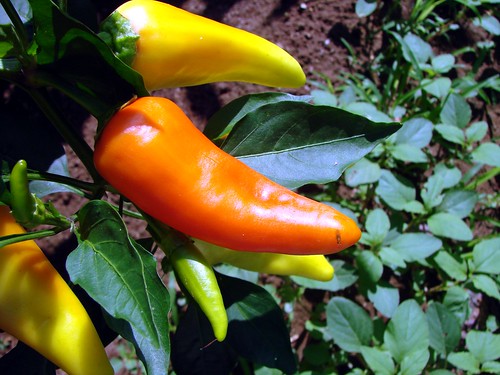
Another vegetable suggestion for the flower garden or the front yard vegetable landscaping is the miniature or the dwarf hot or sweet pepper. Once again the gardener has the choice of the ornamental variety which may or may not bear edible peppers or the edible pepper plants. But why bother with the ornamental pepper when there are so many pretty edible pepper plant options? There is a huge selection of edible pepper plants that have green, red, yellow, orange and almost black peppers that grow against the pretty green leaves of the plant. The shapes of the fruit are varied and can either stand up or hang down. How decorative can those choices be?
Peppers in garden by Martin LaBar
Many plants look like Christmas decorations. Look at this photo of Chili Pepper Prairie Fire pepper . Could any ornamental be prettier?
TheGardenLady received this question from Cat (you can read her blog here).
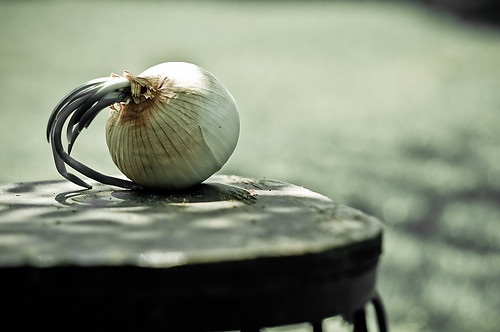
Recently my onions (the ones I bought to eat) decided to demand “freedom†and grow! So much I had to plant them as I was not able to eat them anymore. Some of them didn’t survive too long but one even has a beautiful flower! But I don’t know if they require any extra care? I live on a six floor so right now they are on a pot (a big one) in the balcony. That should do, right?
When you buy onions- Allium cepa is the common onion, squeeze to see if the bulbs are hard. If any onion is soft when you squeeze it, don’t buy it because it will not last long. It will rot or send up leaves as yours did. I often think that when onions are on sale, that is because they are old onions and they are often soft.