Dwarf Crape Myrtles


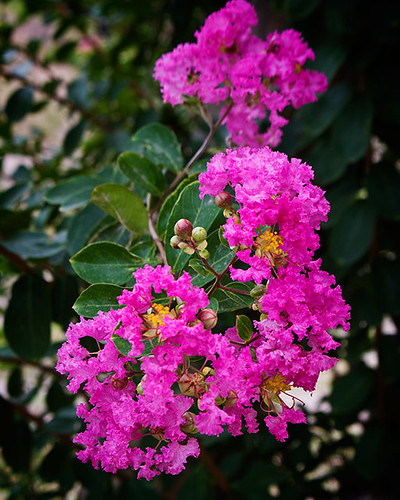
Lagerstroemia Indica (I) by .Bambo.

I love Crape Myrtles Lagerstroemia indica (the American Horticulture Society spells it Crape ) and they love hot weather. With the weather we have been having this summer, they have been in their glory. Another good thing for Crape Myrtles is these dry summers; because once established, Crape Myrtles tolerate some drought. In fact when Crape myrtles were brought to the States from China, they were happiest in the South or USDA Hardy Temperature zones 7 through 9 or perhaps 10 or 11. They didn’t bloom in cooler climates.

Fifteen years ago, I don’t remember seeing many Crape Myrtles in Zone 6. Those few who had them seemed to grow them outdoors in sheltered areas or else they overwintered them in greenhouses. But these days I see Crape Myrtles perennially growing in many yards all over my area. Crape Myrtle breeders had been busy at work creating the Crape Myrtles for Zone 6 so that now everyone in zone 6 seems to have a Crape Myrtle decorating his or her yards.

My Crape myrtle is a baby from a friend who has a Crape Myrtle in almost every color in her small, but very lovely garden. Crape Myrtles have so many seeds from all the flowers, that if you have the right environment, even if you are not a plant hybridizer, you may find new babies in your yard from your main Crape Myrtle.   See here.
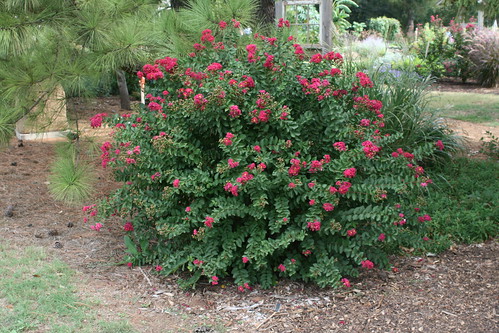
Dwarf crape myrtle by Gardening in a Minute

When I visited my friend’s garden most recently, I saw her newest Crape Myrtle acquisition flowering in her garden. It was a charming dwarf Crape Myrtle!

Continue reading “Dwarf Crape Myrtles”

Nature’s Garden in Ansel Adams Wilderness Area (Photos)

Two readers of TheGardenLady blog are avid hikers who say they are attempting to hike every trail in the Sierras as well as other California trails. Every weekend they try another trail or part of a trail. They love the native flora and fauna they meet or see on these trails as well as the spectacular scenery.

Their most recent hike, on the weekend or August 13, 2011, was in the Ansel Adams Wilderness Area, which is located in the Inyo National Forest (see here) near Mammoth Lakes, California in the Eastern Sierra. Hiking from Agnew Meadows to Thousand Island Lake, where they camped for the night, the trip was an approximately 16 mile loop, taking the River Trail there and returning along the High Trail (aka Pacific Crest Trail).

They sent all the photos that you see on this to share with all the readers.  Enjoy.

Continue reading “Nature’s Garden in Ansel Adams Wilderness Area (Photos)”

Trying to meet the challenges of gardening

NOT ME!! I DID NOT EAT YOUR FLOWERS! by Snap-Smith

Gardening can be a serious challenge for the gardener.  Consider the weather.  Who knows what to do in a profound drought like the one the MidWest experienced this summer? You cannot water plants when the water level goes down too low. Who knows what to do in extensive floods like the ones the MidWest experienced earlier in the late spring/early summer? Consider the insects.  They either go after the garden, like Japanese beetles do, or they go after the gardener, like the mosquitoes or gnats.  Consider the wild animals.  Everyone knows about the problems caused by deer or rabbits.

But we humans are the smart creatures on this earth who should be able to solve these problems. Aren’t we?

We have had dry weather where I live, so I water my flowers daily. I am religious about this job. But the next day after I water my plants, they still look wilted and sad.  I tried holding some basil between my lips as I was told that Italian farmers did to prevent mosquitoes. I wasn’t bitten by the mosquitoes, so maybe the basil helped. And I sprayed my flowers with Liquid Fence to deter the deer and rabbits. But they, too, want what I plant.

Continue reading “Trying to meet the challenges of gardening”

Turkey’s Botanical Treasures

Flower bed at Topkapi Palace, Istanbul by John Picken

In spite of the number of lovely flowers that I have already growing in my garden, this GardenLady always dreams of more flowers. Which ones should I add to the garden when I divide and transplant or give away those that have overgrown their stay? As I have been going through some catalogs deciding on some more bulbs that I want to add to my garden, I realize that so many of my favorite flowers come from Turkey. For example, tulips are native to Turkey as are some of the fall blooming crocuses. See here. Now that Liquid Fence stops deer and rabbits from eating my tulips and crocuses, I am ordering more of both of these bulbs.

When this GardenLady traveled through Turkey in the early 1970s, especially driving through the eastern part of that beautiful country, I was amazed with the number of wild flowers I saw there. They were so many wildflowers, that I decided I would concentrate on seeing how many different flowers of one color that I could find each day I traveled. This was not a difficult undertaking, the wild flowers were so prolific. I had a cup holder in the car and I would fill a cup with a different color of flowers daily.

Though cutting the flowers does not hurt the plants, since this is what one does when one dead heads to encourage more blooms, if everyone did what I did, there would be few wildflowers for others to admire. Though I did this before this type of thing was prohibited, we know better these days and I would never recommend picking wildflowers. I recommend just looking and photographing the flowers. I wished I had a book with me for identifying flowers so I could know what the names of those flowers were. These days, I wonder if there are good books in English on the names of the Turkish flowers.

Continue reading “Turkey’s Botanical Treasures”

More about the farm TheGardenLady grew up on

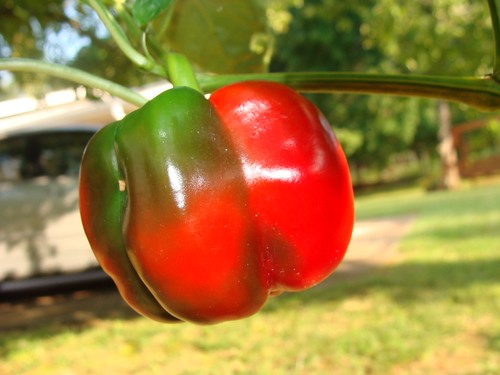
Bell pepper, with both green and red colors, natural color by Martin LaBar

My parents’ farm was small. They raised the usual crops that everyone in the area who wasn’t a chicken farmer raised. And some of the chicken farmers also had small farms that raised the usual crops – tomatoes and strawberries were the basics for sale. These were called truck farms because farmers could truck the produce to the big cities- in our case it was Manhattan or Philadelphia- to try to sell. Or we would truck the produce to the canneries that were in our county. Ritters and Seabrook Farms were the two big tomato purchasers. These companies made ketchup and canned tomatoes.

Canned tomatoes by Unhindered by Talent

There were a lot of truck farms. That was why New Jersey was given the name The Garden State. Competition was fierce so the prices for the harvest was usually low. If everyone raised tomatoes and the season was good, the tomatoes were plentiful and the price the farmer got was low. Those years we had tomato fights. My mother canned a lot of tomatoes.

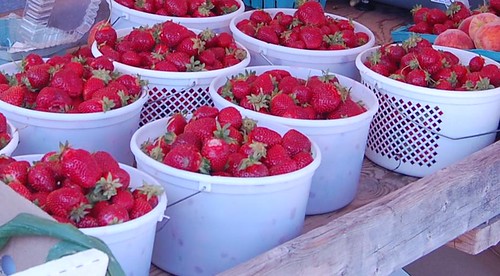
strawberries by Donald Lee Pardue

My mother started her own farm stand. Mostly she sold strawberries and flowers. Neighbors copied her. There were so few cars on the road in those early days that the farm stand did not bring in much money. What little was brought im, though, was greatly needed and appreciated. What didn’t sell became strawberry jam.

Continue reading “More about the farm TheGardenLady grew up on”

TheGardenLady’s Parent’s Farm

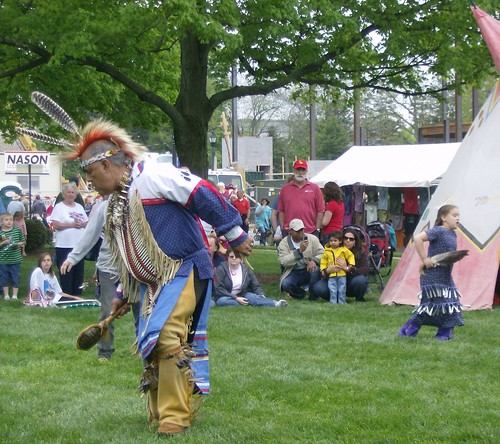
Lenni Lenape dancer by impulse2c

As a child, I wished I knew about the original people who lived on the land that my parents’ farm was on. I wanted to know about the Lenni Lenape Indians that preceded my family to that area. But there were few books in our local library- and very few books on the Lenni Lenape.

I spent many hours of my childhood poring over the ground looking for Indian artifacts. Findings were best after the fields were plowed. It seems that each time the field was plowed it turned up more Indian artifacts. My sister and I, trailed by the family dogs, would slowly go up and down the field looking. We children found lots of flint and arrowheads or pottery shards. (sadly my collection was stolen when I took it to school) We also found clam shells. The closest clams were about one hour drive away from the farm, yet there were clam shells in the fields. So I imagined that the Indians had Pow Wows where they ate clams. But what else did they eat that they found in the area where the farm was?

Continue readingTheGardenLady’s Parent’s Farm”

Growing up on the farm

TheGardenLady’s House on the Farm

We were poor when I was a child growing up on the farm. But so was everyone else in my community and the surrounding communities, so no child felt the poverty. That was how things were. Yet my parents worked hard. Hard physical labor. Especially my mother, who not only worked in the fields and had a small dairy that she took care of by herself, she had two small children at the time and took care of the house.

TheGardenLady’s Mother

My parents worked hard so that we always had food on the table. All summer we had an abundance of fresh fruits and vegetables and for the rest of the year Mom canned everything. No one had a freezer. The cellar was a dirt hole so it was cold like a root cellar. Foods like potatoes and onions could last a long time down there. And the shelves around the walls were filled with Mom’s canned food in glass jars. The jars looked as beautiful as any stained glass window any artist created.

In spite of all this labor, Mom loved flowers. I never thought to ask who planted the roses, the spirea bushes, the deutzia bush, the ornamental quince bush, the yucca, the apple tree, the lilacs, rose of sharon bushes, the gooseberries, weeping willows and other shrubs and trees that surrounded the house- they were just there. Yet this was a question I regret not having asked.

You see, my parents were the second family household to ever live on the farm. Before that the land belonged to Native Americans. The Leni Lenape Indians lived in New Jersey. And they must have spent time on the property that eventually became our farm. We bought the farm from a family who must have somehow bought it from the Leni Lenape- I wish I could learn more of that history.

Continue reading “Growing up on the farm”

What’s Happening in TheGardenLady’s Garden

Pink Crape Myrtle by BFS Man

Since it is so hot outside, it is difficult even for TheGardenLady to want to be out among my flowers. I do spend a few hours daily watering the flowers, so I am out either early in the morning before or just when the sun comes up or close to eight in the evening when the sun is going down. And it is then that I admire my flowers. What is especially pretty now?

I think the Crape Myrtles- Lagerstroemia are stunning right now. Mine is almost completely covered with flowers. Since my crape myrtle is the shape of a shrub, not a tree, I have flowers from the bottom all the way to the top.

Next to the Crape Myrtle, my Brugmansia is starting to show off. I counted ten trumpet-sized flowers open this morning. Since I give away rooted branches in the fall, I try to keep in touch with the babies. One grandchild of my Brugmansia has been blooming its head off for its owners. Only about 3 ft. tall, it has been having at least 18 flowers at one time. Its owner gives it lots of Osmocote – which seems to be the brand of fertilizer that many nurseries seem to use.  See here.

Continue reading “What’s Happening in TheGardenLady’s Garden”

Climbing Hydrangea

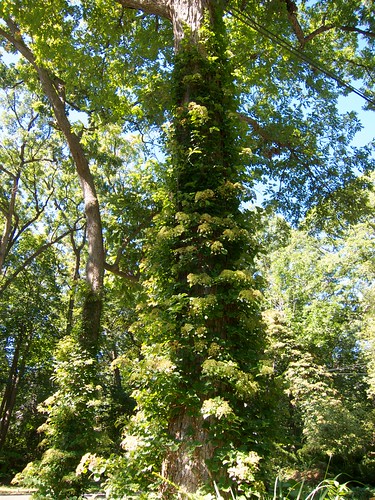
Climbing Hydrangea Vines by beautifulcataya

When the TheGardenLady was asked for the name of a good vine to grow along the wall of a house, my first suggestion was to check the amount of sunlight that side gets. Depending on the amount of sunlight will determine the vine you want to choose. Also, it would be wise to have a soil test of the area where you want to plant anything. The concrete from the base of the house might leach into the soil to change the pH making it very alkaline. This might not affect the plant you want; but it is best to be sure.

My favorite vine for shade is the climbing hydrangea, Hydrangea anomala petiolaris.  See here.   This is a vine that will grow even in a northern exposure though it likes some sun or dappled sun. It grows in zones 4 or 5 and warmer. It will grow in full sun, too but in the Deep South and in western Zones 9 and 10 it needs shade in the afternoon.

Continue reading “Climbing Hydrangea”

On Weeds

Purslane by A. Drauglis..

TheGardenLady has not spent much time writing about weeds. But weeds are something that TheGardenLady spends a lot of time pulling as well as thinking about. (I have read Weeds of the Northeast by Richard H. Uva. )

Whenever I pull the wild purslane- Portulaca oleracea or the Lamb’s Quarters -Chenopodium album or any of the other edible plants that are considered weeds like chickweed- Stellaria species or dandelions-Taraxacum officinale and toss them, I feel really guilty. I know I should really be harvesting these plants not composting them, even though composting means I am recycling these plants.

I have eaten purslane, a popular healthy green used a lot in Middle Eastern cooking.  And one time, I did want to try to make some dandelion wine since I grew up near the Dandelion capital of the world, Vineland, NJ.

Continue reading “On Weeds”