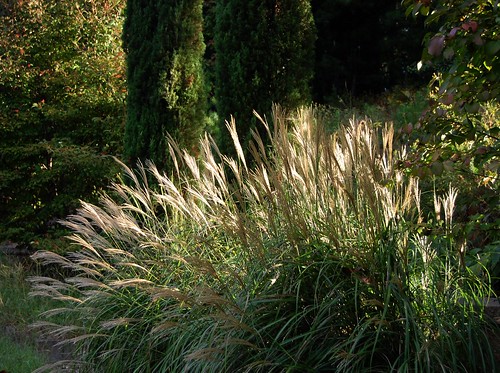
Miscanthus: Ornamental Grasses

More Miscanthus in Our September Garden by UGArdener

TheGardenLady received this question from Joanne.

I am looking for a maintenace free ornamental grass. I need it to be about 4′ in circumfrance and about 7′ tall.  I live in zone 6 in connecticut. I don’t know what to buy. I have partial sun.

This year ornamental grasses seem to be having a great year. I just visited Grounds for Sculpture where they seemed to be dancing in today’s wind.

I am not sure what you mean by maintenance free. There is really no plant that is completely maintenance free, but grasses do require little effort to maintain. Some of these grasses have to be cut back when the new shoots are emerging or if the plant flops over.

You do not tell me how much sun you mean by partial sun or if the area for the grasses is for a dry or moist site.

Since you live in a cooler zone than some grasses like and since you do not have full sun, TheGardenLady thinks you should check out the grasses that are in the Miscanthus family.

Continue reading “Miscanthus: Ornamental Grasses”

Now is a Great Time to Plant Azaleas

‘Autumn Sunset’ and ‘Autumn Embers’ Encore Azaleas by pawightm

Fall is an ideal time to plant azaleas as well as Encore Azaleas! See here.

Plant azaleas as well as Encore Azaleas in fall to enjoy flowers until first frost and allow time for roots to establish without damage from extreme temperatures. In some areas, summer can be too hot to make planting azaleas fun, while fall is just right. Also, plants may appear dormant during winter, but they are working hard at creating stronger roots and new flower buds for spring.

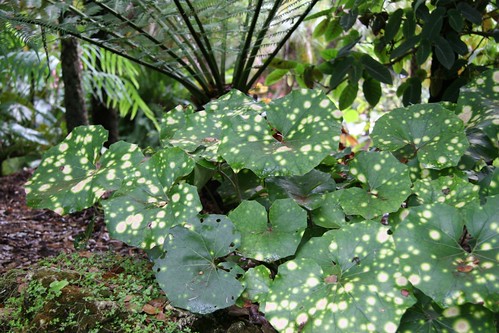
Farfugium – Giant Leopard Plant

Farfugium japonicum cv. Aureo-maculata by brewbooks

TheGardenLady received this question from Jane.

We live in Zone 7 and have just this summer planted a giant leopard plant – farfugium. We are wondering if we need to bring it in for the winter or just cover it with mulch. If so, how much mulch?

TheGardenLady has Ligularia growing in the garden. This name was difficult enough to pronounce but now the Latin name has changed. Now we have to remember that the new Latin name is Farfugium– though websites and many nurseries still refer to the plant as Ligularia.  See here.  Very confusing, isn’t it? Anyway, if readers have this plant and have been told it is called Ligularia, you can tell people its new name. Or if you want to buy this plant, refer to it with both names in case the salespeople don’t know that it is now Farfugium when it is being sold. So to this questioner, congratulations that you know the name it is now.

If your giant leopard plant is indeed Farfugium japonicum ‘Aureomaculata’ it is supposed to be hardy in Zone 7 so you should not have to bring it indoors for the winter. (Different farfugium have different temperature zone needs and the common name of different farfugiums can be leopard plant – thus you should have the entire Latin name; for example, the japonicum tells that it is from Japan. Others originate in China, Taiwan or Korea. Knowing where it is from helps in knowing the zone it grows best in.) You would keep the less hardy farfugium in pots as you would keep Farfugium japonicum in pots if you were raising it in zones 1thru 6.

Continue reading “Farfugium – Giant Leopard Plant”

Pruning Hydrangeas


Hydrangea by Eric M Martin

TheGardenLady received this question from Mary.

Last month I planted a hydrangea plant and it has 8 blossoms on it. Can I cut the blossoms off now, and will it affect the growth next year? Or should I leave it alone?

The choice of cutting the blossoms or leaving them on your hydrangea plant is up to you. Either way is fine for the plant. If you decide that you want to cut the blossoms off now, it is ” safest to remove them with very short stems so you won’t disturb any developing bloom buds for next year. As long as you cut above the first set of large leaves, the blooms will be fine. ” Read this good website for pruning hydrangeas. Deadheading, which is what you do when you remove blossoms, is a type of pruning.

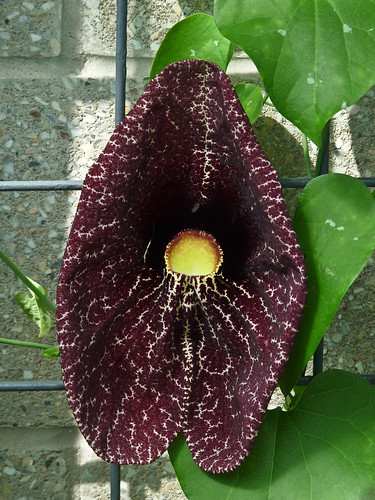
Aristolochia: Dutchman’s Pipe Vine

Dutchman’s Pipe by annkelliott

TheGardenLady received this question M’Lourdes.

I would very much like to know the name of a delicate climber I was given [photo above].  Can you please help me identify this climber?

This plant has three common names, calico flower, pipe vine or Dutchman’s Pipe Vine.The Latin Family name of this plant is Aristolochia. There are over 500 species in this family. See here.  Most of them seem to have the common name Dutchman’s Pipe Vine.

Since you did not mention where you live or your temperature zone you have either Aristolochia (elegans) littoralis (The Latin species name seems to have also changed.) Or you have Aristolochia durior.

Aristolochia littoralis grows as a perennial in zones 8-10. Aristolochia durior is a perennial in zones 4 to 8. To see some of the many Aristolochia you can buy them here.   (There is another Aristolochia that is also called Dutchman’s pipe or Wooly Dutchman’s pipe that will grow in temperature zones 5 to 8. It is Aristolochia tomentosa but its flower is different from the photos you sent. See here. )

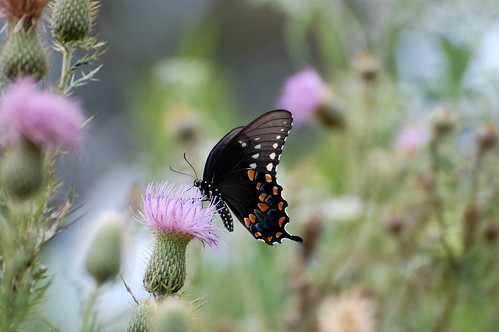
These pretty vines are not too well known and are really quite exotic looking. They seem fairly easy to raise so long as you have the one that grows in your temperature zone. They don’t seem to have many pests or diseases and if you have Aristolochia durior, they attract and support the pipevine swallowtail butterfly.  See here.

Pipevine Swallowtail Butterfly by † David Gunter

Upcoming Gardening Events

StoneCrop Gardens 152 by jon.trimble

TheGardenLady has received some notices of events that might be of interest to readers of TheGardenLady.org blog. As they are received, I will try to let you know what is happening so that you can mark your calendar and plan ahead.

Carolyn’s Shade Garden is having an open house this October 9th at her nursery at 325 South Roberts Rd, Bryn Mawr, PA Telephone: 610-525-4664 She has some lovely plants for sale. Contact her for more information. Her garden alone is worth the visit.

Central Ohio is having their 56th Annual Home and Garden Show on Feb. 26th. If you are interested check out this site.

Stonecrop Gardens in Cold Springs, NY (see here) will have their 4th annual Alpine plant sale in the spring- probably early April. If you are interested in Rock Gardens and plants for the rock garden or just love alpine plants, it seems that Stonecrop Gardens is one of the foremost gardens in the US for these plants so that the Rock Garden Society of America has their alpine sale there. And the Stonecrop Gardens are wonderful to visit even if you don’t buy plants. More information will come about the date when TheGardenLady learns which weekend is chosen for this event.

“The Earth Laughs in Flowers”

garden poem by julie@organikal

TheGardenLady not only loves gardens, she loves poems and quotes about gardens in poetry and literature and philosophy.

Do you know Afternoon on a Hill by Edna Vincent Millay?

I will be the gladdest thing

Under the sun!

I will touch a hundred flowers

And not pick one.

Or how about I Wandered Lonely as a Cloud by William Wadsworth, one of TheGardenLady’s favorite poems.

I wandered lonely as a cloud

That floats on high o’er vales and hills,

When all at once I saw a crowd,

A host, of golden daffodils;

Beside the lake, beneath the trees,

Fluttering and dancing in the breeze.

Continuous as the stars that shine

And twinkle on the milky way,

They stretched in never-ending line

Along the margin of a bay:

Ten thousand saw I at a glance,

Tossing their heads in sprightly dance.

The waves beside them danced; but they

Out-did the sparkling waves in glee:

A poet could not but be gay,

In such a jocund company:

I gazed—and gazed—but little thought

What wealth the show to me had brought:

For oft, when on my couch I lie

In vacant or in pensive mood,

They flash upon that inward eye

Which is the bliss of solitude;

And then my heart with pleasure fills,

And dances with the daffodils.

Gardening friends always say that gardeners are the nicest, happiest and most content people. Maybe it is because “The world is mud-luscious and puddle-wonderful ” as the poet E.E. Cummings, (1894-1962) is quoted as saying. The author Ralph Waldo Emerson said that “The earth laughs in flowers” so no wonder gardeners are nice and happy – surrounded all day with laughter. When in our gardens, we gardeners are with beloved friends, as the famous Persian poet Saadi of Shiraz, Iran says “Leaves twinkle, flowers like persons be, And life pulsates in rock or tree.”

The first written mention of a garden is in the bible – the Garden of Eden, a most delightful garden. Our gardens are our present day Gardens of Edens. The Hebrew meaning of the word Eden translates to mean delight.  See here.  And the Koran describes Heaven as [sura 56:12] in the gardens of bliss.

In our gardens we can meditate even if we don’t have a zen garden.  See here.   And even when asleep or in winter the joy of flowers remain in our thoughts to bring us joy, as the poet William Wordsworth wrote.

We gardeners are so lucky. I don’t think there is anyone who doesn’t love a garden – as shown by all the wonderful quotes by famous writers, philosophers, poets, theologians, artists, etc.  See here.

Do you have a favorite quote, poem or short story about flowers or gardens? If you do, please share them with TheGardenLady readers.

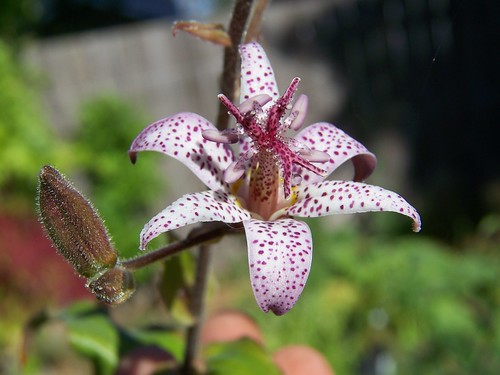
The Toad Lily

Toad lily (day 56) by Photo Munki

Another plant growing in the shade in the garden in Bryn Mawr, Pa, that I believe was also bought from Carolyn’s Shade Gardens, was the Toad Lily. What a strange common name for such a pretty flower. The Latin name is Tricyrtis . The owner of the garden when showing me around told me to look at her Solomon’s seal. It was an interesting mistake because both plants have arching stems and when you take a superficial glance at the leaves, the Toad lilie’s leaves are arranged similarly to the Solomon seal’s leaves. But the flowers are so different, once you see each, you would never mistake the two plants. The Solomon seal flowers in Spring and early summer and are inconspicuous bells but the Toad lily blooms at the end of summer into early fall and are showy and delightful. Some people say the flowers look something like orchids.

There are different varieties, some having white or yellow flowers, but most have flowers that have purple spots or blotches on a white background.  See here.  Some will grow in zone 4 but most will grow from zone 5 through zone 8 though some will grow in zone 9.

This low maintenance plant, the Toad Lily, enjoys the same shaded area and woodland soil and lighting and has similar requirements to those that Begonia grandis has, though it can tolerate drought a little better than the begonia. My trout lilies have buds but they have not opened yet, I think because of the drought we have had.

If you have a shade garden, once you see this delightful plant, you will be smitten.  See here.  You can buy the plant or you can buy seeds and plant them in your garden.  See here or here.

Begonia Grandis

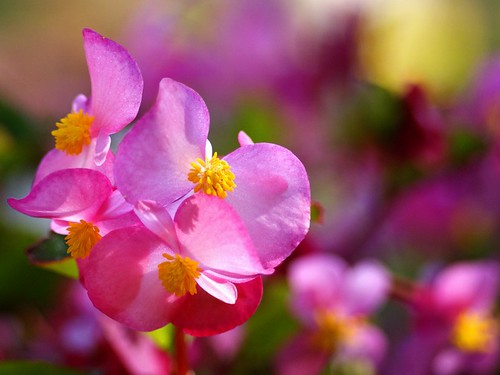
ベゴニア/Begonia grandis by nobuflickr

This past weekend TheGardenLady visited a lovely garden in Bryn Mawr, Pennsylvania. The owner wanted to show me what she had in bloom. Under the trees in the shade and growing in the pachysandra were her hardy begonias – begonia grandis. She especially wanted to show off these plants that were now in flower because she had learned about Carolyn’s Shade garden from the TheGardenLady’s recommendation. This is where she bought these begonias as well as all her other healthy shade plants. And these hardy begonias were not only hardy because they overwintered but because when they are happy and they were so happy in her garden that they are popping up all over. And the flower display was so lovely – flowers with the bonus of a light fragrance.

TheGardenLady had always loved begonias and was familiar with annual begonias, Rex begonias and tuberous begonias but it was only a few years ago that I learned that there was a hardy begonia that would overwinter in zone 6. This was when a friend gave me a baby begonia grandis plant. This plant grew in my garden for a few years but this year’s drought killed it. I am so sad and plan on getting another next year.

Begonia grandis originated in East Asia – China and Japan and is the most cold hardy of all the begonias. It grows as a perennial in temperature zones 6 through 9. In zone 5 it is considered a tender perennial which means that it might survive with a good covering of mulch but you would be safest to take it indoors for the winter. Hardy begonias bloom in late summer and autumn and will propagate itself by seed and bulbils formed in the leaf axils. The plant grows about 2 feet tall and likes part to full shade – it does not really want afternoon sun. It tolerates morning sun and this allows you to see the red veins in the leaves. Begonia grandis seems to tolerate all soil types but likes woodland soil best and tolerates all pH levels though it prefers neutral to slightly acid soil with good drainage and average watering. It can be used as a ground covering.

Continue reading “Begonia Grandis”