Monochromatic Gardens: Creating an Orange-Themed Garden

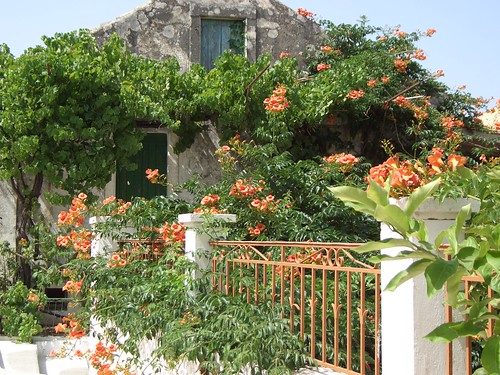
Orange flower garden by happysoul81

Anne in Chicago had once asked me what plants she should use in her front yard. Because I knew that orange was her favorite color, I gave her a list of orange flowers that bloom throughout the season that she might like to try. I thought it would  be exciting for her to create an orange garden.

I suggested orange Hemerocallis fulva aka Day lilies, Orange Asiatic lilies and other lilies like the Tiger lilies,  geums, orange zinnias and marigolds, orange Lucifer crocosmia, even orange roses like Livin’Easy, one of my favorites, or Arizona – there are a lot of orange flower choices.

Anne’s husband isn’t that fond of a one color theme for his flower beds so my list was never used.  I am disappointed that it was never used. I think an orange garden would have been Hot, Hot, Hot. I wish I had enough sun on my property to have an orange themed garden.
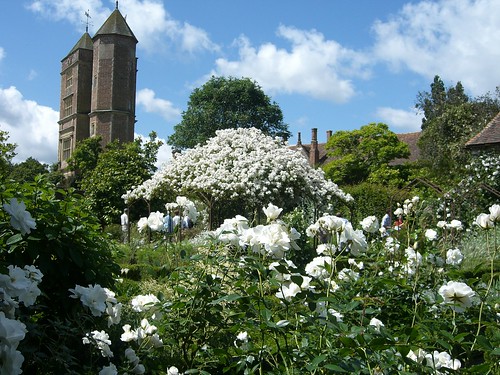
White Garden, Sissinghurst by pillager

People have designed monochromatic or one colored gardens. I visited a garden in Holland where the owner had only yellow flowers in it. A one color themed garden that has a worldwide reputation is in England and is called Sissinghurst. See here.   You must understand that the Sissinghurst garden is NOT an orange garden.  It has only white flowers. But Vita Sackville-West may have been the first person to create a one colored garden. And the Sissinghurst white garden is lovely.

But I have never seen an all orange garden. Perhaps TheGardenLady readers know of one. Of course, if one doesn’t like just orange one can add other colors to the orange garden palette, colors like yellow, red, green and even white would still be hot.

Back to the orange theme. Besides the orange plants that TheGardenLady had recommended that were mostly nonnative, there have recently been new hybrids of a plant that is native to the prairies; so they would be great in the heat of Chicago as well as the rest of the country that is suffering from this heat wave. In fact one of the two main breeders in the United States is the Chicago Botanic Garden, the other is Saul Brothers of Atlanta, Georgia so you know these plants will tolerate heat – up to Zone 9.

These plants thrive in harsh climates and once established they are drought tolerant.  However they will grow in cooler Zones 3 or 4 .They are easy maintenance plants, disease resistant, deer don’t like them, they have a very long summer bloom time – sometimes more than 3 months – with big showy flowers that can  be up to 5 inches – and some say they have  some fragrance. These plants like  well-drained, preferably dry soils in raised beds with average to low nutrients. (TheGardenLady’s are not growing in raised beds.)  Butterflies, bees and hummingbirds love them.
Continue reading “Monochromatic Gardens: Creating an Orange-Themed Garden”
Can You Eat Vegetables Grown Near Agapanthus?

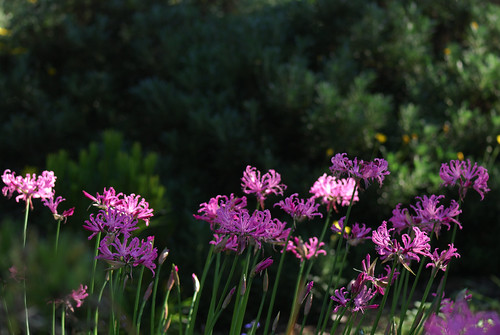
Nerine bowdenii by Eric in SF

TheGardenLady received this question from Zanele.

Is it safe to eat vegetables grown near the roots of agapanthus? I have green beans growing close to agapanthus and am wondering if it is safe to eat them.

This is a very interesting question. All the websites do speak about the sap, bulb and the roots of agapanthus  as capable of causing stomach problems and skin dermatitis.  See here.

TheGardenLady did not think that there would be a problem but did not think she was enough of a poison specialist to say this without consulting an authority. So I phoned the US Poison Control number  which is 1-800- 222 -1222.

The person with  whom I spoke went on his data base. His first question was “what color is your agapanthus?” This was not mentioned in your email. The more toxic agapanthus is the pink agapanthus Nerine Bowdenii. The person I spoke to seemed to say that it was the bulb that was the really toxic part of Nerine Bowdenii.

He did not feel that the other agapanthus would cause more than stomach problems. And from his database,  he did not think any of the toxins from any agapanthus would enter into another plant. So he felt that your green beans were safe to eat.

I always err on the side of safety. I would wash and eat one. You will see that you are fine so then you can go ahead, wash the rest thoroughly, prepare them as you like and enjoy your harvest.

A list of the relative toxicity of all plants is here.

Royal Horticultural Society Garden Hyde Hall Flower Show: Aug 13-15, 2010

Blue stemmed thistle – RHS Hyde Hall by Scootzsx

Are readers of TheGardenLady blog going to be visiting England this month or do you live in England? Lucky you! because you have the opportunity of attending the RHS Garden Hyde Hall first-ever flower show this August 13 through the 15.  See here.

It sounds fabulous. Besides the displays there will be experts answering questions, plants and shrubs for sale besides garden items for sale. Wish I were there. If you attend, could you send TheGardenLady some photos and write something about what you thought of the show?

While at the show, if you have any time, you can also explore Hyde Hall which is a 360-acre estate with a diverse range of self-contained garden areas.  Because Hyde Hall is located in one of the driest places in England, a highlight is their Dry Garden featuring more than 4,000 plants representing 730 species and cultivars, developed to promote sustainable gardening techniques.  With the drought in so many parts of the globe this summer, it would be interesting to learn what Hyde Hall recommends.  TheGardenLady would love to know what is included in the 4,000 plants in this Dry Garden other than cactus.

How To Decide On Whether to Grow these Kmart Plants Outdoors

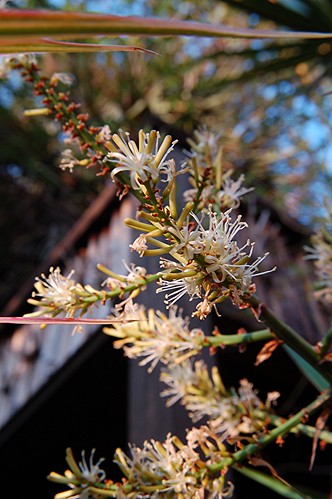
Dracaena marginata blooming by our Bamboo Gate by jungle mama

TheGardenLady received this question from Luella.

I bought some plants from Kmart a few weeks ago and I was wondering if I could plant them outside. I have a mother-in-law’s tongue, a drac marg (whatever that is), and what I believe is a rubber tree.

You did not tell me where you live for TheGardenLady to know if you can grow them outdoors. The plants that you bought do not tolerate any frost or snow or they will die. Since you bought them at Kmart, I imagine you live in an area that cannot grow them outdoors. All three plants that you bought are considered ornamental indoor plants in most of the continental United States.

Dracaena marginata comes from Madigascar. If you live in the plant hardiness zones 9 and 10 you could grow it outdoors.

The rubber tree, also known as a Ficus elastica, will grow outdoors in  hardiness zones 10 or 11. Hawaii is in these zones. In a pot, the Ficus remains manageable but these plants can become really huge trees that can grow up to 50 feet tall.  So even if you lived in a zone where the Rubber Tree would live outdoors, I doubt that you would have enough land to grow such a large tree. But don’t worry about its getting too big in your house. When grown in a pot the Rubber tree should only grow about 10 feet tall.

If you live in California and some other hot areas of the US, you might be able to grow the Mother-In-Law’s Tongue plant, Sansevieria, outdoors. You need to live in Plant Hardiness Zone 8 or higher.

Check the Hardiness Zone you live in to see which plants you can grow outdoors.

Even if you can’t plant these three plants outdoors permanently,  know that during the hot summer months you can take all three plants outdoors in their pots.  They love hot weather.  But you must bring them in before the first frost or they will die.

Don’t Expect Delicious Avocados If They Have Been Grown From Seed

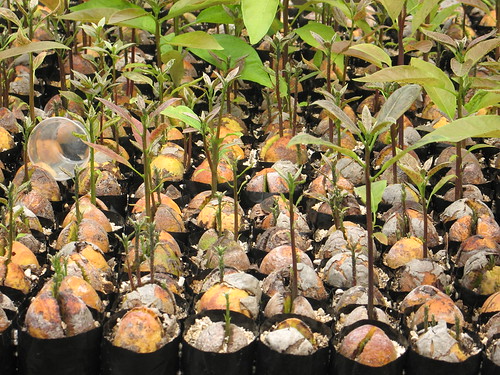
Avocados growing from seed by joeesabol

Jonathan from California has an avocado tree growing nicely in a pot on his deck.  He asked if this avocado tree that he has raised for many years from the pit of a delicious avocado he used in a salad will ever bear fruit if he were to plant it in a garden.

Sadly, Jon, the answer is probably not and if it does produce fruit, you might not want to eat it. “Avocados grown from seed rarely produce fruit before 8 – 10 years, and such fruit may be of poor quality. Commercial avocado orchards are planted with budded or grafted trees of named varieties of known fruit quality.”  See here.

So enjoy your avocado tree as a house plant.  If you do get a garden large enough to grow an avocado tree, buy a grafted one that is guaranteed to produce delicious avocados. But you have to have a fairly large garden because avocado trees can grow quite large and have large strong roots.  See here.

Affecting the Color of Endless Summer Hydrangeas

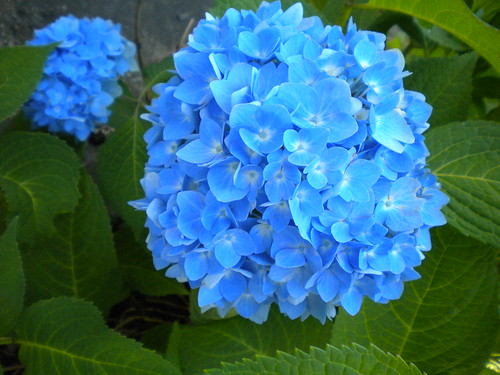
Endless Summer Hydrangea by geekstogardeners

TheGardenLady received this question from Kathy.

I live in Fenwick, Old Saybrook and have always had a yard full of beautiful, brilliant blue Endless Summer hydrangeas. However, this year is the exception!! I have tried deadheading since the blooms are  overly abundant but the color is still lackluster, pale blue.  I have tried adding hydrangea acid based fertilizer and watering with the hose daily.  Any suggestions?

First of all you should check the pH of the soil where the hydrangea is growing. If your soil is highly alkaline, you will have problems maintaining the blue flower no matter what you do. The pH of the soil should be 5.2 to 5.5.  Sometimes if your hydrangeas are planted near cement, like a sidewalk, the alkaline can leach into your soil. And sometimes your water is alkaline. Get test strips to test the water and the soil, or have the soil in your hydrangea garden tested at your state agricultural extension or through your local Master Gardener office.

If you have the proper pH, next Spring, water the plants really well and then add a solution of 1/2oz (1Tbsp) aluminum sulfate to each 1 1/2 gallons of water and feed this carefully to your plants- it can burn the roots. This should be applied in the spring when you see the buds forming- about 6 weeks before the flowers come.

Readers who have new hydrangea plants should NEVER use aluminum sulfate until your plants are about 3 years old. The addition of the aluminum sulfate seems to be the most reliable method of keeping the hydrangea flower blue.

It is good that you used a hydrangea fertilizer that is high in potassium. But most authorities do not think that this will help change the color.

An excellent site that goes into details of how to keep your hydrangea blue or pink is this.

Pest Problems Related to Indoor Plants

Mealy bugs by mpshadow2003

TheGardenLady received this question from Ben about pests problems with indoor planting.

I know you have answered a few questions on dormitory planting before, and I have settled on starting with an Aspidistra and branching out once I’m comfortable with what seems to be a relatively easygoing plant. I’m simply looking to spruce up my room aside from the obvious posters and lights, so a plant and a small fish tank are on my to-do list this summer.

However, no one seems to address any kinds of pest problems related to indoor planting. Are there any major bug issues I should watch out for when dealing with dorm room plants? I have a room to myself as a Resident Advisor next year, so a south-facing window sill will be available year-round in Midwest temperate weather.

I like to keep the window open during the day so stagnant air should not be a problem, but I worry that circulation will increase the risk of infection either to or from the plant(s).

If I have missed anything or made some kind of gross assumption, your input would be much appreciated. Thanks!

You want to be prepared. Though you are correct to be concerned about raising plants indoors, most people have plants indoors and get away without serious problems. Raising plants indoors would not be such a popular hobby if there were that much to worry about.

Since all living organisms can have problems, I hope you are aware that fish can have health problems in their tank.  I remember how sad we were when our fish developed a disease known by its abbreviated name, ich.  We knew something was wrong in our first aquarium when we saw all those white spots on the fish. But raising fish is still popular and fun. You just have to be vigilant to see that everything in the tank is healthy.

Continue reading “Pest Problems Related to Indoor Plants”

‘Tis the Season for Plums

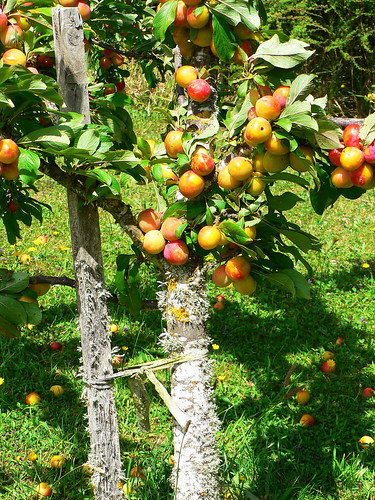
part of the plum tree by Brenda Anderson

I love a good plum.

I remember when my father planted a plum tree that was supposed to have 5 different types of plums on one tree.  We couldn’t wait for that first year’s harvest. I don’t ever remember 5 different types of plums on the tree, that was a bit of a disappointment. But I do remember that there seemed to be more than one kind of plum on the tree that first year. And they were delicious. After that first year I only remember one type of plum on the tree and the yield was always sparse. But l  always loved plums and couldn’t wait for the plum tree to have fruit. And I have always loved plums after that.

Plums were the right sweet tart for my tongue and the skin was smooth, not furry.  My mother rarely bought fruit at the market- if we didn’t harvest our own fruit, we didn’t buy fruit because we were so poor. Except for Italian prune plums, which I still buy if I see them. But the bought plums were never as good as the plums on our plum tree.

It is plum season in California where we get so many of our wonderful plums. The season is really just beginning. People refer to plums as stone fruit. I had never heard this expression applied to fruits with pits until my son moved to California.

I try all the different plums as they arrive in my supermarket, but my favorite is one that has smooth and almost black skin and the pulp inside is purple as well. I wish someone would  tell me which plum this is.My son in California, who also loves this plum, says it is the Santa Rosa plum. But the information I see is that Santa Rosa plums have amber flesh.  See here.   Can anyone tell me what is the name of the plum that has the purple pulp that is so heavenly? Is it a variety of the Santa Rosa plum?

Continue reading “‘Tis the Season for Plums”

Eggplant Problem

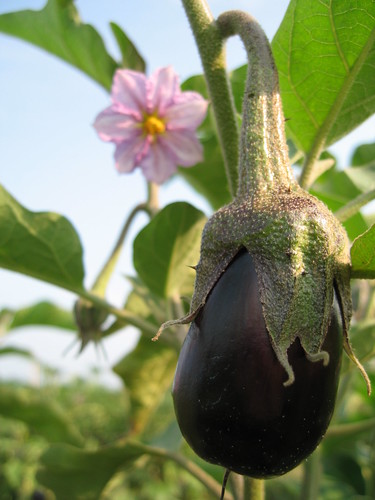
Eggplant by Gare and Kitty

TheGardenLady received this question from Terri.
Why does the eggplant blossom dry up instead of producing a vegetable?
Though eggplants like hot weather, they do need good irrigation. Your eggplants should have been planted in a warm spot facing south, and near a water supply. The soil should have been a soil that drains well and is high in organic matter. Soils that dry rapidly, pack, cake, or crust are not desirable. Irrigation is essential during the eggplant’s long growing period. Excessive dry periods like we are having this summer can cause eggplants to lose the flowers.  See here.  Eggplants have fairly deep roots that have to receive water. The amount of irrigation water you need also depends on soil type and growing conditions. See here.


Caring For and Identifying a Bonsai Tree

Japanese White Pine Bonsai Tree (Pinus parviflora) by Steve Greaves

TheGardenLady received this question about her Bonsai tree from Judy.

I just bought a Bonsai tree which has needles and not leaves and I am not sure what kind it is. How can I tell the type it is? Also I would like to know, when watering do I water at the soil or water from the top to get the needles wet?

There are so many evergreen trees (trees with needles) that are made into Bonsai trees that without a good clear photo of the needles, it is impossible to tell what type of tree you bought. TheGardenLady attempted to bonsai what is known as a red cedar tree but is really in the Juniperis family. It was used because it is supposedly an easy tree to learn how to make a bonsai. Yours might be a juniperis because it is also one of the cheaper evergreen trees.  See here.

Without seeing your Bonsai tree, no one can guess what kind of tree it is. Most stores selling trees usually tell you what type of tree it is. Also, the store should have given you instructions on the care, which includes watering of the tree. If this is a reliable store, you should go back to the store if possible to get the type of the tree and at least basic care information, including watering information.

If you were sold a true bonsai, you should treat it like a tree, not a plant because true bonsai are not really indoor houseplants. It should be kept outdoors all year round. TheGardenLady thinks this is a fairly difficult plant to maintain for a beginner. Most die because of improper care, especially improper watering.

Please read this link for information on the care of Bonsai. Evergreen Gardenworks tell you that when you water, the plants must be watered thoroughly when they become slightly dry. You must test the soil to see if it is dry by sticking your finger in the soil. Watering should be done from the top (of the soil), not by submerging the plant, and the bonsai should be watered until they are saturated. You will see water pour from the drain holes when they receive enough water. This method of watering helps to prevent salt buildup in the soil. Since you will be leaving the plant outdoors all year round, it will get some rain as well. In times of drought you may have to water more than once a day. You can bring the Bonsai tree indoors when you have company or to admire its beauty and then return it to the outdoors.

People who are really bonsai enthusiasts take care of them like babies, some even taking their bonsai trees on vacation with them to be sure that they get the proper care