Advice about Moss Gardens

Moss Acres

TheGardenLady received this question from Bob on her post “Create a Moss Garden”.

Any suggestions for keeping weeds out and killing the new ones? Will broad leaf weed killers harm moss? Any feed suggestions other than buttermilk?

One of the best resources for technical support on raising moss is Moss Acres. Their website is this. It’s one of the best sites this GardenLady knows about for buying moss and learning how to raise moss. I contacted Moss Acres with these questions.

First one should check the pH of the location where you want to have your moss garden.  For success the pH  should be between 5.0  or lower and  6.0  Any higher a pH number and you are asking for trouble.

Buttermilk helps but if the soil doesn’t have the proper pH, the soil for the moss can easily be amended with liquid sulfur or aluminum sulfate that is sold by Moss Acres to lower the pH to the desired range.

Moss Acres tells you to get rid of weeds BEFORE the weeds set seed. If the weeds you want to pull are tall you can carefully use a weed whacker.  See here. Just be careful to  whack only the weeds, not the moss.

Early in the year you can try using Preen vegetable garden organic preemergent weed killer. Once the weeds emerge it is too late to use Preen.

If weeds do come up, it is recommended that you pull them out with tweezers when they are small- before they set seed. Hold the moss around the weed so that you don’t pull moss with the weed.

You can try using a broad leaf  weed killer like Weed be Gone or Round Up, but experiment first by using the weed killer on a small spot to see if it works or if it will hurt the moss. TheGardenLady is against using weed killer whenever possible because of the chemicals that are worrisome. For example, Denmark bans the use of Round up.

If you are really interested in moss gardens, Moss Acres has just started giving workshops on how to do one. They had their first workshop in May and have two other workshops planned. The workshops will be for all levels from beginners to landscaper professionals.

Moss Acres sells moss to gardens all over the US and Canada. They will also answer any moss questions even in areas where they don’t sell moss. They will answer questions even if you don’t live in the US. Readers from anywhere in the world can contact them for advice.
I Love Animals, Especially Birds, In My Garden

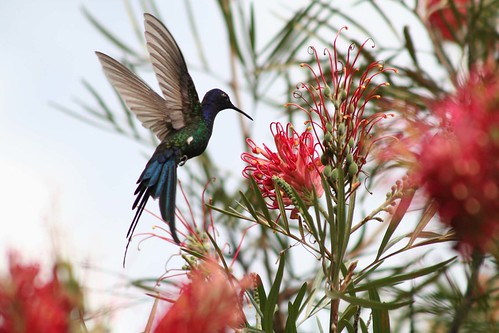
Beija-flor (Eupetomena macroura) – Swallow-tailed Hummingbid 2 592 – 2 by Flávio Cruvinel Brandão

My heart leaps up when I behold
A rainbow in the sky

by William Wordsworth

So does my heart leap up when I behold an animal, bird or beneficial insect that has returned or come for the first time to my garden.

For example, I have a number of birds nests but only one seems to have a resident each year. I know that size of opening is a major factor that determines which bird will use a certain bird house. But I also read that birds seem to like pretty bird houses and this birdhouse that has had birds build nests every year is the prettiest birdhouse on my property.  I had also been told that bird houses should be cleaned out yearly because birds can have lice and that the inhabitants need it clean. This bird house was filled so high with twigs that I couldn’t believe another bird could fit into it. So last fall I cleaned out all the all old twigs only to be entertained by this year’s birds filling the nest back up with twigs piled so high. I didn’t think anything could fit in besides the twigs but I hope they know what they are doing and lay eggs on that pile.   Check out this video clip.

I have lots of birds on this property because I have lots of shrubs for them to hide or build nests and have a stream for them to drink water. I plant flowers that I believe will encourage birds, butterflies and good insects. My soil has been amended so that I have lots of healthy worms. Robins love the worms. I have yellow flowers for the goldfinch so it is a special delight when they return. One has been tap-tap -tapping on the window.

And of course, I do everything I can to encourage hummingbirds. This year I added a honeysuckle that they love Lonicera sempervirens – coral red honeysuckle. Hummingbirds are always such a delight to see in the garden. ( I also have hummingbird moths. See here. )

I have so many birds singing at daybreak that I don’t need a rooster to wake me up each morning.

I have been spraying Liquid Fence on the plants so that deer won’t eat the ones I planted. My heart leaps up even when I see deer but there is enough wild greens for them to eat without eating dessert all the time – like my hostas are to them.  This year I have so many hostas in bloom that I hope all the black swallowtail butterflies will see them  and return. I have been counting those swallowtail butterflies that I see but there haven’t been that many.  I always had a lot of hosta flowers before deer became so prevalent and decimated these flowers. Liquid Fence has been my garden’s savior.

As I sit and write TheGardenLady post, I am often entertained by a bird resting on a branch outside in my backyard. I especially love to see the colorful ones, like the cardinals that always build nests in shrubs around the house.

I almost stopped using my front door because a delicate paper wasp nest was built. I am leaving it up for now unless someone gets stung. As much as I believe this is a beneficial insect, at the end of the year, sadly, I will have it removed.

Silver Lake Nature Center: Award Water Garden Tours

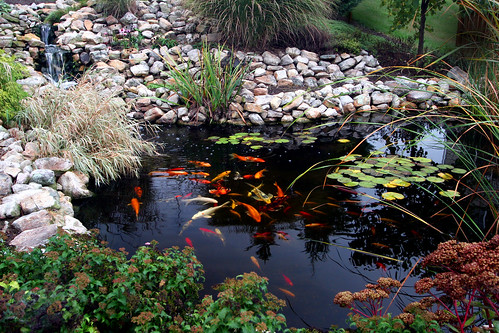
Back Yard Water Garden by ranhar2

Have readers of TheGardenLady blog ever wanted to build a pond or water garden on your property? Or are you someone who has a pond or a water garden and wants to see what others are doing with theirs? Or are you, like TheGardenLady, someone who just loves to visit gardens of all types?

Well, if you are in the Bristol, Pa area, the people at  Silver Lake Nature Center know that many people would just love to have a chance to see backyard water gardens. So in the past they have created award winning water garden tours.  And this year, again, they have arranged a “Water Garden Tour” where visiters can enjoy the beauty of water gardens,  ask questions, share ideas, or just enjoy the beauty of trickling water and tranquil fish. These tours will be held Sunday July 18 and Sunday July 25. 11am – 5pm. You need to buy tickets which are sold on line here.
Once at the above site, click on “About the Water Garden Tour” for more information.
Below is a photo of Silver Lake Nature Center:

Daybreak on the 4th by mike@bensalem

Cricket Hill Garden: Name this Peony Contest

Are you a fan of contests? Are you  creative with  names? I just learned that Cricket Hill Garden is having a contest to name a really pretty new peony. Winner will receive the peony.

Check out the peony contest here.

Check out their link here to learn how to enter. Let me know if a reader of TheGardenLady wins.

Also, check their site if you are having problems with your peonies. Cricket Hill Garden is the place to go with any type of peony questions.

The Amazing Effect of TheGardenLady’s Garden

TheGardenLady’s Garden in Bloom

TheGardenLady’s garden is a flowering garden. I attempt to have flowering plants for as long as the year allows flowers to bloom.  I recently found the book Continuous Bloom by Pam Duthie in the local library and was pleased that I had almost every plant she suggested blooming in my garden. (I have more than Duthie suggests because she only writes about perennials and I have a lot of flowering shrubs and add flowering annuals.)

The earliest plants to flower in my garden are Hellebores, which open in the winter. Can you believe that one Hellebore plant is still in bloom? From that first flower, I insist on having flowers in continuous bloom.  Some of the flowering plants blooming now are echinaceas, buddleias, brugmansia, phlox, among others.  These blooming flowers are mostly along the street where there is most sun and fewest tree roots so everyone who passes the house sees the flowers. This is not a hidden garden.

Because of the problems of the property, my garden is not a particularly beautifully landscaped garden. But because of the visibility of the continuous blooms, the most interesting sociological phenomenon has occurred. This GardenLady thinks the phenomenon is amazing.  She thinks that someone should do a study about it. What has happened that I find so amazing is that every day, more than once a day, mostly when I am out working in  the garden, people stop to tell me how much they love the garden and how beautiful the garden is. I say that it happens mostly when I am in the garden, because sometimes when I am in the house people come to ring my door bell to tell me how much they appreciate the garden. Many of the people are neighbors or people that I know but most of the people are complete strangers. People stop their cars to tell me of their enjoyment. Many of these people have become new friends.  People tell me that they love seeing the flowers so much they purposely drive out of their way to see what is in bloom. Complements have ranged from “You have created a little piece of paradise” to “It is another world walking past your garden”  to a two year old asking if any flowers had more than one color. I showed him my lantana flowers.

When I grew up in the small farming village, this was a common occurrence. People would stop over to discuss gardens and plants all the time. But in the town I have now been living in for about 38 years, people were more formal. People would never just drop over. I missed the friendliness of the town of my childhood. But now my gardens have brought this friendliness back. As I said, I am amazed. Neighbors now drop over and strangers stop and talk or ring my doorbell and talk. This garden attracts people as it does birds, bees and butterflies.  I have met such lovely interesting people of all ages. Today a young man who looked like he was in his twenties stopped. I have been invited to see other people’s gardens – people who don’t live in my town. I now can give plants to people when I divide plants instead of composting the overgrown plants. People have offered me plants that I don’t have.

I can not tell you how much I enjoy this phenomenon. In a more and more impersonal world, my garden is bringing people together. Who would have expected?

TheGardenLady Loves Readers’ Comments

Comments by miss miah

TheGardenLady does not really like her blog to be about her personal thoughts unless they pertain to something that relates to an issue she is writing about. The premise of the blog is to discuss or help people with gardening issues, ideas and suggestions. Also, there is the hope that readers will share in these discussions.

But please allow TheGardenLady to get personal when she writes how much she loves when people write in comments.

I enjoyed hearing from  the person who wrote about the importance of the honeybee and how long they have lived in this country.

The honeybee history is very much the history of the first settlers to the US.  See here.

I agree on the importance of the honeybee. Every day I love to examine the pollinators on the plants in my garden hoping to find healthy honey bees returning. Today I was so happy to find two honey bees happily gathering the nectar and pollen.

Mostly I see other pollinators that I encourage and hope that gardeners will encourage to their gardens. When we make our garden environments good, clean and safe all the pollinators will be healthy and do their jobs. This GardenLady hopes that honeybees will make a full recovery. There is no question that we need them and miss them.

Continue reading “TheGardenLady Loves Readers’ Comments”

Things To Do When Gardening in July

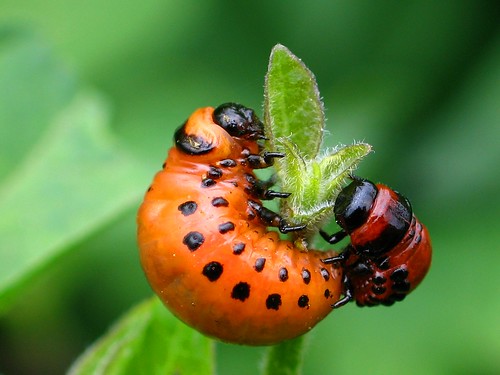
Colorado potato beetle larvae dining on nightshade leaves by imarsman

July is the time to work in the garden -  so get up early before the sun gets brutal.  A few of the jobs to be done in July are:

Water plants: If you live in an area that is having a drought, you will have to water. With the heat of summer and the drought,depending on your plants, many will need to be watered frequently. How to water correctly is often misunderstood. A good site for information on proper watering is this.  And because water is becoming more and more of a rare commodity, with a drought might come prohibitions from your township on using it outdoors on your grounds. So you will have to check with your local government to see if watering outdoors is being allowed.

In times when water is rationed you might want to use what is called gray water to keep the plants alive. Gray water is the water used in your house for washing, etc. – all but toilet water. The proper usage of gray water is explained here.

It is best to water before the sun comes up. It is best to soak the soil around the roots of the plants rather than to spray water over the tops of the plants. First, it saves water. Less water evaporates when you soak the root area. And for some plants, especially roses, watering the leaves can cause fungal problems like black spot – if the plants are susceptible to the disease.   When you water it is best to soak the plants deeply so that the roots stay down in the soil. Shallow watering can cause roots to more upwards.  See here.
Continue reading “Things To Do When Gardening in July”

How To Deal With Squirrels In The Garden

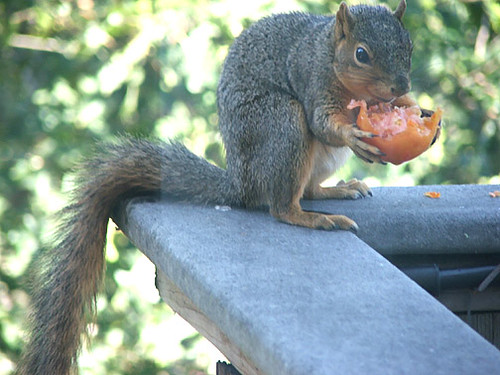
Squirrel eating my tomatoes…by CaitieBeth

TheGardenLady received this question from Jim.

After all the work of setting up a garden and caring for it, the squirrels get to the tomatoes before we can enjoy them.  They just nibble on part of the tomato as it begins to ripen but enough to prevent us from eating it. It is very discouraging. Do you have any ideas that could help me?

As cute as some people think they are, squirrels are a big nuisance in the garden.

There are both dry and liquid products on the market that are supposed to stop squirrels from eating your tomatoes and they are organic so they should be safe to use. These products are supposed to be effective because the squirrel has a good sense of smell. It is recommended that the product should be reapplied after a heavy rain. Check your hardware store to see what they sell.

Two brand names are: Squirrel Stopper (see here) and the other is Shake Away (see here). This GardenLady has not used these products. If you use these products, take care when applying because they may have hot pepper as part of the ingredients so you have to be sure it doesn’t get into your eyes or on your skin- gloves and goggles are recommended when applying.

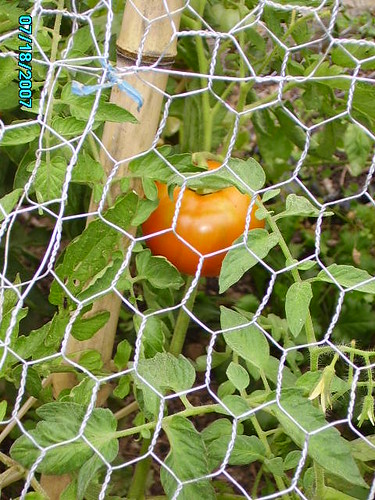
Next year, if possible, make a raised bed with screening that squirrels cannot enter. TheGardenLady’s husband had made a raised bed surrounded by screening to prevent animals from getting her tomatoes. On the ground, under the soil where the plants were we put screens – we used old window screens – so that no animal could burrow in through the bottom but rain could go through. The sides and the top also had screening made of the smallest holed chicken wire that was available in the hardware store. If you get screening that has too large holes, rabbits and squirrels can get in. The screens were attached to frames that had hooks so that the frames could be removed in order to plant, weed and harvest. Watering is easy through the chicken wire.

My Tomato Garden covered with chicken netting to protect from squirrels by k2marsh

TheGardenLady’s Love of Poppies

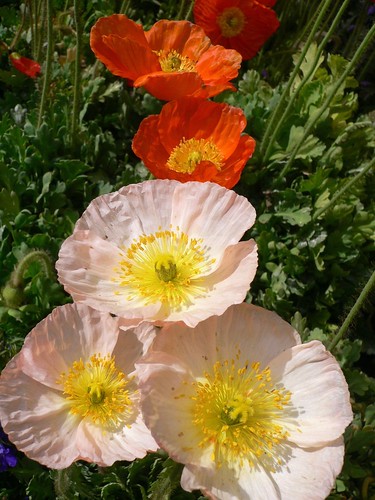
Papaver nudicaule (Iceland Poppy) by Luigi FDV

TheGardenLady hopes to write about each type of plant on her property. To start off the list, I would like to talk about the Iceland poppiesPapaver nudicaule.

I love poppies and have tried, unsuccessfully, to raise them for years. The major reason, I believe, I have not had success is because my property is mostly shaded. I may be wrong because a friend had poppies along the back of her house for years and I usually visited them when there was shade.  I just do not know the amount of sun she had in this location. If she had at least 6 hours of sun, then they would thrive. Poppies need a lot of sun.

My friend very generously gave me poppy plants.  I believe they were the oriental ones, but they always, sadly, left my garden after one year of bloom and never returned the second year. But I am persistent and try planting plants in different sites on my property in the hopes that one spot will make the poppies happy enough to return the following year. Mostly I have planted the Iceland poppies because I love orange and yellow in the garden. None has ever reseeded.

This year once again I planted Iceland poppies in three different sunny spots. This year I also planted seeds of the California poppyEschscholzia Californica. A neighbor has them and they reseed and bloom for him in the same spot every year. I hope some of the California poppies will take- I forgot where I planted them, so I am hoping one day as I inspect my garden some California poppies will appear to say, “We’re here.”

As I said, I had never been lucky enough for my poppies to reseed. But this year I saw a strange plant in one flower bed. To pull or not to pull was the question. It was such an unusual looking “weed” that l left it thinking that it didn’t look too difficult to pull if it later turned out to be an obnoxious weed. Then a second “weed” started growing across the walk from the first. The first “weed” kept growing and growing. I kept asking gardener friends if they could identify the plant. Most thought it looked like lettuce. So to really ID the plant, I needed the flower. The second plant grew much more slowly. Then, voila, one day I saw the buds on the first plant. They were the give away. Finally, after many years of trying, I had an Iceland Poppy that had self seeded. Now almost every day my “weed” produces a pink flower for me.

I read that pink is the recessive Iceland Poppy color. I had never planted a pink poppy. It is very exciting for me to see this 3 ft. tall poppy with its ethereal pink flower.  The second plant is just showing its first bud. I will be curious to see what color it is. And the three other Iceland poppies that I planted this year are orange and yellow.   Iceland Poppies are native to the northern parts of North America and Asia. They are said to like poor gravelly soil but the plants that self seeded for me are in an area richly mulched with aged horse manure.

I found some on-line sites that sell poppy seeds.  See here.  I plan on ordering the blue Meconopsis poppy next year.  See here.

Giant Hogweed: Identifying and Disposing It

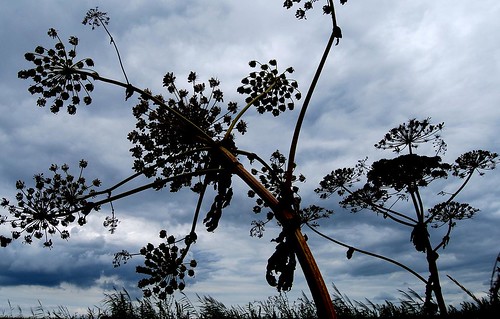
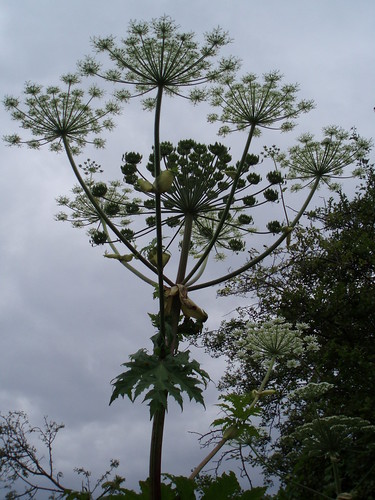
Giant Hogweed (Heracleum mantegazzianum) by sillie_R

Most reports of giant hogweed turn out to be Cow Parsnip, Angelica, or some other [member of the carrot family]. See here.  People can distinguish giant hogweed from other species of the carrot family, not only by its gargantuan size, but by its purple-splotched, hairy stems.

Giant Hogweed by Limbo Poet

“Cow parsnip stems have a more ‘furry’ look to them, whereas the hogweed has long, white hairs which are most pronounced at the base of the leaf petiole (stem). But the foliage of cow parsnips and giant hogweeds before they send up flower stalks is so similar it’s almost impossible to tell them apart.” This statement comes from the U.S. Department of Agriculture’s National Noxious Weed Program on Giant Hogweed, where you can get some bulletins with photos and information on Giant Hogweed.

Here’s another website that has a photo of the Giant Hogweed  so that you can see if this is indeed the plant you wrtie about. It looks like a Queen Anne’s Lace flower on steroids because the plant can grow up to 20 feet with a flower that measures up to 3 ft across and leaves that can be 5 feet wide. Giant Hogweed

Continue reading “Giant Hogweed: Identifying and Disposing It”