Do you know when lady apples are in season? I heard it wasn’t until October, I wanted to use them in September for Rosh HaShanah.
The Pink Lady Apple is a new apple that was developed in Western Australia and is now grown in the United States on our west coast.
Because TheGardenLady wanted to give you the correct information, she contacted the Pink Lady America spokesperson. Pink Lady America is a grower-supported association in Washington State.
Here is their response:
Thanks for contacting Pink Lady America.
Are you referring to ‘Lady Apples’ or ‘Pink Lady Apples’? Domestic Pink Lady Brand Apples are available from December until mid summer while fruit from Chile is on the market through September.
If a consumer can’t find this apple at her favorite supermarket, we
recommend she ask the produce manager and store manager to stock it.
Thanks again,
Alan Taylor
Marketing Director
Pink apples with honey would look lovely on the table at Rosh HaShanah. Have a sweet, happy, healthy New Year.
Perennials are wonderful to have in the garden. Many are almost carefree once they are planted. Oh yes, you have to dig up and divide every few years for optimum bloom, but other than that, you are pretty free of work once the plants are planted. But you do sacrifice something. The sacrifice is that generally perennials have a short blooming period. You have to enjoy them while they are open. Many gardeners try to find perennials of the same type that bloom early, mid season and late. Or you try to find different types of the same perennials that will extend the bloom season. To prolong the season, many artists have tried to capture the beauty of the perennials that they love in paintings, sculpture, ceramics or whichever art they practice.
One of my favorite perennials is the iris. The Japanese iris, the siberian iris, the bearded iris or whatever iris. The GardenLady loves them all and wishes her garden could hold all off them.
Many aritists around the world over the centuries have created art of the iris. From ancient times to modern times, from the amateur to the professional, in paintings, sculpture, glass art, ceramics, etc. the iris has been memorialized. Here are some examples.
TheGardenLady received this question from Jessica.
I was wondering what you thought about Yerba buena. I discovered this plant today and love the lemony minty smell to it. I wanted to know if it’s a dorm friendly plant. I’ll be living in Mills College in Oakland, CA. I was thinking of buying a small bamboo shoot and another plant (yerba buena?). Maybe you can recommend other plants the do well in dorm rooms and has a nice fragrance (not to strong)? I also like plants that can be used for different things, like made into a tea to sooth the throat. Something like that.
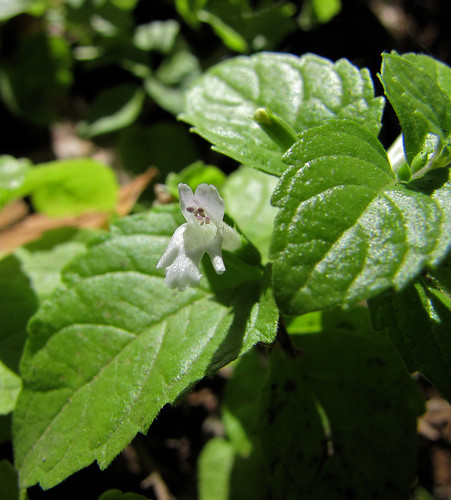
Yerba buena is Spanish for good herb. Another common name is Oregon-tea. The Latin name is Satureja (savory) douglasii, sometimes called Clinopodium douglasii and is in the Lamiaceae or Mint family. The common name Yerba Buena has been applied to several species of mint, especially Spearmint (Mentha spicata), but in the West it generally refers to Sartureja douglasii.
Sartureja douglassi is native to western N. America. It grows in redwood forests and was much used by tribes in the Pacific Northwest. It needs moist, sandy, slightly acid loam and partial shade when grown outdoors. It is used as a trailing plant for the front of window boxes and hanging baskets in semi-shade. TheGardenLady has never heard of it’s being used as an indoor plant, but since most mints will grow indoors, give it a try. Just know that it is a creeping perennial that likes to spread up to 6 ft. across. So give it a big pot, put it in a window with good light but not sun and keep the soil moist. If you are lucky, you will be able to make a mild tea from the leaves.
The article below has been going around the internet and is being posted so that TheGardenLady readers can see what creative gardeners can accomplish. To see more of the art check out this site or this site.
Stunning crop art has sprung up across rice fields in Japan. But this is no alien creation – the designs have been cleverly planted.
Farmers creating the huge displays use no ink or dye. Instead, different colours of rice plants have been precisely and strategically arranged and grown in the paddy fields.
As summer progresses and the plants shoot up, the detailed artwork begins to emerge.
A Sengoku warrior on horseback has been created from hundreds of thousands of rice plants, the colours created by using different varieties, in Inakadate in Japan
The village has now earned a reputation for its agricultural artistry and this year the enormous pictures of Napoleon and a Sengoku-period warrior, both on horseback, are visible in a pair of fields adjacent to the town hall.
More than 150,000 vistors come to Inakadate, where just 8,700 people live, every summer to see the extraordinary murals.
Each year hundreds of volunteers and villagers plant four different varieties of rice in late May across huge swathes of paddy fields.And over the past few years, other villages have joined in with the plant designs.
Napolean on horseback can be seen from the skies, created by precision planting and months of planning between villagers and farmers in Inkadate Fictional warrior Naoe Kanetsugu and his wife Osen appear in fields in the town of Yonezawa, Japan
The largest and finest work is grown in the Aomori village of Inakadate, 600 miles north of Toyko, where the tradition began in 1993.
Another famous rice paddy art venue is in the town of Yonezawa in the Yamagata prefecture.
This year’s design shows the fictional 16th-century samurai warrior Naoe Kanetsugu and his wife, Osen, whose lives feature in television series Tenchijin.
Various artwork has popped up in other rice-farming areas of Japan this year, including designs of deer dancers.
Smaller works of crop art can be seen in other rice-farming areas of Japan such as this image of Doraemon and deer dancers
The farmers create the murals by planting little purple and yellow-leafed kodaimai rice along with their local green-leafed tsugaru roman variety to create the coloured patterns between planting and harvesting in September.
The murals in Inakadate cover 15,000 square metres of paddy fields. From ground level, the designs are invisible, and viewers have to climb the mock castle tower of the village office to get a glimpse of the work.
Rice-paddy art was started there in 1993 as a local revitalization project, an idea that grew out of meetings of the village committee.
Closer to the image, the careful placement of thousands of rice plants in the paddy fields can be seenThe different varieties of rice plant grow alongside each other to create the masterpieces
In the first nine years, the village office workers and local farmers grew a simple design of Mount Iwaki every year.
But their ideas grew more complicated and attracted more attention. In 2005 agreements between landowners allowed the creation of enormous rice paddy art.
A year later, organisers used computers to precisely plot planting of the four differently colored rice varieties that bring the images to life.
I recently had some plants that I transplanted From 1.6L pots to 3.5L pots. For the first sized pot I used a mix of plain peatmoss/perlite/topsoil/black earth. I noticed that I had to water these plants every 2/3 days depending on the heat outside. Now that I’ve put my babies in “new shoes”. I’ve used a new soil mix to fill in the rest of the space in the new pots. The soil I used is Schultz’s moisture plus w/time released nutrients (0.08-0.12-0.08). I am completely unsure now when to water because 2 days after the transplant and watering the soil still feels fairly fresh. I tried running some water through one of the plants to make sure it’s not clogged, which it isn’t. It”s slowly dripping out. I guess my first question is, if my particular plants are prone to root rot, is this new soil going to cause this if I over water them? My second question is, what would be some tips with this soil on when to water it being they are gallon pots?
You have asked excellent questions. This GardenLady called Schultz’s for the answer. They said that you were doing the best thing for plants and especially for seedlings that are prone to root rot by using their moisture plus w/time released nutrients because the crystals are mixed so well in the potting soil that they help control the amount of water released into the soil. This prevents too much water in one spot which causes root rot. Also the soil is kept consistently wet from the top to the bottom of the pot. The way the crystals work is that they hold the water and then continue to release water into the soil until all the water in the crystals were released.
I asked how to tell if the plant needs more water. I was told that with the crystals it takes twice as long for the plant to be watered – so if your plant needed to be watered in 2/3 days, with the crystals in the soil, the soil will dry out in 4 to six days. I asked how to check if the soil needs watering. I was told that you stick your finger in the soil and if the soil clings to your finger, it doesn’t need watering. I asked if there were a device to stick in the soil to see if there were enough water and was told that was a good idea and he will suggest inventing such a device.
TheGardenLady wrote an article on caring for plants in time of drought. Schultz said that you can use their crystals on plants that have already been planted. Work them into the soil, water the plant and put a mulch over the crystals and soil where you put them to help retain the moisture.
For more information check out their website and go to Products and click on Moisture Plus Potting Mix or call their product specialists at 1-800 257 2941
”]TheGardenLady received this question from Bonnie.
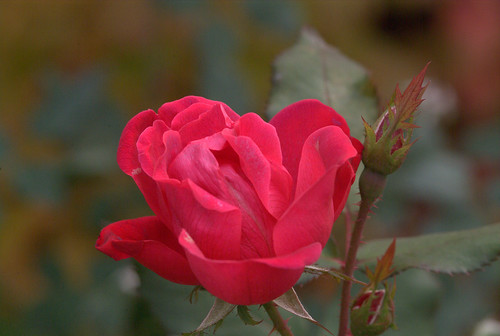
We planted a knock-out rose bush this past spring. It started blooming and had beautiful roses. We noticed that the stems were cut. The deer are eating them. What can we do?
Deer love roses. It seems strange because there are thorns. In spite of the thorns, I guess deer like plants that humans eat. Rose petals and rose hips and are eaten by humans. See here, here and here.
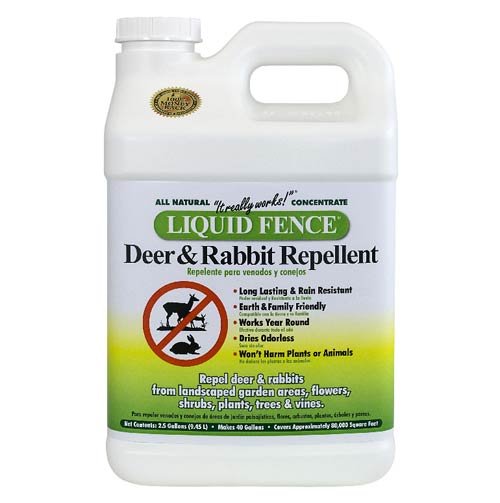
I spray my roses and other plants that deer love with a product called Liquid Fence. I have been using the product for a few years and my plants are not eaten by deer or rabbits. I think it is pricey because I use it much more frequently than recommended on the container. I have used it even more frequently this summer because of all the rain. Even though the product label says it lasts through rain, I am fearful of losing the plants. Because some some plants are deer resistant, I do not spray all the flowers I have. But I have learned that some plants that I wouldn’t think deer would eat, like sunflowers, will be eaten by the deer if I don’t spray. Liquid Fence stinks like the rotten eggs that is the major ingredient. That dissipates fairly quickly for the human nose; but the smell lingers for the more sensitive nose of the deer. The one thing that I dislike is that the leaves retain a white film from the spray. However, it washes off in the rain.
TheGardenLady recevied these additional questions about Knockout roses.
I just heard about the knockout rose and think it will be perfect for my side patio. Two questions: The above picture? are those purple or pink? How does the Knockout do in partial shade?
There is no purple Knockout rose. They have single and double pink, single and double red, and have recently brought out a yellow rose plus they have a rainbow colored rose and a pale pink single rose. Check out their site.
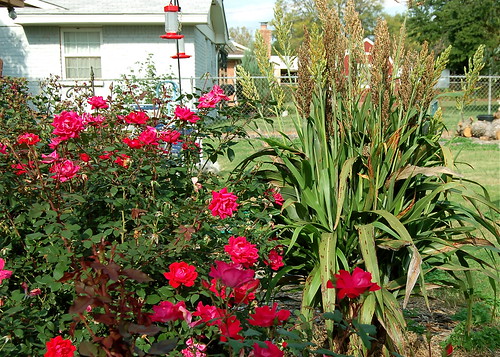
TheGardenLady has the pink and the red Knockout roses . Though the company says they grow 3 to 4 ft high and 3 to 4 ft wide, mine are higher – 5 or 6 ft tall and and about 5ft wide. I pruned mine down this spring yet they grew back as tall. They bloomed their heads off this spring. And with all the rain we have had, the plants are very healthy with no rose diseases.
I just had the lower branches of trees pruned so that the roses would get more sunlight. Until then they were getting about 5 hours of morning sun. But the company says they can do well with as little as 4 hours of sunlight.
If you’re interested in reading about blooming problems with Knockout roses, please take a look at this post.
TheGardenLady received these two questions about Knock Out roses from Mary and Diane respectively.
I planted eight knock out roses in the sun last year and they bloomed. After blooming the first year I put mulch on the base of the rose bush and the ground was not frozen. This spring I cut them back slightly the first bloom was great. We went on vacation and had a bad rain storm and the roses stopped. What am I doing wrong?
Last Spring (2008) I planted 9 knock-out roses. They grew and bloomed fairly uniformly. This Spring they looked very healthy, and all burst into bloom at the same time. After the first bloom, two of them turned a very light green. I have checked them for over/under watering. Fertilizing is not an issue as I have fertilized them all uniformly. The other 7 are beginning to bloom for the second time, but these two do not have new buds. They do not look like they are ready to die. I can find no evidence of insect damage either at the root or leaf level. They are all planted in the same bed in one grouping for concentrated color (i.e. within feet of each other). I am stumped as to what to do. Any ideas?
TheGardenLady imagines that you must have a fantastic show of concentrated color with those beds Knock Out Roses. TheGardenLady has just two Knock Out Roses and the floral show is amazing.
Two questions that are similar but not the same; however the treatment of the roses should be the same.
The first lady had Knock Out roses that stopped blooming after heavy rains knocked off the flowers and haven’t started reblooming.
The second lady has some of her Knock Out roses in one bed that are not blooming.
I have two adult Lady of the Night plants. I fed them Miracle Gro for Acid Loving Plants. Will anything happen to them? And if so what can I do to save them?
Lady of the night by wiccked
TheGardenLady is assuming your Lady of the Night Plant is Brunfelsia americana. How lovely to have this plant reputed to be the most fragrant of all the Brunfelsia plants which are very fragrant and the MOST fragrant of all plants.
Brunfelsia’s soil pH requirements are 6.1 to 6.5 (mildly acidic) to 6.6 to 7.5 (neutral).
Moderate occasional food and moderate water is all that is required. This Lady of the Night plant even handles dry soil well. They are very long lived. Brunfelsia plants are light eaters which means they don’t need much fertilizer.
But your concern is that you fed them Miracle Gro for Acid Loving plants. TheGardenLady doubts that you will have any problem from the one time only feeding of Miracle Gro for Acid Loving plants.
If you fed them as the Miracle Gro label says to feed plants and not given them an overdose (Remember to ALWAYS follow label instructions when applying fertilizers!) there should be no problem but don’t give these plants any more fertilizer. Brunfelsia don’t really need fertilizer- or if you feel you need to feed, highly dilute the fertilizer.
However, if you feel that you overdosed the plants on Miracle Gro, you can try flushing the soil with water. Brunfelsia plants don’t like overwatering just as they don’t need much fertilizer, so this is only to be done if you think you may have given the plants a gross amount of fertilizer.
Now if you have a problem with any Scotts’ product and Miracle Gro is a Scotts’ product, call them at 1-888-270 3714 as TheGardenLady did to be sure she was advising you correctly. They suggested that if you feel you must fertilize your Brunfelsia their recommendation is that you should use their all purpose fertilizer which has the numbers 24-8-16 on the box.




![Cropping the Roses by Beyond the Trail [Gary]](http://farm4.static.flickr.com/3169/2616166078_35aa8e134f.jpg)