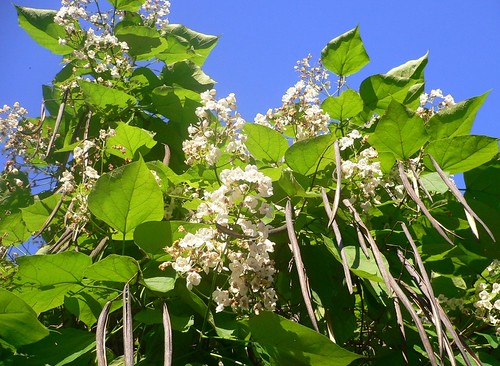
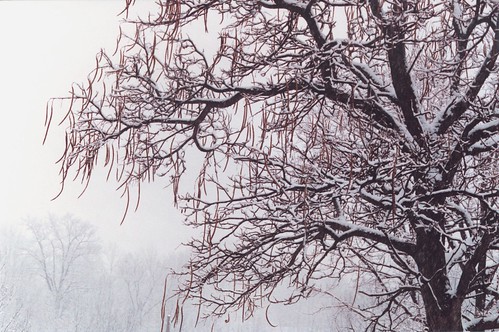
One of my favorite trees is in bloom right now. It is a tree I grew up with and played with the flowers that fell to the ground. It is the Catalpa speciosa or catawba tree.
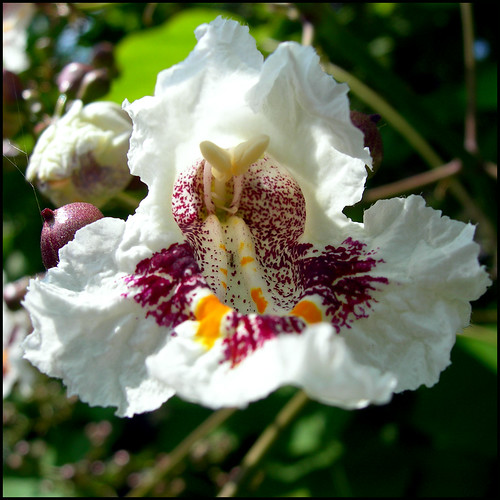
TheGardenLady has one shedding its flowers on the side of her property. One delighted me by self seeding near the driveway. And I just transplanted a baby that self seeded or a bird planted in my perennial bed. I worry that the baby might not be happy in its new location because this is an area that might not have good drainage, which the catalpa likes. The catalpa tree does not like poor drainage or really feezing weather.
The catalpa tree has numerous common names like umbrella tree, Indian bean tree, Johnny smoker tree, Indian cigar tree, fish bait tree and Lincoln Log Tree. This is a tree that native Americans used and the early pioneers liked, seeing how successfully the tree lived under all sorts of situations from polluted cities to windswept prairies; how it grew quickly; lived long- up to 70 years; and had profuse fragrant flowers while it gave shade with its large heart shaped leaves. Farmers found they could use the wood, which makes strong, lightweight rot-resistant fence posts . In fact the northern catalpa is used for carving, millwork, framing, furniture, drawer sides, and general-purpose construction. The species is also intentionally planted to control erosion, aid brownfield revitalization or new stand growth, and as windbreaks and screening from the sun. Thus pioneers found a good tree to take with them wherever they moved. They planted catalpa trees on their new property all over the country.
There are two types of Catalpa trees: the larger more showy Northern C. speciosa and the Southern C. Bignoniaceae, but both seem to do well outside their range from zone 4 to 8. The nectar in their flowers entices hummingbirds, tiger swallowtail butterfly larva, and bees. The trees and seedpods attract lots of birds.
Though TheGardenLady has never had any problems with the catalpa trees on her property, they can have problems. One is the Catalpa Sphinx moth (or catawba sphinx moth) The caterpillars can cause defoliation; but if the tree is hardy it will have its leaves grow back unless major defoliation occurs for a few years in a row. Then the tree might see a limb die. Cut off any dead branches. A lot of fishermen find the caterpillar of the sphinx moth great for fishing. There is also a fungal disease that may affect the tree, but that is not too common. If a tree dies, do not plant another catalpa in the same area.
Warning : The flower pollen is quite allergenic so if there are allergies in the family, don’t plant the Catalpa. Also, the tree can become a large tree that will crowd other trees out or give heavy shade where plants can’t grow; so this is a tree for a fairly large yard. Know that the tree the roots are poisonous, Be wary that the sawdust from working with Catalpa wood can cause inhalant and skin allergy symptoms. Don’t use catalpa wood chips or shavings as animal bedding in case they might cause a problem for pets. The seedpods and seeds of catalpa contain a mild narcotic and sedative and should not be put in the mouth or eaten.