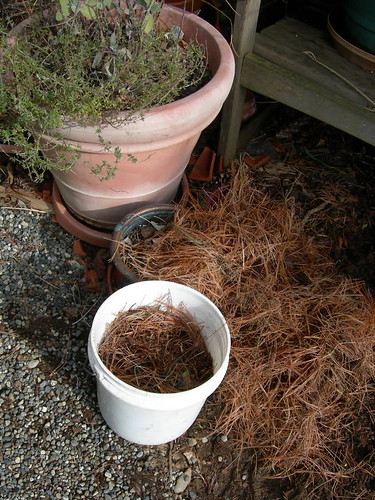
Pine needles for blueberry mulch by greenwalksblog (on flickr)
TheGardenLady received this question from June.
Would potatoes like a pine needle mulch?
According to Clemson University Extension, pine needle mulch is good
for potatoes.  See here.
Tip: Pine needles and coffee grounds make great mulch for acid-loving
plants, such as rhododendrons, azaleas, blueberries, raspberries,
strawberries and potatoes.
Please let TheGardenLady know how you make out with pine needle mulch.
TheGardenLady received this question from Claudia:
Every weed killer that I have located includes moss as a weed so it kills the moss too. Is there a weed killer that does not kill moss?
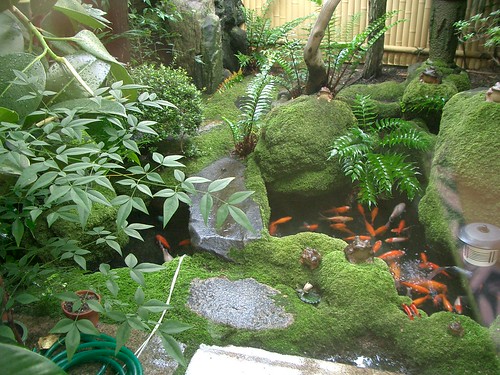
In one public garden with moss that I visited, I asked this very question. They said they got down in the moss and carefully plucked out all the weeds by hand using some type of tweezers. Moss has no roots. So if you pull some up just push it back in the spot it came from.
Moss loves acid soil- a ph of 5 to 6 is what mosses prefer. Weeds tend not to like soil with such a high acid content. So when the moss is in its preferred environment then it grows vigorously enough that weeds won’t be a problem. In fact you might be surprised that acid loving native plants take root in the soil even if you hadn’t planted them. They come into the moss environment like weeds. You can try adding wettable sulphur to the areas where the moss is weedy – add 1/2 the amount that is on the bag directions and put it in a small, test area to test if it works.
If you have weeds that you can’t hand pull try spotting the weeds with ” Weed Be Gone” or ” Round up”. Use these products in a small test area first to see if it doesn’t burn the moss. Then if it doesn’t burn the moss, you can use these products in other areas.
One of the best places to buy moss and moss products like the wettable sulphur is from Moss Acres. Moss Acres offers a wide range of soil amendment products to lower pH. They also will answer moss questions.
The owner of this company, David Benner, has the loveliest moss garden that is open to the public for a few days every May. Try to visit this garden and ask the tour guide, either David or his son, moss questions.
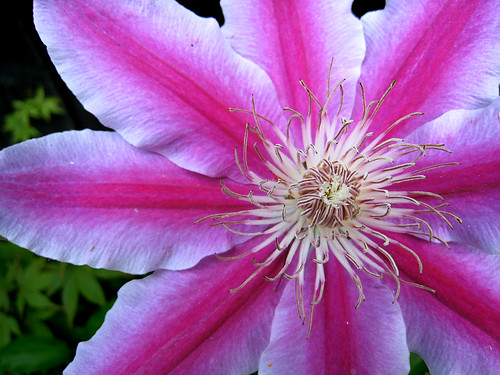
Clematis likes soil that has a pH close to neutral (6.6-7.0). You have to add enough lime to ensure that your soil is not too acidic. Generous amounts of bone meal and compost should be added to the soil. Clematis likes soil that drains well, so coarse builder’s sand should be added to soils that have a high clay content.
Lilacs also like a rich, well-drained soil with a neutral pH. They will grow happily in soil with a wider pH range- from 5.8-7.8 pH.
If the writer of this question is from the New England area where soils are often very acidic, soils will require modification for optimal lilac or clematis growth.
But do not try to change the pH of your soil by guessing. If you live in the US., contact your county agricultural extension service or your local Master Gardener Office for soil-testing information. You will get a soil testing kit that you will fill with soil for the test and when the results are returned, you will learn if your soil needs to be altered. The test results will be sent to you with instructions for altering soil pH to meet the needs of your plants. And if you don’t understand the instructions, you can visit the Master Gardener Office where the Master Gardeners will explain the instructions to you.
TheGardenLady received this question from Katherine.
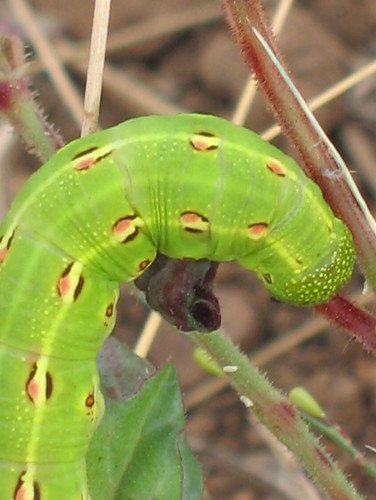
Is there anything I can do to keep the horned worm caterpillar off of my tomatoes? I really hate those little things. My kids pick them off, but most of the time they are hidden and I can’t see them!
You may know that the horned worm caterpillar is the immature stage of
the hawk moth. It goes through a few stages, but the most damaging stage is the caterpillar stage.
Some suggestions to get rid of the pest:
Rotate the place where you plant your tomatoes. Don’t plant tomatoes in the same place every year. If you plant them in the same location year after year, insects and diseases build up in the soil which can cause problems. For example, the hornworm larvae burrow into the soil to pupate.
Remove crop residues from last year and keep the area clean of weeds. Both can encourage insects to hide, lay eggs and grow.
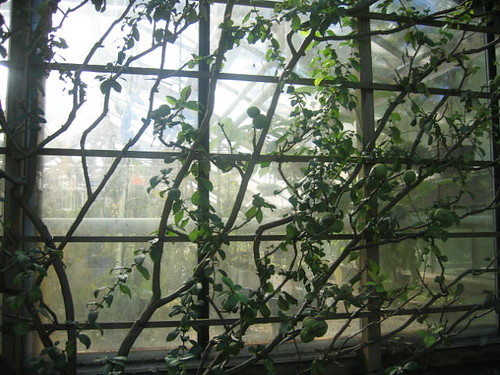
Beautifully espaliered quince by andrea_hall (on flickr)
TheGardenLady received this question from Elizabeth.
Can you tell me where I might be able to find a nursery/source for an espalier? I’ve been trying for years, to no avail, to espalier a quince. I would like to buy one that flowers.
Until you asked for a nursery to buy an espaliered tree, TheGardenLady
always thought that one had to create one own’s espaliered tree by training it yourself. Trying to check out your request, TheGardenLady discovered nurseries that sell already espaliered trees. But unfortunately, none that she called have espaliered quince trees for sale.
Espalier is when a tree, shrub or vine is trained to grow on a single plane and not allowed to deviate from it, that is known as the “espalier” style. Espalier stems from a 16th-century European practice.
Most people choose apple or pear trees to espalier not only to save space but to get more fruit in a small space. And there are nurseries that do sell espaliered apple and pear trees.
Quince can be espaliered but it can be trickier because many of the
shrubs have thorns. See here.
There are many excellent sites on espaliering so that you might be
willing to try making your own espaliered quince tree. See e.g. here.
TheGardenLady will continue to ask if there are nurseries that sell flowering quince that is already espaliered and if she ever finds a place will post it on the blog; but thus far, she has not been able to find any nursery in the states that sell it already espaliered. Because Europe seems to do more with espaliered trees perhaps you can find a European nursery that sells
one.
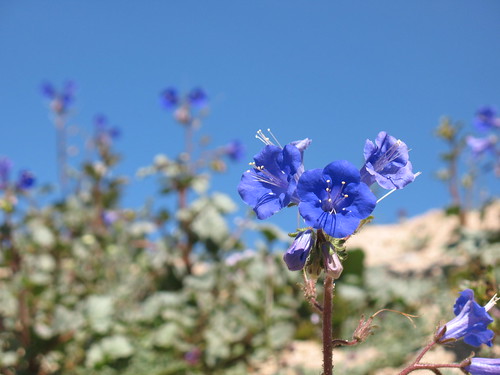
Bluebell Wildflowers - In Joshua Tree National Park by MadeIn1953 (on flickr)
In a departure from the man-made gardens that are often the subject of this blog, this past weekend’s adventure was spent exploring the wildflower displays at two unique spots within the Mojave Desert (see here). Covering southern Nevada, western Arizona, southwestern Utah, and southeastern California, this roughly 25,000 square-mile-large swatch of land is home to hundreds of species of plants; many of which produce springtime blossoms of white, yellow, orange, red, lavender, purple, and blue.
Separated by almost 200 miles, the two unique spots included the southernmost and westernmost tips of the Mojave Desert; respectively in Joshua Tree National Park and the Antelope Valley California Poppy Reserve-both in Southern California. While the blossoms on the two parks’ namesakes-the Joshua tree (Yucca brevifolia) and California poppy (Eschscholzia californica)-were an obvious motive behind picking the locations, numerous other blossoming species also inhabit these regions.
The first stop of the adventure, Joshua Tree National Park (see here), technically spans two deserts: above 3,000 feet and on the west side of the Park is the Mojave Desert, and below on the east side is the Colorado Desert, which is part of the larger Sonoran Desert. On the border, between the two deserts, lies the Lost Palms Oasis Trail; a favorite among hikers eager to see springtime wildflower blossoms. The 7.5 mile hike takes you from the Cottonwood Spring Oasis to the Lost Palms Oasis and back. With the right amount of fall and winter rains, and warm enough springtime temperatures, the typically parched, rocky, and sandy landscape between the two oases is transformed with patches of color.
This early-April weekend, at least 20 different blossoming species were on display along the Lost Palms Oasis Trail. Most prevalent were the yellows of the Creosote Bush (Larrea tridentata), Desert Dandelion (Malacothrix californica), and Brittlebush (Encelia farinosa). Moreover, on the way to the trailhead, when driving from the north end of the Park to the south end, a wonderful highlight was the fields full of Desert Dandelion on both sides of Pinto Basin Road.
TheGardenLady received this question from Cecilia.
I have some daffodils in pots and the flowers have already dried out. What do I need to do to keep them healthy for next year? Or will theybe fine without my help?
When the flowers on your daffodils dry out, cut them off. This goes for daffodils growing outdoors, too. But NEVER cut off the leaves. After flowering the leaves continue to provide nutrients to the bulb. By cutting the flowers off you prevent the daffodil from setting seed. Unless you are a professional daffodil breeder or an avid amateur, daffodil seeds are more difficult to work with so you don’t want the plant to set seed. You want all the energy and growth to go into the bulb for next year’s bloom.
Now with potted daffodils, because the plant was forced- the bulb may no longer be any good. But you can try to save it and hope it is still ok. The daffodil you bought came in a small pot with limited soil which was depleted of nutrients when it was forced and bloomed. So even though the fall is the best time to plant daffodil bulbs, TheGardenLady would immediately plant the flowerless bulbs into the ground with the leaves still on. This way the bulbs may have a chance of living by getting some nutrients from the leaves as well as from the outdoor soil. Mark where you planted the bulbs after the leaves die, so that you know where to look next spring to see if you saved those daffodils. Remember, plants want to live so that if you give them a good chance, they might comply. But, if they die, you know you tried.
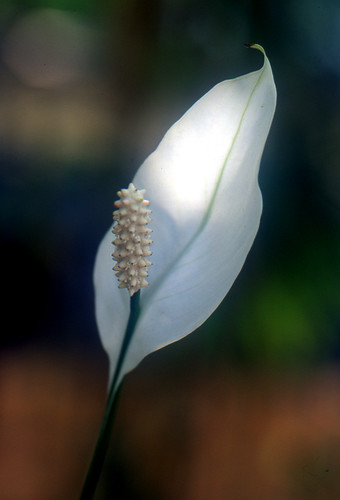
I have a peace lily indoor plant which has sentimental value to me and over the past winter it has contracted a leaf condition – the leaves die from the tip towards the stem. It’s as though a critter is “sucking” the life from it. It still flowers, but I am afraid as more and more leaves are infected I will lose the battle. Any suggestions?
TheGardenLady has to assume from your brief email that you have not changed anything in your plant’s environment- you haven’t moved your plant or changed the lighting, temperature, humidity or care. Usually most brown tips are caused by low humidity. And I also have to assume that you had not re-potted your Peace Lily Spathiphyllum improperly or put it in poor soil.
Or your Peace Lily might have to be re-potted. Sometimes a plant that has been in the same pot for a long time has a build up of salts in the soil from fertilizers and alkaline tap water. When you re-pot your plant, be sure you do not re-pot it too high or too low and use good potting soil (see here).
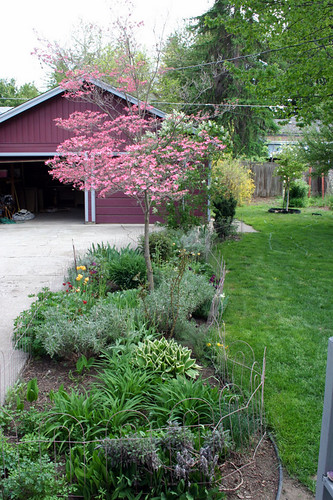
My Garden in Springtime by zenamoonbeam (on flickr)
TheGardenLady received this question.
I’d like to plant variegated hostas beneath a pink dogwood this spring. Is it a good idea?
TheGardenLady thinks that planting variegated hostas under a pink dogwood sounds gorgeous. But because dogwoods are being stressed these days, plant the hostas with caution (see here).
Be careful not to plant the hostas too close to the dogwood trunk. Notice that dogwoods in nature don’t like plants close to the trunk. Plant the hostas just outside the tree’s drip line (see here). Dogwoods have shallow, far-reaching root systems, so when planting the hostas be careful that you don’t damage big roots which are fairly shallow. Those are roots that are 1″ in diameter and larger. You don’t want to hurt the tree by damaging the roots (see here). The younger the tree, the closer you can plant the hostas because the roots will find the ideal places to grow their roots. Don’t pile lots of soil over the dogwood roots when planting anything near the tree.
Remember that dogwood trees like a lot of water. Dogwood roots don’t like to compete for water. Keep your dogwood well watered – Water weekly in the morning during dry periods. Caution: Do not wet foliage. If you are having a drought in your area, as many areas are having, be sure that the dogwood and the hostas get well watered. Since they are shallow-rooted trees, dogwoods are among the first plants to show drought stress. They need supplemental water in the absence of regular rainfall, especially during the summer and fall. Water in the morning, preferably with a soaker hose, to a depth of 6″. Use of a sprinkler is not recommended because it wets the foliage, setting up ideal conditions for certain diseases. But dogwoods don’t like to be overwatered. They don’t want the soil saturated. Dogwoods are feeling lots of stress these days; so you don’t want to add any more stress to the tree you have (see here).
If you have bought Encore Azaleas, the only patented azalea that is said to bloom not only in the spring, but also in the summer and the fall, instead of contacting TheGardenLady with questions about those azaleas, EncoreAzalea now has an online digital/web magazine that answers all questions related to the Encore Azalea. Check out the site for the advice and information about the Encore Azalea.
Autumn Twistâ„¢ (Rhododendron Hybrid)
Encore Azalea® has launched a new digital magazine that offers gardeners insight into all things related to Encore Azaleas, from planting tips and regional care to spacing suggestions.
Novice and master gardeners alike will enjoy the photos and articles while taking advantage of the easy care tips found in “Blooms.” The digital magazine can be viewed and downloaded here.
“Blooms” also features advice from Robert E. “Buddy” Lee, the inventor of Encore Azaleas and a well-known plant breeder. Lee offers his tips and techniques on soil amendment, planting, mulching, watering, and pruning.
Buddy’s care instructions are also available in Quicktime, or Windows Media format, or as an iTunes podcast. To download these easy-to-use files, visit EncoreAzalea and click the icon on the bottom of the home page.