Invasive Lillies

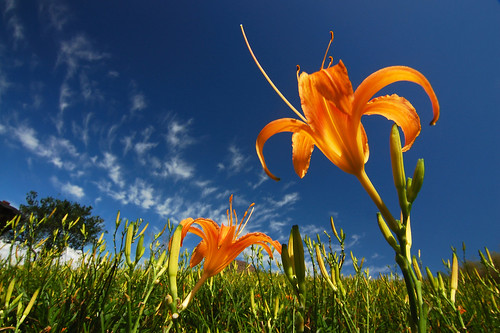
2007.09.02 金針花 / 赤科山 / Day Lily by MaxChu

TheGardenLady received this question from Nikki.

I have seen orange sillies resembling tiger lilies growing wild. I think they might be day lilies. I am wondering if it is possible for day lilies to spread from from your garden and become wild lilies. Do you think it is possible for a garden variety plant to become wild?

Day lilies/Hemerocallis fulva, with the common names of common orange day lily, tiger lily, roadside ditch lily plus a few other common names, have become invasive in a number of states. (see here and here and for a map of where this lily grows, check out this site)

There are beautiful native lilies that you could grow that will not become invasive.

But if you are interested in growing day lilies, not all varieties are invasive according to the American Hemerocallis Society ‘s Information Release site about invasives. They say that, “Any of the thousands of commercially available hybrid day lily cultivars which are clump forming are said to not be invasive.”
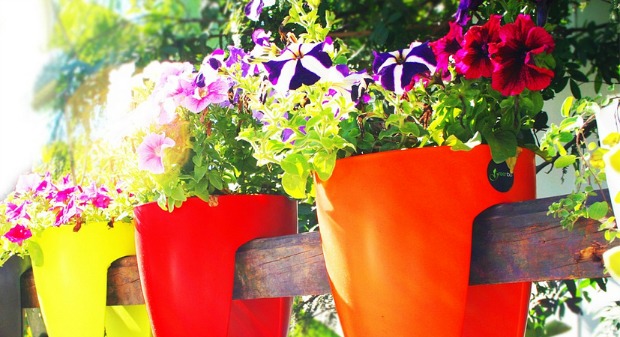
 

Modern Funky Balcony Planter

TheGardenLady is always scanning the Internet or nurseries for unusual or new gardening items. I just saw a funky new design of pots that cleverly hang on railings. The company that makes these pots is called Greenbo. Check out the website of this company.  These pots would be great for those gardeners who live in an apartment where the only place to garden is a small balcony with railings that are not too thick- not more than 4 inches wide-that you don’t want to or can’t hammer nails in to hold window boxes.  And the design of these pots the advertisement claims is such that they won’t fall off the railings. They better not if they are used on balconies in a high rise apartment. That’s the only thing about the design that makes me a bit nervous. I wish they had a secondary security system. But look at the design to see if they will work for you.

Pruning and Limbing Up Crape Myrle

Lagerstroemia indica by jacilluch

Bernadette asked TheGardenLady when would be the best time to prune her crape myrtle/Lagerstroemia tree.

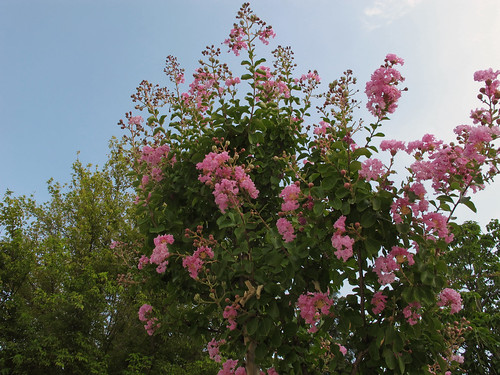
You can always prune off dead or broken branches at any time of the year on your crape myrtle or any shrub or tree. You can also cut off the dead blossoms after flowering if you don’t like the looks of them- the ones you can reach, that is.( sometimes this will force the crape myrtle to send out more flowers) If you don’t mind leaving the blossom ends, you don’t have to even cut those lower blossom ends. Some people think they have winter interest and birds like  to eat the seeds in the winter. Of course, you don’t have to bother with the blossom ends you cannot reach at the top of the plant because nature will dispose of them.

The crape myrtle does not need much pruning if you like the shape it is in. It is the kind of shrub I like, the lazy man’s shrub.

Continue reading “Pruning and Limbing Up Crape Myrle”

Flowers of Kauai

A reader of  TheGardenLady blog recently visited Kauai and sent in photos of some of the plants growing on the island.  A highlight was visiting Kauai’s Limahuli Garden and Preserve which grows native plants of the island and teaches about  Hawaiian history in relation to the native plants. As you walk through this beautiful botanical garden you have gorgeous tropical scenery.  This was the location that served as the Bali Hai backdrop in the movie “South Pacific.”  Limahuli covers almost 1000 acres. Though much of it is restricted for research and preservation, one can walk a 3/4 mile long trail through the demonstration garden. Read more about this garden here or check out this page for flowers in Hawaii.


Landscaping your gardens – front, back, side, and roof – with vegetables


I guess, because ThisGardenLady was born and raised on a farm, to me there is nothing more beautiful than seeing farms, gardens or orchards.  And I guess, because I was a poor child, I like to see value in what I raise. Don’t misunderstand, I think that a lawn is pretty and a peaceful sight. But I like to see added “bang for my buck.”  And what can be better than seeing plants grow and then getting food from them?

I know that there are towns or housing developments where you have to have a front yard that looks like every body else’s front yard. That is the law in some places. I know that neighbors have to be kept happy.  There are some neighbors who want to see a similar front yard as theirs and are intolerant especially when someone landscapes a little bit differently. Some of these people call the police or take people to court for these differences.  I believe in peaceful coexistence and would never encourage any fights, even over front yards or gardens.

Continue reading “Landscaping your gardens – front, back, side, and roof – with vegetables”

Bees in TheGardenLady’s garden

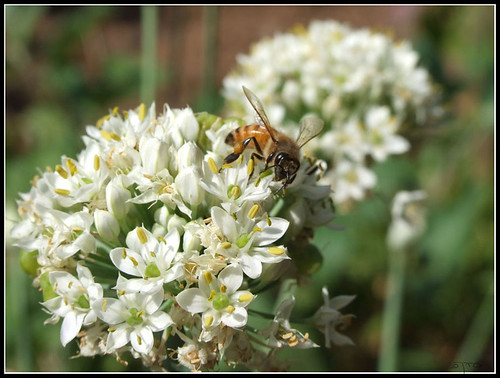
Chinese chives – עירית שומית by Eran Finkle

A few mornings ago, as TheGardenLady did her daily walk in the garden to see which flowers had newly opened and what butterflies were nectaring, I was astounded to see the number of bees on many of my flowers. There seemed to be more bees than ever and all were so concentrated on what they were doing, you could tell their lives depended on it.

I am so pleased to be able to meet the bees’ needs. So many of the bees on my flowers this summer have been bumble bees. I like bumble bees because they are excellent pollinators.  In fact, bumble bees are among the bees that pollinate most of the flowers. There is a Bumble Bee organization where you can learn about the importance of bumble bees.  Bumble bees pollinate but they do not share their honey.

But I love to look for honey bees. My prayer is that scientists will solve the problem of the sick honey bees and that my garden, that never uses chemicals, will play a small part in helping honey bee health. Honey bees pollinate a lot of the food or crop plants AND they give us honey. If you can’t tell the difference between bumble bees and honey bees, check out this Canadian website.

Continue reading “Bees in TheGardenLady’s garden”

Spiders in TheGardenLady’s garden

When visiting me this past weekend, my children were excited to see a huge yellow and black spider in my garden. My daughter took the above photograph of the spider.

I have noticed what seems to be a larger than usual number of spiders in my garden. I didn’t know if I were imagining this but learned that because of the earlier hot weather this year, which had the flowers bloom about 3 weeks early, spiders are also in the garden earlier. They are out and about a month earlier this year.

The beautiful, huge yellow and black spider in my garden is an Argiope aurantia spider.  This is a beneficial spider that catches such insects as the Asian tiger mosquito, the eastern yellow jacket, the carpenter ant and the Virginia Pine sawfly in its orb web. Unfortunately even beneficials, like the garter snake, do not discriminate between the bad and the good. The garter snake eats some good guys in the garden like the toads and the argiope spider also eats some good or beneficial insects. But the beneficial work it does outweighs the bad, so we have to protect these beneficial insects and beneficial snakes.   For more on the argiope spider read this.

Continue reading “Spiders in TheGardenLady’s garden”

Snakes in the garden

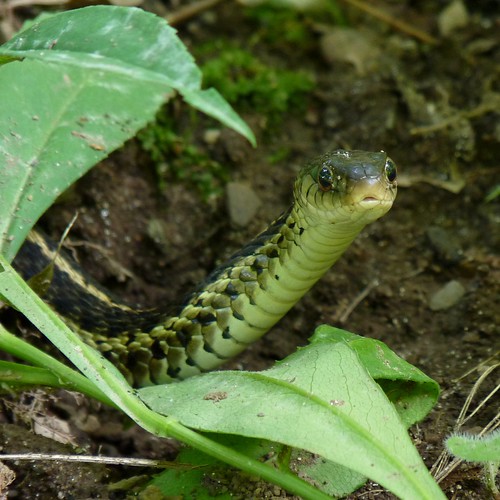
Face to face with a garter snake by Dendroica cerulea

While  dead heading Queen Anne’s Lace/Daicus carota plants- a weed that I have loved since childhood so that I allow it to flower in my garden beds- a woman walking by stopped to talk about my garden. Then she asked me about snakes. She was visiting from out of state and her host said that there were snakes living on my property because of the stream.  I have written about this stream that dissects my property and have talked about the wildlife that is on my property because of the water.  Yes, I assured her, there were snakes on my property. But they were all beneficial snakes. Yes, all snakes bite if they feel attacked. But the snakes that live near me are non-aggressive creatures- they do NOT ever attack people and will never bite unless stepped on, picked up or forced into a corner or threatened with imminent injury. Even then, all snakes would much rather get away than risk a fight. And the snakes that live near me are not very poisonous, dangerous ones.

Continue reading “Snakes in the garden”

Shade Loving Plants

Shade Garden by edgeplot

TheGardenLady received this question from Susan.

Outside our office in south Florida we have a planter that is entirely in the shade of an overhang. We have placed plants there and all have died. Can you suggest some plants that would survive and add beauty to building.

Before you plant anything in your planter, check to see if it has drainage holes. Plants MUST have good drainage to survive for any length of time. If there are no holes in the planter, you should either bore holes on the bottom of the container or buy new planters with holes.  (see here)

Then use good potting soil. Organic matter is always best. If your office has a gardener maintaining lawns around the building, see if he could start a compost spot for your building to use. This might be a first- creating an office building compost site. You might even be able to compost lunch leftovers in it for a savings to the building. Barring that, TheGardenLady likes to recommend buying soil with slow release fertilizer already in the soil.  If you do buy potting soil with fertilizer added to it, check to make sure the bags are not wet and that the potting mix doesn’t look like it has been sitting around a really long time. For adding your own slow release fertilizers to your potting soil, my friends like the Osmocote brand.

Continue reading “Shade Loving Plants”

Colorizing your garden with tomatoes, cauliflower or artichokes

Fractal cauliflower by Mikenan1

There are a few other vegetables or fruit that I want you to consider when creating your vegetable landscape.

One is the tomato- especially the miniature tomatoes, the cherry and grape type of tomatoes. The fruit of these plants look like jewels and come in red, yellow, orange, purple, chocolate, black, white and of course green fruits (see here). Some of these tomato plants bear 100s of fruits per plant- one claims to have over 650 tomatoes per plant- for a spectacular show. Some tomato plants hang down and others are upright. Some are great for container growing.

red small tomatoes by Martin LaBar

Another vegetable to look at for your landscaped garden is cauliflower. Everyone knows that there is white cauliflower. But did you know that Cauliflower comes in yellow and almost orange, green as well as purple heads? (see here) My favorite cauliflower look is the green Romanesco Cauliflower.The shape of the head is unique.

Continue reading “Colorizing your garden with tomatoes, cauliflower or artichokes”