Fall Planting


Bulbs. by don.wing45

Everyone knows that fall is the time to plant many of the bulbs that will bloom in the spring. All the stores are now carrying daffodils, tulips and other bulbs and catalogs are sending out the bulbs you ordered this spring. But fall is also the time to plant other plants for next year’s garden.

TheGardenLady just received a mailing from one of her favorite online rose companies The Antique Rose Emporium   reminding me that fall is probably the best time to plant roses if you live in zone 6 or warmer. Roses planted in the fall acclimate quicker and perform better the following spring. Also, this is a great time to get plant bargains especially in your local nurseries.  Friends of mine have found wonderful roses at discount prices at some of the big box stores that sell plants. Continue reading “Fall Planting”
Decorating your garden with found objects

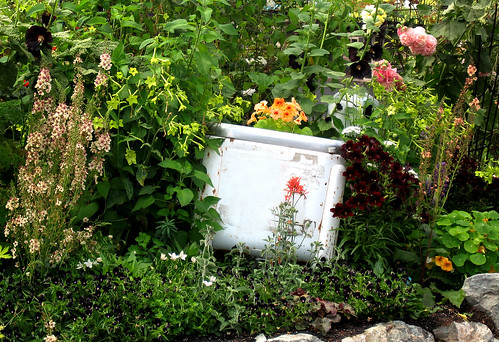
wringer washing machine in my garden by lolaleeloo2

After a while some people feel that they have enough plants in their garden with plenty of flowers, but the garden does not seem to be quite complete. Well, from time immemorial gardens have placed sculpture in a garden to add another interesting dimension. Sadly, some of us do not have the finances to purchase real statuary or real art  What can we do to remedy this? Put on your creative thinking caps and start looking around you. Did this hurricane bring down some trees in your yard? Don’t just cart it to the dump, but see if when it is chopped up, you could use it to build garden furniture.  TheGardenLady loves to visit gardens when garden club groups open their private houses to allow others to see what they have done. This is a great way to get ideas for my garden because gardeners are cleverly original.

Continue reading “Decorating your garden with found objects”

Marzipan – An Almond Delicacy

Photo taken by TheGardenLady’s daughter at the Marzipan Museum. Everything in the photo is made out of marzipan.

My favorite candy is marzipan. I am in love with this candy made out of almonds. I think marzipan is more popular in Europe than it is in the United States. Each country you visit in Europe makes its own marzipan. Even though marzipan is made basically the same way, there is a difference in marzipan from country to country.

Photo taken by TheGardenLady’s daughter at the Marzipan Museum. Everything in the photo is made out of marzipan.

What is the difference between marzipan and almond paste? I thought that what Europeans referred to as marzipan, Americans or English speaking people also called Almond paste. I always thought they were the same. But apparently there is some debate which depends upon how it is made. For a discussion of the difference you can read what this website has to say; plus read their recipe to make marzipan at home.

Continue reading “Marzipan – An Almond Delicacy”

Photos of Greece

This photo of canned fruits was taken in the town of Levidi in the Peloponnese.

My daughter and my son with his family visited Greece this August. They spent a week with friends on the island of Santorini,  a volcanic island where there are 600 species of plant life. The main edible crops growing on Santorini are grapes and a unique type of tomato called the Santorini tomato.  See here.  My son and his family then traveled through mainland Greece after my daughter left for Eastern Europe.

The photo of the goat was taken in the village of Elaiochori in the Peleponnese. Elaiochori is where my son’s friend’s father is from. This farm was just down the road from where a US trained architect, is building his retirement home.

This bucolic scene was taken outside a small organic winery we visited in the village of Kapsia in the wine region of Mantinia, Peloponnese.

From Santorini Sempervivum

Before they left for Greece, I asked my children to please take photos of any flora and perhaps fauna in Greece for TheGardenLady blog. Here are some of the photos. A few of the plants TheGardenLady can not identify. Perhaps my readers could help.

Continue reading “Photos of Greece”

Deer-Resistant Plants?

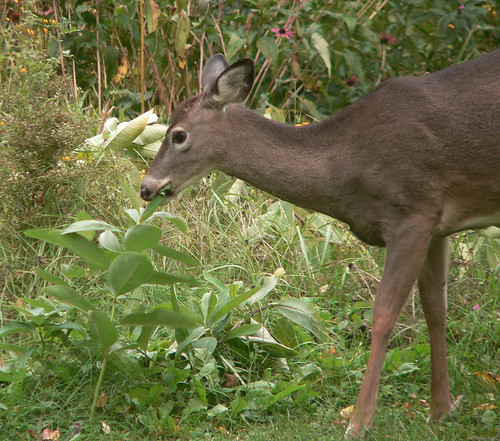
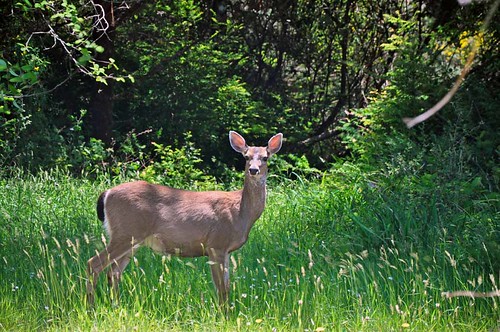
2008 10-04 caught in act Deer 23 by yeimaya

A few people have told me that they only grow plants that deer don’t eat. Sorry. As TheGardenLady understands it, no academic or scientific report will say that there are any plants that deer don’t eat or that are deer proof. There are plants that are highly resistant to deer damage. So it is always smart to plant these plants if you don’t have an 8 ft fence surrounding your plantings. But deer that are hungry or starving will seemingly eat anything if they can get to the plant. And sometimes deer will taste to see if a plant is worth eating.

That is how some of the products or recipes that repel deer work.  See here.  Many leave a residual smell that we humans can not smell but the deer can and find offensive. And they leave a bad taste in the deer’s mouth. But even they aren’t effective 100% of the time. They wash off or new growth isn’t smelly and bad tasting. Or the deer that are hungry learn to tolerate the repellent.

Continue reading “Deer-Resistant Plants?”

Butterflies in High Line Park

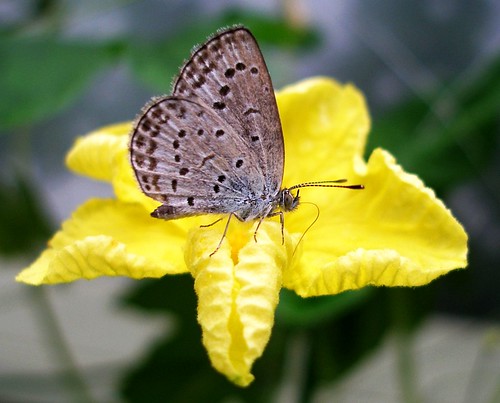
Butterfly on a yellow flower by tanakawho

Whenever I see a butterfly, I get so excited, I am like a child. What is the wonder of butterflies that make them so magical?  Bear with TheGardenLady as I share a favorite poem or skip to the bottom to read about Manhattan’s newest park.

“To A Butterfly” (1801)
I’VE watched you now a full half-hour;
Self-poised upon that yellow flower
And, little Butterfly! indeed
I know not if you sleep or feed.
How motionless!–not frozen seas
More motionless! and then
What joy awaits you, when the breeze
Hath found you out among the trees,
And calls you forth again!

This plot of orchard-ground is ours;
My trees they are, my Sister’s flowers;
Here rest your wings when they are weary;
Here lodge as in a sanctuary!
Come often to us, fear no wrong;
Sit near us on the bough!
We’ll talk of sunshine and of song,
And summer days, when we were young;
Sweet childish days, that were as long
As twenty days are now.
________________________

STAY near me–do not take thy flight!
A little longer stay in sight!
Much converse do I find in thee,
Historian of my infancy!
Float near me; do not yet depart!
Dead times revive in thee:
Thou bring’st, gay creature as thou art!
A solemn image to my heart,
My father’s family!
Oh! pleasant, pleasant were the days,
The time, when, in our childish plays,
My sister Emmeline and I
Together chased the butterfly!
A very hunter did I rush
Upon the prey:–with leaps and springs
I followed on from brake to bush;
But she, God love her, feared to brush
The dust from off its wings.

By William Wordsworth (1770-1850).
_______________________________

Today I saw the second Monarch butterfly this summer. I wasn’t certain the first butterfly I saw yesterday was really a Monarch because it flitted away from me so quickly. Then I spoke to a friend who saw a Monarch flying when she was walking on the High Line in Manhattan a few weeks ago. So I knew that the Monarch butterflies are starting to migrate in my area.

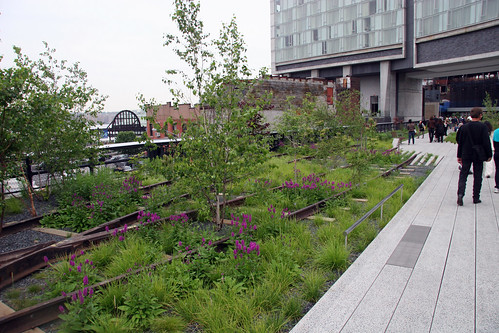
090610 High Line Park 017 by joevare

If you don’t know about the High Line and love walking in gardens then you are in for a treat if you visit Manhattan. It is the newest park. Located on Manhattan’s West Side, it runs from Gansevoort Street in the Meatpacking District to West 34th Street, between 10th & 11th Avenues. Section 1 of the High Line opened to the public on June 9, 2009 and the rest just opened June 8, 2011.The park is filled with native plants. Check out their website where you can get a list of the native plants they planted and which plants are in bloom each month.  See here.

Plants that Attract Bees

bee on mint flowers-1 by Mr Po

One comment TheGardenLady received was from a beekeeper who was delighted that she has mints growing in her yard because they attract so many bees. I agree, my mint plants attract a lot of bees as do other plants and herbs that are in flower as well as the many flowering plants that are in the mint family, Lamiaceae or Labiatae, such as plants in the Agastache genus, most commonly called Hyssop. (Remember to feel for the square stem to know the plant is in the mint family. And do remember that these plants can become invasive. )

Agastache plants which bloom almost all summer long not only attract lots of bees, they attract butterflies and even attract hummingbirds but deer won’t eat them. At least two of the Agastache plant species are referred to as Hummingbird mint.  See here.

Continue reading “Plants that Attract Bees”

Dwarf Crape Myrtles


Lagerstroemia Indica (I) by .Bambo.

I love Crape Myrtles Lagerstroemia indica (the American Horticulture Society spells it Crape ) and they love hot weather. With the weather we have been having this summer, they have been in their glory. Another good thing for Crape Myrtles is these dry summers; because once established, Crape Myrtles tolerate some drought. In fact when Crape myrtles were brought to the States from China, they were happiest in the South or USDA Hardy Temperature zones 7 through 9 or perhaps 10 or 11. They didn’t bloom in cooler climates.

Fifteen years ago, I don’t remember seeing many Crape Myrtles in Zone 6. Those few who had them seemed to grow them outdoors in sheltered areas or else they overwintered them in greenhouses. But these days I see Crape Myrtles perennially growing in many yards all over my area. Crape Myrtle breeders had been busy at work creating the Crape Myrtles for Zone 6 so that now everyone in zone 6 seems to have a Crape Myrtle decorating his or her yards.

My Crape myrtle is a baby from a friend who has a Crape Myrtle in almost every color in her small, but very lovely garden. Crape Myrtles have so many seeds from all the flowers, that if you have the right environment, even if you are not a plant hybridizer, you may find new babies in your yard from your main Crape Myrtle.   See here.

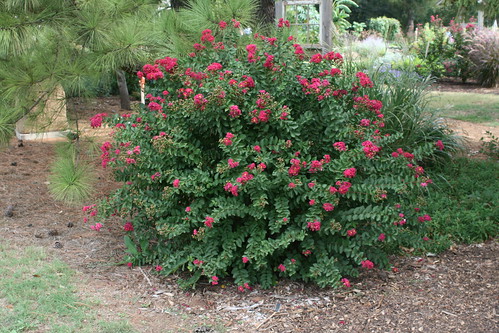
Dwarf crape myrtle by Gardening in a Minute

When I visited my friend’s garden most recently, I saw her newest Crape Myrtle acquisition flowering in her garden. It was a charming dwarf Crape Myrtle!

Continue reading “Dwarf Crape Myrtles”

Nature’s Garden in Ansel Adams Wilderness Area (Photos)

Two readers of TheGardenLady blog are avid hikers who say they are attempting to hike every trail in the Sierras as well as other California trails. Every weekend they try another trail or part of a trail. They love the native flora and fauna they meet or see on these trails as well as the spectacular scenery.

Their most recent hike, on the weekend or August 13, 2011, was in the Ansel Adams Wilderness Area, which is located in the Inyo National Forest (see here) near Mammoth Lakes, California in the Eastern Sierra. Hiking from Agnew Meadows to Thousand Island Lake, where they camped for the night, the trip was an approximately 16 mile loop, taking the River Trail there and returning along the High Trail (aka Pacific Crest Trail).

They sent all the photos that you see on this to share with all the readers.  Enjoy.

Continue reading “Nature’s Garden in Ansel Adams Wilderness Area (Photos)”

Trying to meet the challenges of gardening

NOT ME!! I DID NOT EAT YOUR FLOWERS! by Snap-Smith

Gardening can be a serious challenge for the gardener.  Consider the weather.  Who knows what to do in a profound drought like the one the MidWest experienced this summer? You cannot water plants when the water level goes down too low. Who knows what to do in extensive floods like the ones the MidWest experienced earlier in the late spring/early summer? Consider the insects.  They either go after the garden, like Japanese beetles do, or they go after the gardener, like the mosquitoes or gnats.  Consider the wild animals.  Everyone knows about the problems caused by deer or rabbits.

But we humans are the smart creatures on this earth who should be able to solve these problems. Aren’t we?

We have had dry weather where I live, so I water my flowers daily. I am religious about this job. But the next day after I water my plants, they still look wilted and sad.  I tried holding some basil between my lips as I was told that Italian farmers did to prevent mosquitoes. I wasn’t bitten by the mosquitoes, so maybe the basil helped. And I sprayed my flowers with Liquid Fence to deter the deer and rabbits. But they, too, want what I plant.

Continue reading “Trying to meet the challenges of gardening”