‘Tis the Season for Plums

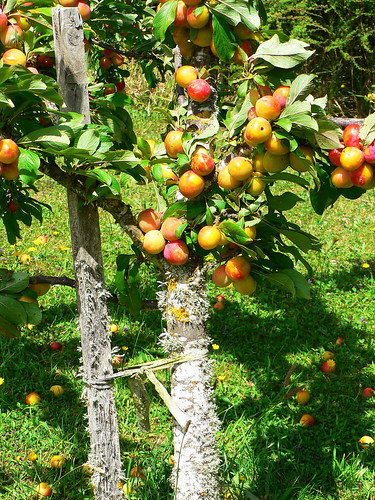
part of the plum tree by Brenda Anderson

I love a good plum.

I remember when my father planted a plum tree that was supposed to have 5 different types of plums on one tree.  We couldn’t wait for that first year’s harvest. I don’t ever remember 5 different types of plums on the tree, that was a bit of a disappointment. But I do remember that there seemed to be more than one kind of plum on the tree that first year. And they were delicious. After that first year I only remember one type of plum on the tree and the yield was always sparse. But l  always loved plums and couldn’t wait for the plum tree to have fruit. And I have always loved plums after that.

Plums were the right sweet tart for my tongue and the skin was smooth, not furry.  My mother rarely bought fruit at the market- if we didn’t harvest our own fruit, we didn’t buy fruit because we were so poor. Except for Italian prune plums, which I still buy if I see them. But the bought plums were never as good as the plums on our plum tree.

It is plum season in California where we get so many of our wonderful plums. The season is really just beginning. People refer to plums as stone fruit. I had never heard this expression applied to fruits with pits until my son moved to California.

I try all the different plums as they arrive in my supermarket, but my favorite is one that has smooth and almost black skin and the pulp inside is purple as well. I wish someone would  tell me which plum this is.My son in California, who also loves this plum, says it is the Santa Rosa plum. But the information I see is that Santa Rosa plums have amber flesh.  See here.   Can anyone tell me what is the name of the plum that has the purple pulp that is so heavenly? Is it a variety of the Santa Rosa plum?


Continue reading “‘Tis the Season for Plums”

Cricket Hill Garden: Name this Peony Contest

Are you a fan of contests? Are you  creative with  names? I just learned that Cricket Hill Garden is having a contest to name a really pretty new peony. Winner will receive the peony.

Check out the peony contest here.

Check out their link here to learn how to enter. Let me know if a reader of TheGardenLady wins.

Also, check their site if you are having problems with your peonies. Cricket Hill Garden is the place to go with any type of peony questions.

TheGardenLady Loves Readers’ Comments

Comments by miss miah

TheGardenLady does not really like her blog to be about her personal thoughts unless they pertain to something that relates to an issue she is writing about. The premise of the blog is to discuss or help people with gardening issues, ideas and suggestions. Also, there is the hope that readers will share in these discussions.

But please allow TheGardenLady to get personal when she writes how much she loves when people write in comments.

I enjoyed hearing from  the person who wrote about the importance of the honeybee and how long they have lived in this country.

The honeybee history is very much the history of the first settlers to the US.  See here.

I agree on the importance of the honeybee. Every day I love to examine the pollinators on the plants in my garden hoping to find healthy honey bees returning. Today I was so happy to find two honey bees happily gathering the nectar and pollen.

Mostly I see other pollinators that I encourage and hope that gardeners will encourage to their gardens. When we make our garden environments good, clean and safe all the pollinators will be healthy and do their jobs. This GardenLady hopes that honeybees will make a full recovery. There is no question that we need them and miss them.

Continue reading “TheGardenLady Loves Readers’ Comments”

Things To Do When Gardening in July

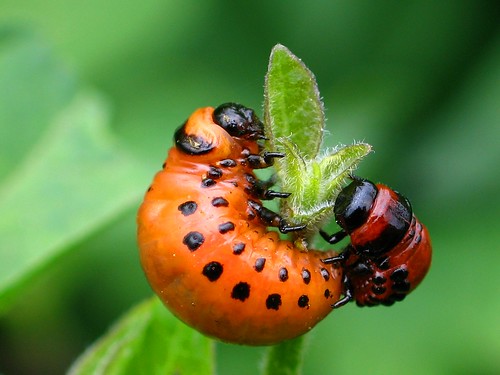
Colorado potato beetle larvae dining on nightshade leaves by imarsman

July is the time to work in the garden -  so get up early before the sun gets brutal.  A few of the jobs to be done in July are:

Water plants: If you live in an area that is having a drought, you will have to water. With the heat of summer and the drought,depending on your plants, many will need to be watered frequently. How to water correctly is often misunderstood. A good site for information on proper watering is this.  And because water is becoming more and more of a rare commodity, with a drought might come prohibitions from your township on using it outdoors on your grounds. So you will have to check with your local government to see if watering outdoors is being allowed.

In times when water is rationed you might want to use what is called gray water to keep the plants alive. Gray water is the water used in your house for washing, etc. – all but toilet water. The proper usage of gray water is explained here.

It is best to water before the sun comes up. It is best to soak the soil around the roots of the plants rather than to spray water over the tops of the plants. First, it saves water. Less water evaporates when you soak the root area. And for some plants, especially roses, watering the leaves can cause fungal problems like black spot – if the plants are susceptible to the disease.   When you water it is best to soak the plants deeply so that the roots stay down in the soil. Shallow watering can cause roots to more upwards.  See here.
Continue reading “Things To Do When Gardening in July”

How To Deal With Squirrels In The Garden

Squirrel eating my tomatoes…by CaitieBeth

TheGardenLady received this question from Jim.

After all the work of setting up a garden and caring for it, the squirrels get to the tomatoes before we can enjoy them.  They just nibble on part of the tomato as it begins to ripen but enough to prevent us from eating it. It is very discouraging. Do you have any ideas that could help me?

As cute as some people think they are, squirrels are a big nuisance in the garden.

There are both dry and liquid products on the market that are supposed to stop squirrels from eating your tomatoes and they are organic so they should be safe to use. These products are supposed to be effective because the squirrel has a good sense of smell. It is recommended that the product should be reapplied after a heavy rain. Check your hardware store to see what they sell.

Two brand names are: Squirrel Stopper (see here) and the other is Shake Away (see here). This GardenLady has not used these products. If you use these products, take care when applying because they may have hot pepper as part of the ingredients so you have to be sure it doesn’t get into your eyes or on your skin- gloves and goggles are recommended when applying.

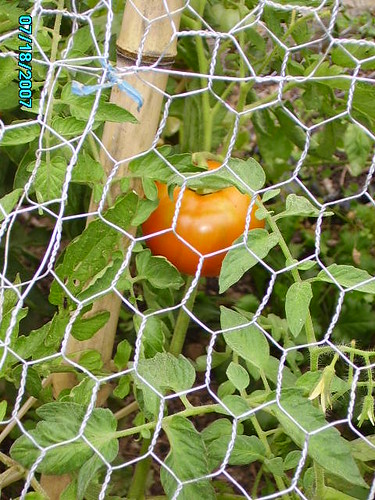
Next year, if possible, make a raised bed with screening that squirrels cannot enter. TheGardenLady’s husband had made a raised bed surrounded by screening to prevent animals from getting her tomatoes. On the ground, under the soil where the plants were we put screens – we used old window screens – so that no animal could burrow in through the bottom but rain could go through. The sides and the top also had screening made of the smallest holed chicken wire that was available in the hardware store. If you get screening that has too large holes, rabbits and squirrels can get in. The screens were attached to frames that had hooks so that the frames could be removed in order to plant, weed and harvest. Watering is easy through the chicken wire.

My Tomato Garden covered with chicken netting to protect from squirrels by k2marsh

TheGardenLady’s Love of Poppies

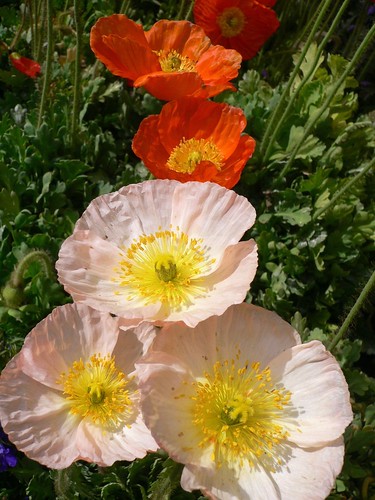
Papaver nudicaule (Iceland Poppy) by Luigi FDV

TheGardenLady hopes to write about each type of plant on her property. To start off the list, I would like to talk about the Iceland poppiesPapaver nudicaule.

I love poppies and have tried, unsuccessfully, to raise them for years. The major reason, I believe, I have not had success is because my property is mostly shaded. I may be wrong because a friend had poppies along the back of her house for years and I usually visited them when there was shade.  I just do not know the amount of sun she had in this location. If she had at least 6 hours of sun, then they would thrive. Poppies need a lot of sun.

My friend very generously gave me poppy plants.  I believe they were the oriental ones, but they always, sadly, left my garden after one year of bloom and never returned the second year. But I am persistent and try planting plants in different sites on my property in the hopes that one spot will make the poppies happy enough to return the following year. Mostly I have planted the Iceland poppies because I love orange and yellow in the garden. None has ever reseeded.

This year once again I planted Iceland poppies in three different sunny spots. This year I also planted seeds of the California poppyEschscholzia Californica. A neighbor has them and they reseed and bloom for him in the same spot every year. I hope some of the California poppies will take- I forgot where I planted them, so I am hoping one day as I inspect my garden some California poppies will appear to say, “We’re here.”

As I said, I had never been lucky enough for my poppies to reseed. But this year I saw a strange plant in one flower bed. To pull or not to pull was the question. It was such an unusual looking “weed” that l left it thinking that it didn’t look too difficult to pull if it later turned out to be an obnoxious weed. Then a second “weed” started growing across the walk from the first. The first “weed” kept growing and growing. I kept asking gardener friends if they could identify the plant. Most thought it looked like lettuce. So to really ID the plant, I needed the flower. The second plant grew much more slowly. Then, voila, one day I saw the buds on the first plant. They were the give away. Finally, after many years of trying, I had an Iceland Poppy that had self seeded. Now almost every day my “weed” produces a pink flower for me.

I read that pink is the recessive Iceland Poppy color. I had never planted a pink poppy. It is very exciting for me to see this 3 ft. tall poppy with its ethereal pink flower.  The second plant is just showing its first bud. I will be curious to see what color it is. And the three other Iceland poppies that I planted this year are orange and yellow.   Iceland Poppies are native to the northern parts of North America and Asia. They are said to like poor gravelly soil but the plants that self seeded for me are in an area richly mulched with aged horse manure.

I found some on-line sites that sell poppy seeds.  See here.  I plan on ordering the blue Meconopsis poppy next year.  See here.

Taking Care of Encore Azaleas in the Summer

Encore Azalea by Connie@VA

Encore Azaleas wants you to know how to treat your azaleas during the hot days of summer.

The heat of summer can be harsh on all plants, and we at Encore® Azalea would like to help you prepare.

Keep a watchful eye on the moisture level of the soil around your Encore Azaleas.

The shallow fibrous roots like to be moist, but not saturated. A mulch of pine bark will help hold moisture near the roots, as well as protect the roots from the harsh rays of the sun.

This is your last chance to prune for the season. Any heavy pruning should be done immediately after your Encore Azalea’s spring bloom cycle. Remember only to prune lightly in high heat.

Double Knock Out Rose Problems

Nice & Easy Double Knock Outs by perennialpal

TheGardenLady received this question from Wendy.

I live in eastern North Carolina and I have several double knockout rose bushes and they have been beautiful. This year I pruned them back in early spring and had a magnificent show – we have had several hard storms lately and now there are no blooms on the bushes. There are a lot of dead heads. Should I pinch off all of them or should I leave them be? I dont remember having to do this after first pruning in the past – but I also thought I had more blooms and for a longer time through out the summer.

When one has a hard rain it knocks a lot of flowers off. The rain did a job on my peony flowers as well as my Knock Out Rose flowers. Perhaps someone should invent a rose umbrella to protect the flowers from hard rains. They do sell umbrellas for Peonies – but these umbrellas are really to protect the peonies from too much sun. Cricket Hill Nursery sells peony umbrellas from Japan (see here).  Too much sun will make the peony flower have a shorter bloom period. So gardeners do have to work with the elements.

Back to your roses. Knock Out Roses are bred to not have to dead head them.  See here.  The petals pretty much fall cleanly off. But I think the part that is left does not look pretty, so I cut it off back to some leaves.  It seems much cleaner looking to me. You will have to decide what you want to do – to dead head or not to dead head. Just know that you don’t have to deadhead. I let the rose rest a little after its initial burst of blooms. The next time I have to water the roses, I add a little fertilizer that has a high phosphorus content to the water in a watering can and pour it around the roots of the bush.

I loved Schultz’s Bloom Plus which had the highest phosphorus percentage; but Schultz gave up this fertilizer component of their products. I was so upset to learn they no longer are making their Bloom Plus nor did they tell me if any other company has taken over the manufacture of it. So I went to all the local nurseries to see if any had this Bloom Plus product left on their shelves. One of the best nurseries in my area, knowing how good the product was, had ordered a lot; so I bought up a lifetime supply- it doesn’t spoil and one uses so little of it per gallon. Of course, there are other brands that make rose fertilizer or fertilizers for optimum flowering of plants. I just never thought they were as good as Schultz’s.

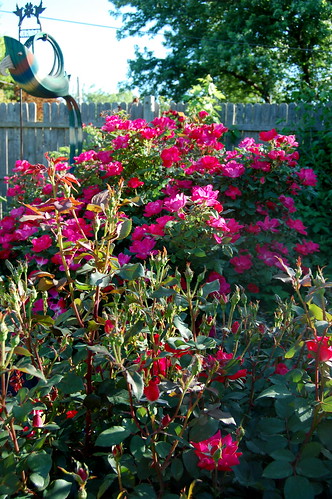
Double Knock-Out Roses by Charity D

I have seen that with this added fertilizer encouragement each time I water my roses, I have a great flower show. But even without the extra fertilizer boost, Knock Out Roses will delight you with continuous bloom throughout the summer. Just let it catch its breath.

Growing Herbs in the Dormitory

Indoor Herb Garden- Day 1 by Talkingsun

TheGardenLady received this question from Alexandra.

I saw your article about growing plants in a dormitory room that you did quite a long time ago (2006!) and I was wondering if you would be okay with answering a kind of similar question.

My roommate and I want to grow lots of plants in our dorm room next semester because it’s so drab in there (white walls, white ceiling, white floor, etc.) and we both have agreed that it would be cool if we could start growing herbs. We both like making tea, and we both think that it would be nice to have plants that would smell good, taste good, or be useful instead of plants that just look good.

We are going to live in a corridor-style dormitory room, and it has one big back wall window. I am not sure if it faces south, or not (new room) but I have stayed in the room style before and I know it lets in a decent amount of light. The dormitory IS air conditioned/heated, so keeping plants warm is not a problem.

What kind of plants would you suggest? And is this a good idea at all?

Good for you to want herbs in your dorm and I am so pleased that you checked out TheGardenLady archives.

You can grow herbs indoors but the crucial item that you will need is light. Herbs come from the Mediterranean where they get lots of sunlight. You need a minimum of 6 hours of sunlight to grow herbs. Rooms, even with windows, generally don’t get enough sunlight for herbs. So the first thing I recommend is getting good growing lights into your room.

One suggestion is to buy a special lamp already created to raise herbs.

Herb Garden – Post-Potting by a crafty vegan

A company called Aero Grow makes one with a planter attached to make it easy – everything you need for your indoor herbs in one compact piece.  See here.   I saw one in my local hardware store. It is not that large, but it would be a start.

If you want something larger, perhaps you and your dorm mates could build a grow light to put over a planter. A friend of mine who loved African violets had her husband build one where she raised show quality African violets that were always in bloom.

You could probably get information on how to build grow lights with a planter at your local lumber yard or Home Depot or Loews. They would also advise you on the best bulbs that are needed. You want a cool bulb so the heat doesn’t get too much for the little plants.  See here.

Continue reading “Growing Herbs in the Dormitory”

Graveyard Plantings

Carolyn’s Shade Garden in Bryn Mawr, Pennsylvania

TheGardenLady recently wrote  a post answering a question about the the types of plants she would recommend planting near a graveside.  You can read it here.   She then received the following letter from Carolyn Walker of the famous  Carolyn’s Shade Gardens in Bryn Mawr, Pennsylvania, which  was about the same topic.  Here’s Carolyn’s letter.

Hello Garden Lady

It is very coincidental that you should have this question about planting around graves. One of my customers referred an elderly woman to me who was interested in planting around her husband’s gravestone. The cemetery, which was in the woods, allowed live planting. She sought my advice on what would be elegant, simple, easy to maintain, and most importantly, deer proof.

My son and I went to the graveyard and transformed the site. First we removed the sod in a rough oval extending around the sides of the grave to soften its stark outline (see before photo). Then we planted ten shade perennials for maximum year round impact and deer resistance. We chose three Helleborus niger ‘Jacob’, one of the new Christmas roses that is not only evergreen but also blooms from November to April. We surrounded it with five Lamium maculatum ‘Shell Pink’, the only lamium that blooms from April to November. It is also evergreen. We now had flowers and foliage year round. Finally, we added two Brunnera macrophylla ‘Jack Frost’, a perennial forget-me-not with huge, silver leaves and long-blooming blue flowers in spring. To me the heart-shaped leaves of this plant symbolize the husband and wife. The two after pictures show the completed job. The plants will fill in quickly so that no bare earth remains.

I have never done this type of planting before, but it was immensely satisfying.

Carolyn