Companion Planting for your Garden

Photo of Marigolds planted next to Cucumber plants by Ellen Sousa at Turkey Hill Brook Farm

When planning your garden this year, consider companion planting.  What does it mean to do companion planting? Companion plants are the plants you should grow next to plants that you want in your garden. These companions assist because they have natural substances in their roots, flowers, leaves, etc. that can either repel and/or attract insects. The companions can also provide nutrients to the soil to help enhance the growth rate and flavor of the plants they are near. Companion planting has been used since the 14th century in small gardens as a way of helping to get rid of pests. Then in the 1970s organic gardeners started using companion planting to raise their plants without commercial pesticides. Companion planting is now included as one tactic in what is called Integrated Pest Management.

Why is Integrated Pest management also referred to as IPM? IPM is using a variety of methods that are benign and safe to get rid of plant pests. Companion planting is not the final solution to gardening problems; it is just one means of safe, benign pest elimination. So add it to your arsenal instead of just using synthetic pesticides, insecticides, or weedicides that can be dangerous to the user as well as the environment.


Continue reading “Companion Planting for your Garden”

Watermelon: where to find different varieties

A piece of watermelon.... by Rebeca Mello

TheGardenLady received this question from Bluelytes:

Would you know where I could obtain seeds of these russian watermelon varieties?:  Podarck Solatsa or Skorospelyi Sakharnyi

Watermelon is one of my favorite fruits -  if you can find them when they are ripe and fully sweet. That doesn’t seem to be the case these days. When shopping for a watermelon if you see the stem end still remaining on the melon, one can tell that the watermelon was harvested early. This is a clue that generally the watermelon will be a disappointment. Hopefully, also, when you buy a watermelon, you will get one harvested locally so that you know the melon could ripen longer on the field.

summer by carrie227

China is the number one producer of watermelons. If Chinese watermelon are sold in US stores, they were probably picked before they ripened.

Your question intrigued me. I imagine that you are requesting a watermelon that you know is super sweet. So I did some research to try to find the seeds you yearn for.

I learned that watermelons are thought to have originated in the Kalahari desert of Africa. That makes sense to me because when I was a child, my parents planted a field of watermelon in a year that had a severe drought. We were surprised to see that even when the plants seemed to be dying we had the best harvest of watermelons we ever had. We had so many watermelons we didn’t know what to do with them; so we children would break them open, eat only the heart and have watermelon fights with the leftover watermelon flesh. Pink snowballs in the hot summer. We had so many we couldn’t give them away fast enough.

Family from Philadelphia drove down to the farm one day and loaded their car with so many watermelons that the car could barely move. Later we learned that just before they reached Philadelphia, their car had broken down from so much weight. It happened on the Benjamin Franklin Bridge.

Continue reading “Watermelon: where to find different varieties”

How to Get Free Tickets to 2010 New Jersey Flower & Garden Show (Feb 18-21)

New Jersey Flower Garden Show by Free Of The Demon

Once again PSE&G is giving free tickets to the New Jersey Flower & Garden Show that is being held at the Raritan Center in Edison, NJ, starting Thurs., February 18 through Sunday, February 21st. You print the ticket yourself and it is a free pass for two.   Click here.

For a fresh whiff of Spring, TheGardenLady recommends your attending flower shows. Let GardenLady readers know if there are free or discounted garden show tickets for flower shows in your state.

New Jersey Flower Garden Show by Free Of The Demon

Galanthus and Other Winter Plants To Buy From Carolyn Walker’s Shade Garden

More Galanthus and other winter interest plants that you can buy from Carolyn Walker’s Shade Garden

Potter’s Prelude

Charles Cresson’s Heirloom Snowdrop Collection

New G. ‘Atkinsii’: In Snowdrops, Matt Bishop says that ‘Atkinsii’ has “elegant elongated flowers that suggest the drop-pearl earrings of Elizabeth I”—if that description doesn’t portray a true English classic, I don’t know what does. It is a large-flowered cultivar (the largest I am offering) valued for its early bloom and particularly sweet fragrance. Selected in the 1860s by James Atkins of Gloucestershire, Charles got his bulbs from the famous Swarthmore bulb authority Mrs. Wister. She bought her bulbs in the 1960s from the Dutch bulb nursery, Van Tubergen, renowned for their well documented bulb collections. The authenticity of Charles’s stock has since been reconfirmed by Michael Hoog, the grandson of Van Tubergen’s founder. Charles’s plants have the appearance and documented lineage of true ‘Atkinsii’, a snowdrop almost impossible to obtain today outside of England. $25 (1 plant per pot).

G. elwesii var. monostictus ‘Potter’s Prelude’: This is a free-flowering and vigorous snowdrop with wide recurving blue-green leaves and large flowers similar to the best of the species except that it blooms from November to January. It was selected by Jack Potter in the 1960s, former gardener to Mrs. Wister and Curator of the Scott Arboretum. In 2004, Charles registered it with the KAVB (the international registration authority for bulb cultivars) in the Netherlands. Matt Bishop declared ‘Potter’s Prelude’ the best of its type and will include it in the revised edition of Snowdrops. I am honored to be the only source for this cultivar. $40 (1 plant per pot) (photo above).

New G. ‘Magnet’: The descriptions of this snowdrop are a joy to read, and I can see why after having it in my garden. The stem (or pedicel) of the substantial flower is long and thin causing it to sway in the slightest breeze and setting ‘Magnet’ apart from all other snowdrops (no magnifying glass needed). Selected in the 1880s, it may have been named ‘Magnet’ after the child’s fishing game with magnets and sticks, we can’t be sure. I do know that Matt Bishop says it defines garden-worthiness and is a mainstay of snowdrop collections throughout the world. $25 (1 plant per pot).

Continue reading “Galanthus and Other Winter Plants To Buy From Carolyn Walker’s Shade Garden”

More On Galanthus To Buy From Carolyn Walker’s Shade Garden

More on Galanthus that you can buy from Carolyn Walker’s Shade Garden

Galanthus ‘Potter’s

Galanthus elwesii

Early January bloom, unique green markings, naturalizes

Galanthus nivalis

Bears many flowers, spreads rapidly

Galanthus nivalis ‘Flore Pleno’

Double flowers

Galanthus nivalis ‘Viridi-apice

Green markings on outer petals, substantial plants, my favorite

Galanthus ‘S. Arnott’

Heart-shaped green marking, rounded petals

Galanthus ‘White Dream’

Late-blooming, rare

Galanthus woronowii

Continue reading “More On Galanthus To Buy From Carolyn Walker’s Shade Garden”

Galanthus Nivalis at Carolyn’s Shade Gardens

Calling all Galanthophiles

(That’s a British word for gardeners obsessed with snowdrops)

Galanthus nivalis at Carolyn’s Shade Gardens

Carolyn Walker of Carolyn’s Shade Gardens writes that ” buying snowdrops ‘in the green’ (as they say in the snowdrop world), rather than as bulbs in the fall, is the best way to insure vigorous healthy plants. You will also be able to enjoy the blooms immediately as most plants will be flowering when you receive them. ” She has teamed up with the famous Swarthmore gardener Charles Cresson to make available some of his exceptional heirloom varieties. Charles teaches the bulb course at Longwood Gardens (among other accomplishments) and has traded with numerous garden friends and snowdrop enthusiasts to amass an amazing collection of snowdrops, some of uniquely local origin.

Carolyn is also offering four additional winter interest plants: a miniature arum, a special crocus, a spectacular hardy cyclamen, and an early-blooming Christmas rose.”

GALANTHUS: Common snowdrops (G. nivalis) appear naturalized throughout Carolyn Walker’s garden. The wonderfully honey-scented, white flowers appear by the thousands from February through March-a signal that winter is ending. By adding unusual varieties, one can extend the snowdrop bloom season from mid-fall through spring. For example, ‘Potter’s Prelude’ blooms in the fall, while G. elwesii, ‘S. Arnott’, and ‘Atkinsii’ bloom in the winter before the common snowdrop. A great companion plant for hellebores, snowdrops grow in full sun to full shade and are usually not picky about soil. Deer resistant and summer dormant. For more photos, use Google images.

To Order: If you would like to order any listed in the above paragraph, please send Carolyn an email to carolynsshadegardens@verizon.net with the plant name, quantity, your name, and telephone number. Supplies are limited (except for G. nivalis) so order early. You will receive an email confirming your order, amount owed, and outlining pick up options for late February or early March. Any snowdrops purchased can be planted in your garden immediately or enjoyed in the pot until they are planted later in the spring.

More photos from Carolyn Walker’s Shade gardens that are for sale will appear in the next column.

US Fish & Wildlife Service’s Endangered Species Bulletin

TheGardenLady just signed up to receive US Fish & Wildlife Service’s Endangered Species Bulletin. “The Endangered Species Bulletin was created in 1976 to meet the growing demand for endangered species program news. Through the Bulletin, the U.S. Fish and Wildlife Service disseminates information on rulemakings, recovery plans and activities, conservation partnerships, research developments, and a variety of other issues. It is distributed on-line four times per year. ” Check out their information here. TheGardenLady readers might also be interested in receiving their mailings. Perhaps there is some way we can help in preventing more loss of endangered species and help to recover some of them from extinction.

And if you have children or grandchildren or know children, you can raise their awareness level by subscribing because there is a section for Kids called Kids Corner that is educational and fun as well as telling children how they can help. This is a site I want my friends, children and grandchildren to know about.

Where to get Spring Snowflakes, Leucojum

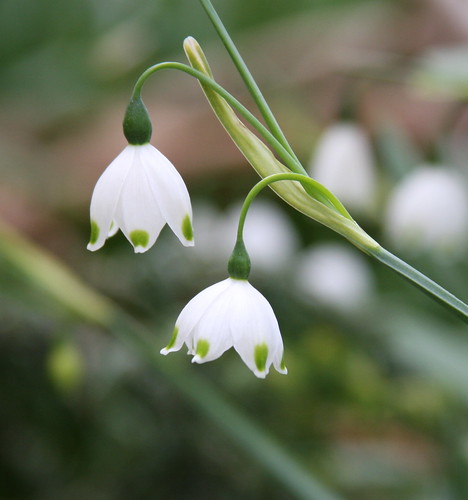
Leucojum by ajay77*

TheGardenLady received this question from Lisa:

I have been looking for spring snowflakes, but can’t find them here in the US. Do you sell them, or know where I might be able to find?

According to the Pacific Bulb Society, “Leucojum is an European genus with species commonly known as “snowflakes” and often regarded as the poor relation of Galanthus with species known as “snowdrops”.  Species are regarded as hardy in the south of England, New Zealand, Australia and the southern states of the USA. Leucojum is a member of the Amaryllidaceae family. ”

Beauty... is the shadow of God on the universe. ~Gabriela Mistral, Desolacíon by Abby Lanes

There are numerous nurseries that sell Leucojum. Two that I would recommend are Brent and Becky’s Bulbs and John Scheeper’s Inc.  They are both very fine bulb nurseries and they both sell two kinds of snowflake, Leucojum aestivum and Leucojum aestivum Gravetye Giant.

But they probably do not sell snowflakes at this time of year.  Leucojum have to be planted in the fall for spring flowering.

Scheeper’s fall catalog will come out in early June.

When you order from these nurseries, the bulbs will be shipped to your property at the proper time for planting in your temperature zone.

Good luck. And send TheGardenLady a photo of your snowflakes next spring.

Carolyn Walker’s Garden Catalog

Dear Readers, I am letting you read a letter I received from one of my favorite spring plant gardeners who also sells her plants and has a wonderful catalog – with Latin names – so you can order plants you want for your own home. This is Carolyn’s Shade Gardens.

If you live in or are visiting the area, by all means, visit Carolyn Walker’s home and charmingly delightful garden where you will see every plant she sells, happily growing and you can buy the plants you love seeing on her property. Carolyn’s Shade Garden sells quality plants and this GardenLady recommends them. If you meet Carolyn , tell her you read about her sale on TheGardenLady.

Happy New Year to you and your family!

I am sending out my catalog (here it is CATA2010) early this year to serve as a brief respite from the cold weather we have been experiencing. Curl up by the fire or in bed and enjoy this glimpse of warmer weather to come. I must admit, winter is not my favorite time of year. Even now though, I have plants in bloom: the snowdrop ‘Potter’s Prelude’ and the Christmas rose ‘Jacob’, among others. My gardens provide me with a restful sanctuary from the stresses of daily life and, this year, the difficult economic times we still face. I hope you can also seek solace in your gardens. For a small investment in plants, there is a big reward.

Plants can also be a positive step in sustaining the environment. When I read Doug Tallamy’s book Bringing Nature Home, I finally understood why native plants are not only desirable but crucial to the survival of our world. His book has inspired me to do more to promote native plants. When you read the attached catalogue, you will see that all native plants appear in green so you can easily find them. Look also for plants marked New to read about some exciting introductions to my list.

Please come to Carolyn’s Shade Gardens this spring to see what plants you can add to your own refuge from the cares of the world—your garden.

Enjoy the catalogue,

Carolyn.

Coastal Maine Botanical Garden

This past summer TheGardenLady went to Maine with her family. The first night we stayed in a lovely Bed and Breakfast called Snow Squall Inn that my son found serendipitously on line. The owner Paul Harris is not only a professional chef, but he loves to garden. He was originally from England where, I think, gardening is in the genetic makeup of the people. We arrived later than expected, but Mr. Harris came out to greet and welcome us. Upon learning that I was interested in Gardens, he told me about a new botanical garden in the area that he said shouldn’t be missed. How right he was.

The Coastal Maine Botanical Garden opened in 2007 on 128 acres of pristine land with 3,600 feet of tidal shore frontage in Boothbay. They were then gifted more land adjacent to the original 128 acres so that ” Coastal Maine Botanical Gardens is now comprised of 248 acres, which makes it the largest botanical garden in New England. The property boasts nearly a mile of tidal salt water frontage. It is also one of a very few waterfront botanical gardens in the United States. ”

Continue reading “Coastal Maine Botanical Garden”