Clematis or Akebia?

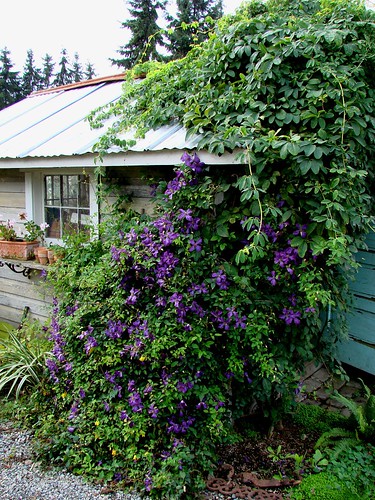
Clematis and Akebia by edgeplot

TheGardenLady received this question from Rose.

I saw a gorgeous plant at a person’s house and thought it was a clematis. She said it wasn’t and said a name like “boca via” or something. I tried to do a search and couldn’t find anything like that. It is a very tall plant in a huge pot with a trellis type thing to hold it up. Just beautiful! Any ideas what is was?

Trying to find a plant without knowing its Latin name or even a common name, with no description of the flower and its color nor having a photo of the plant- even a photo of its leaves if not a photo of the flower, is asking a lot of TheGardenLady.

I will guess that your friend might have an Akebia Trifoliata known as the three leaf chocolate vine. This has a pretty flower. with a fragrance. It doesn’t like its roots disturbed and can be planted in a container or in the garden. It grows tall.

BUT Akebias can be INVASIVE.   See here.  If this is the vine you are seeking, when buying BE WARY! What does invasive mean? It means that the roots or seeds of the plant will spread all over and for the rest of your life you will be trying to kill the plant all over your yard and your neighbors’ yards. Invasive plants do not allow other plants to live and because the Akebia is not native, it will probably not allow native birds or good insects like butterflies to have sufficient foods that they need. Especially the Akebia quinta (the five leaf chocolate vine) which is definitely said to be VERY invasive. I’ve read of a new variety of Akebia quinta called Silver Bells Chocolate vine. TheGardenLady thinks that this vine will also be an invasive. Just because something is sold does not mean that it is ok.

Please, if this is the vine you are looking for, check out your state’s invasive list or call your local Master Gardener office to check on the plant’s invasiveness. I would worry about the invasive quality of any Akebia and buy a beautiful clematis instead. There are so many clematis to choose from.

If the Akebia is not the vine you are looking for, contact Georgiavines. The owner has made it her life’s work to raise vines of all kinds. She might even suggest a vine for you that the person whose vine you loved will find even more enticing. Two other vine nurseries are here and here.
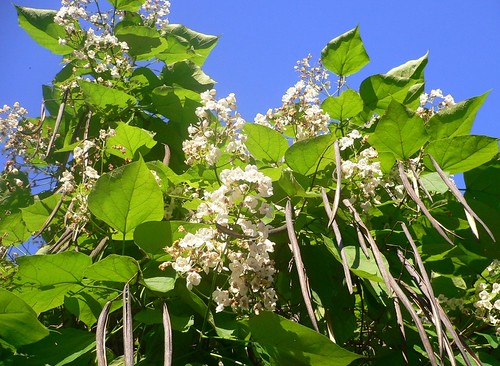
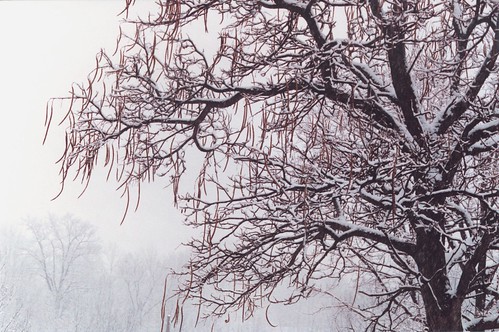
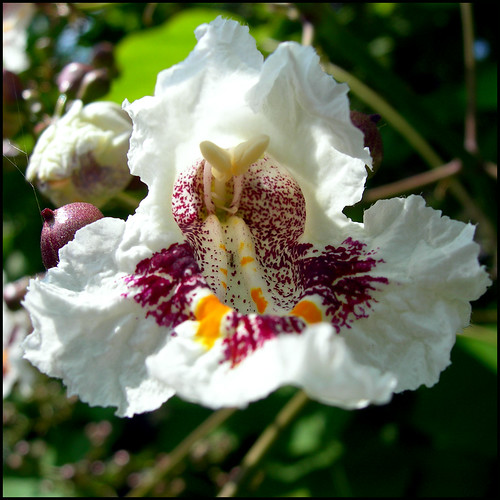
Catalpa Speciosa

Catalpa bignonioides tree by Luigi FDV
"Catalpa bignonioides" tree by Luigi FDV
CATALPA DAYS by wildcardpoet

One of my favorite trees is in bloom right now.  It is a tree I grew up with and played with the flowers that fell to the ground. It is the Catalpa speciosa or catawba tree.

CATALPA SPECIOSA by ESOX LUCIUS

TheGardenLady has one shedding its flowers on the side of her property. One delighted me by self seeding near the driveway. And I just transplanted a baby that self seeded or a bird planted in my perennial bed. I worry that the baby might not be happy in its new location because this is an area that might not have good drainage, which the catalpa likes. The catalpa tree does not like poor drainage or really feezing weather.

The catalpa tree has numerous common names like umbrella tree, Indian bean tree, Johnny smoker tree, Indian cigar tree, fish bait tree and Lincoln Log Tree. This is a tree that native Americans used and the early pioneers liked, seeing how successfully the tree lived under all sorts of situations from polluted cities to windswept prairies; how it grew quickly; lived long- up to 70 years; and had profuse fragrant flowers while it gave shade with its large heart shaped leaves. Farmers found they could use the wood, which makes strong, lightweight rot-resistant fence posts . In fact the northern catalpa is used for carving, millwork, framing, furniture, drawer sides, and general-purpose construction. The species is also intentionally planted to control erosion, aid brownfield revitalization or new stand growth, and as windbreaks and screening from the sun. Thus pioneers found a good tree to take with them wherever they moved. They planted catalpa trees on their new property all over the country.

There are two types of Catalpa trees: the larger more showy Northern C. speciosa and the Southern C.  Bignoniaceae, but both seem to do well outside their range from zone 4 to 8. The nectar in their flowers entices hummingbirds, tiger swallowtail butterfly larva, and bees. The trees and seedpods attract lots of birds.

Though TheGardenLady has never had any problems with the catalpa trees on her property, they can have problems. One is the Catalpa Sphinx moth (or catawba sphinx moth) The caterpillars can cause defoliation; but if the tree is hardy it will have its leaves grow back unless major defoliation occurs for a few years in a row. Then the tree might see a limb die. Cut off any dead branches. A lot of fishermen find the caterpillar of the sphinx moth great for fishing. There is also a fungal disease that may affect the tree, but that is not too common. If a tree dies, do not plant another catalpa in the same area.

Warning : The flower pollen is quite allergenic so if there are allergies in the family, don’t plant the Catalpa. Also, the tree can become a large tree that will crowd other trees out or give heavy shade where plants can’t grow; so this is a tree for a fairly large yard. Know that the tree the roots are poisonous, Be wary that the sawdust from working with Catalpa wood can cause inhalant and skin allergy symptoms. Don’t use catalpa wood chips or shavings as animal bedding in case they might cause a problem for pets. The seedpods and seeds of catalpa contain a mild narcotic and sedative and should not be put in the mouth or eaten.

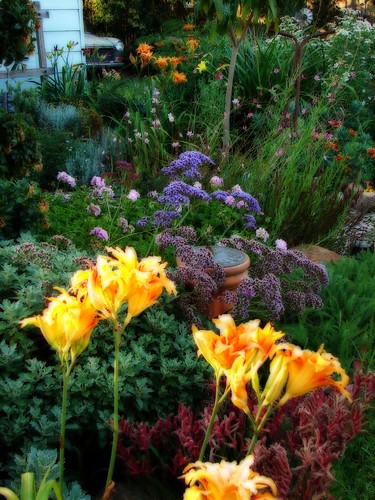
Showcase Your Garden

My garden in full bloom by aussiegall

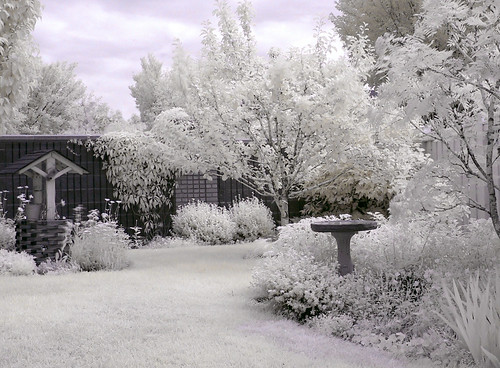
The GardenLady is always looking for beautiful and interesting gardens. And I am sure that the readers would also love to see photos of wonderful gardens. The blog would love to showcase YOUR GARDEN.  If you want to show off your garden, contact me by filling out the information on this page.

Welcome to My Garden by njchow82

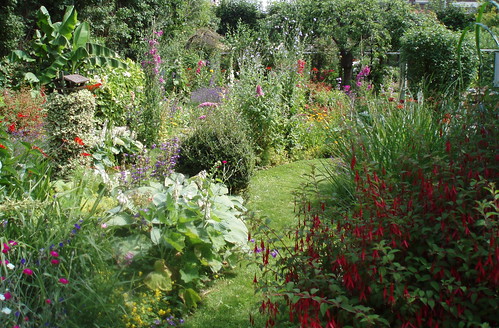
I am asking TheGardenLady.org readers for photos of your garden with a little write-up about the garden. The write-up should include what country (US, Canada, England, Abu Dabai, etc) and state your garden is in. If you don’t mind telling what town or city your garden is in, that would be wonderful. It would be nice to see both over views and close ups of your plants with the names of the plants in your garden. Other interesting details would be the age of your garden- how long have you been creating it; which direction is North in your garden; something about the soil- is it acidic, neutral or alkaline; what you use for mulch; how much sun your garden gets; any problems your garden has; any interesting anecdotes about your garden; and anything you think would be of interest to TheGardenLady blog readers. Email as many photos as you can.

View on my garden by frans schmit

Of course, if you don’t have a garden but have indoor or patio plants, TheGardenLady would love to see photos of your plants, too. Include information about the plants- names, how long you’ve had the plant, how you designed your container with plants, etc.

Thank you.

(The webmaster reserves the right to choose the photos for the website and edit the writings.)

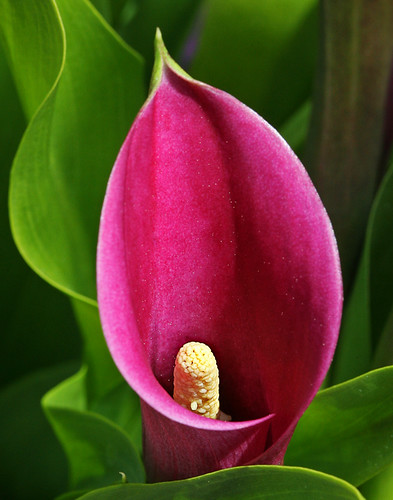
How Calla Lilies Can Hold Their Pink Color

Calla Lily by janruss

TheGardenLady received this question from Deb.

How do I keep the flowers pink on my calla lily plants?  They are turning white.

As much as TheGardenLady loves calla lilies, because she does not live in a zone where calla lilies are happy and can be left in the ground all year long she does not grow them. Therefore she does not consider herself an authority on Calla lilies. For that reason TheGardenLady contacted MidCity Nursery, Inc in California to ask this question.

Their response was what TheGardenLady suspected, which is to say that when flowers age many of them will fade to a different, lighter shade – for example, pinks can become paler or white. Calla lilies can fade in the sun after a few days. If the Calla lilies were planted in a shadier area and not in full sun, it would hold its pink shade longer. There are nurseries that sell garden umbrellas for this very reason.  See e.g. the Cricket Hill Nursery.

However sometimes, if you plant pink calla lily bulbs in the same vicinity as you planted white calla lily bulbs, the following year the white calla lily bulbs will be dominant and you won’t find any pink calla lilies blooming. Or since the color white is the dominant calla lily gene color, that might take over to give you white calla lilies where you had pink.

There is nothing you can do but enjoy the white calla lilies. TheGardenLady feels certain that calla lily breeders must be working on this problem.

Container Gardening

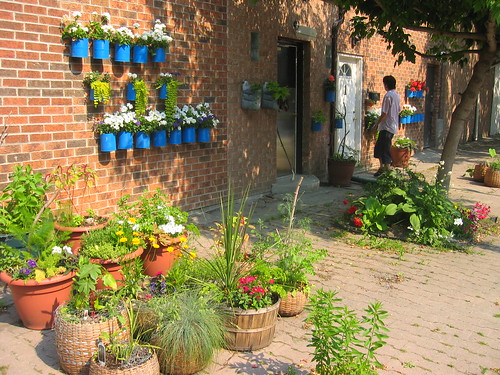
Container garden, Toronto, Canada by Happy Sleepy

TheGardenLady received this question from Joyce.

We have a long raised planter that gets quite a bit of sun but only in the afternoon. It’s very shaded most of the day.  I tried impatiens there last summer but they got too much sun. Any suggestion for colorful easy to grow and fairly low growing annuals? Would pansies or geraniums work?

Container gardening is fast becoming one of the most popular ways to garden. All sorts of plants are good to grow in planters.  See here.  Let your imagination run wild. I will give some suggestions of flowering plants.  But consider planting vegetables or herbs in your container or a combination of both.  Watch this video.  Visit local nurseries to see what they have planted in containers both to see what grows well in your area and to see what combinations look good.

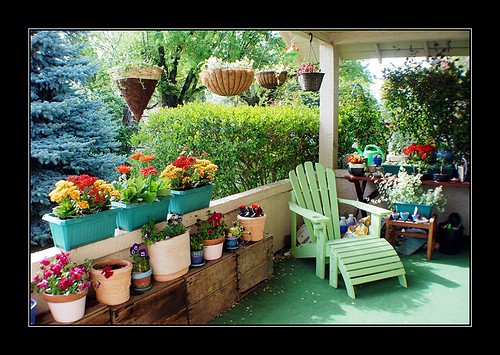
FrontPorchSpringGardenMay08 065small by _Anaya_

Afternoon sun is the hottest sun. Most flowering annuals as well as vegetables and herbs need the hot afternoon sun. These plants want approximately 5 or 6 hours of the afternoon sun. Do you think your planter gets that much sun? Try to see how long the sun shines on your container. If it gets lots of afternoon sun, you have lots of choices.

If you are buying plants, try to get healthy plants from the stores. One brand that prides itself on selling healthy plants is called Proven Winner. A list of stores in Maine that sells this brand is this. If you should have a problem with the plants, I would think the stores would back these plants.

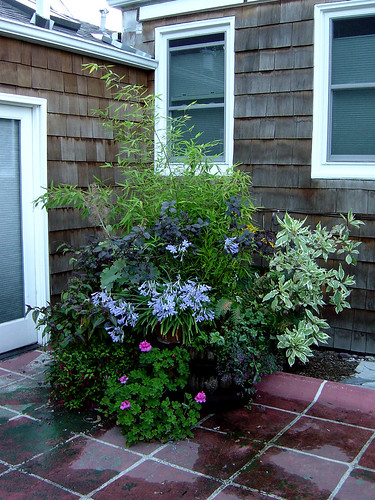
Container Gardening by edgeplot

If you are buying plants or using seed packets, check to see the height the plants will grow to be sure that you get plants the height you want. For example, if you decide to plant zinnias, they come in differing heights. Look for a dwarf variety if you want short plants.

You asked about pansies. Pansies would look lovely in planters. One summer when I was in Freeport, I was impressed with the planters in front of many stores filled with pansies. But understand that pansies are a cool weather plant. They hate hot weather and will not last in the heat. So if this summer is hot, you will be out of luck. Pansies like full sun but will tolerate partial shade.

Geraniums (whose Latin name is Pelargonium) are an excellent choice. They love full sun but will tolerate partial shade, though they may not bloom so profusely. They are drought resistant which might be good for you since containers can dry out more quickly than a garden. There are so many different kinds of geraniums. Consider scented geraniums- Pelargonium species and cultivars with fragrant leaves, ivy-leaved geraniums Pelargonium peltatum with a trailing habit and Pelargonium zonale a bushy plant with red, pink, purple, orange or white flowers and often multi-colored foliage. Remember to dead head the flowers to keep your geraniums blooming.

Some other afternoon sun loving flowering plants you can use are calendula, petunia, marigold, salvia, Calibrachoa, Nasturtium, lantana, melapodium, and if you can find these two unusual annuals- creeping zinnia Sanvitalia procumbens and Tassel flower- Emilia javanica.

Consider using plants with different colored foliage like Dusty miller -Senecio cineraria. Put in plants of different heights so that there is a tall plant in the center and plants that hang over the edges. You can mix tropical indoor plants with the annuals or vegetable plants with the annuals-like cherry tomatoes and marigolds.

The choices are extensive. I wish you luck.

Please share photos of your container with TheGardenLady’s readers.

Controlling Fungus Gnats

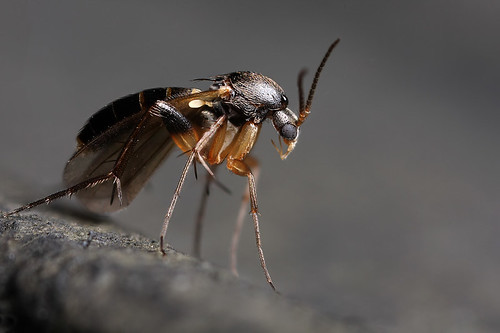
Think this belongs in LOTR - a fungus gnat by Lord V

TheGardenLady received this question from Devon.

Do you have any tips on controlling fungus gnats.  I have some in a herb planter, so i don’t want to use chemicals because I’d still like to be able to consume the herbs.

Fungus gnats look like tiny mosquitos that are about 1/8 inch in length. They lay their eggs in cracks on the soil surface which hatch into larva within 6 days and begin feeding on plant roots. After feeding for about 2 weeks, they pupate in the soil and emerge in less than a week as adults, to begin the cycle all over again. Usually when you first get them they are in the egg stage- in the soil of plants that have been outside for the summer or in damp bags of potting soil or from the nursery where they were bought. It is the larva stage that can do damage to young plants and seedlings by feeding on the new, tender roots. Their feeding stresses the plants and provides an entryway for disease pathogens.

Fungus gnats are usually a problem in the house or greenhouse. When you buy herbs, you should check to see that the soil is free of this problem. Fungus gnats can be a real problem to eliminate. Hopefully, you are finding them early so that you can eradicate them. If you have a really bad infestation, it might be easier to get rid of the plants and get new, healthy plants.

It is smart to practice IPM – which stands for Integrated Pest Management- as this is the most user friendly method of getting rid of pests on your plants. Stay away from chemical pesticides if you can. With fungus gnats, it is not really necessary for the home gardener to use any chemicals.

First of all fungus gnats like dampness. Are you over watering your herbs? Most popular herbs are native to areas that are dry. These herbs like sunny dry conditions when raised in your garden or when in pots. Herbs do not like over watering. Many herbs are drought-tolerant. Moisture is needed especially when the herbs are seedlings and moisture is needed to maintain active growth but don’t over do it. Water herbs thoroughly and then allow the soil to dry out somewhat before watering again. Plants should be watered early enough in the day that leaves can dry before nightfall.

It is advisable to get yellow sticky traps. For some reason insects are attracted to the yellow. You can see from the number of fungus gnats sticking to the traps just how bad the infestation is to plan your next step. Commercial greenhouses keep these traps all over to monitor their insect problems. Yellow sticky traps are sold in hardware stores.

Always keep plant areas clean. Get rid of weeds and dead debris which can be a breeding place for pests like fungus gnats. If the plants are in pots, see that the weeds and debris are discarded and not left near the pots. Don’t use fresh composted organic matter or potting mixes that contain fresh compost unless it was pasteurized first. In addition to feeding on plant roots, fungus gnat larva will consume organic material in the soil. Don’t use mulches or moist and decomposing grass clippings or organic fertilizers on the soil. Clean up free- standing water and eliminate any plumbing or irrigation system leaks. And be sure that the soil is well draining.

Put a moist slice of potato and keep it moist- on the soil. The potato surface sometimes attracts the feeding larva which can be used to collect and dispose of larva and to gauge when the larva are actively feeding.

There are some predators that you can buy. Two types of beetles feed on fungus gnat larva – rove beetles and ground beetles and there are some nematodes that will destroy the larvae. You will have to check for these products on line or in catalogs. And then there is a biological insecticide Bacillus thuringiensis subspecies israelensis (Bti) (the product is sold as Gnatrol) that can be applied to control fungus gnat larvae in container media. Bti applied as the label tells you to provides temporary control and is toxic only to fly larvae, such as mosquitoes, black flies, and fungus gnats. Repeat applications are needed for long-term control.  See here.

Carolyn Walker’s Shade Garden is selling compost

Carolyn Walker’s Shade Garden is selling compost.  If you do not make your own compost and want some, you should contact the owner’s son immediately. But you have to pick up the bags.

Final Call for Compost:

Carolyn Walker’s sons, Matt and Alex, have a limited supply of beautifully sifted, fully decomposed compost available. Carolyn Walker never prepares a bed or plants a plant without adding some “black gold” (she says ” top soil and peat moss are a waste of money-they just don’t compare”). Her plants thrive without fertilizers and with minimal watering on their compost diet.

If you would like to place an order and can pick up during this weekend June 27th and June 28th, email Matt at mattwd21@yahoo.com. When placing an order, please include your name, phone number, and the number of bags you want. Matt will confirm your order by email.

If you cannot pick up this weekend, want at least four bags, and wish to be placed on a waiting list, please let Matt know.

North Star Orchards included the following comments in their most recent newsletter:

“Don’t forget your vitamins! Well, in this case, organic matter (i.e. compost).

Our highly unscientific experiment this spring showed dramatic results. Daffodils grown on the ‘untreated’ poor overworked soil
our farm came with (photo on the left)….and daffodils grown just a few feet away in soil ‘treated’ to a heavy dose of well-made compost (photo on the right).

And that’s the same 12-inch ruler standing next to each bunch.

Yep…the compost thing really does make a difference.”


image002image0031

image001

Avocado Tree Problems

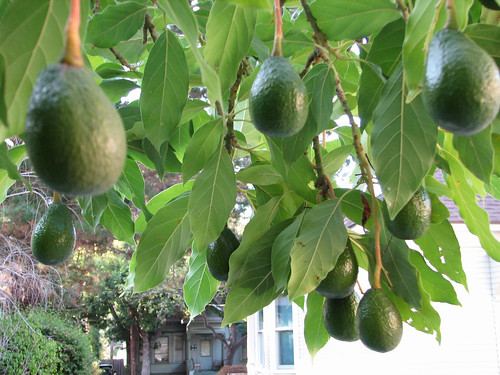
bounty by emdot
bounty by emdot

TheGardenLady received this question from Jonathan.

I recently planted a 3-4 year old avocado tree which is now about 8ft tall.  Since planting the leaf tips have been going brown and some leaves are very brittle, despite watering once or twice a day. Am I over watering? When I feel the earth around the tree it can be quite dry.

From reading your question, TheGardenLady cannot tell if you planted the avocado tree in a pot or out in the garden. If you planted the avocado tree in a pot, there may be too much salt gathering in the pot so you have to flush the pot out with lots of water. If it is grown in a pot it is best to give it frequent, light waterings with an occasional deep soak. Generally, the soil should be moist but not saturated. Yellowing leaves are a sign of over-watering; let the plant dry out for a few days. But if, as you described, the leaves turn brown and brown at the tips, too much salt has accumulated in the soil. Let water run freely into the pot and drain for several minutes.

Avocado Trees Damaged by Frost by wlwarner

But if you planted the tree in the soil without a pot, one of the most common problem of avocados is tip burn and marginal necrosis (death) caused by water stress and salinity, which is most prevalent during hot, dry weather according to this site.  Proper watering is essential.

Even if you have good drainage, one can never tell if the ground is dry or wet just by looking at or feeling the top of the earth.  Recommendations are to make a basin around the tree over the root ball that is kept filled with water.   See here.  Also to have a device in the soil to see if the ground is really moist enough. Where avocados are planted on well-drained soil, it is better to give them water frequently than to try to keep them too dry. Read the link carefully for the recommendations on watering your avocado tree.

Eastern and Western Dogwoods

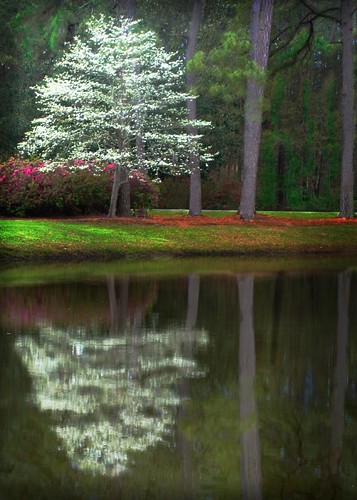
Dogwood In Bloom by pearson251

This spring has been an amazingly beautiful one florally. Usually during most springs on the east coast one sees the magnolia trees burst forth in bloom; but very shortly after they open there is a deadly frost that kills all the flowers. So what were once beautiful magnolias trees are now laden with frozen, brown ugly flowers. Nothing can be uglier than those big brown dead flowers. But this year it was different. The magnolia flowers remained looking lovely every day. Some magnolia trees were literaly wrapped in flowers.

The daffodils were spectacular. Everyone greeting one another saying, “isn’t this a magnificent year for daffodils?”. And it seemed like every house had amazing displays of daffodils. People in my area even had planted them in the center islands that were built to slow down traffic. So roads were beautiful as well as the gardens.

And this year wisteria were blooming their “vines” off. Visitors from the west coast were amazed to see tall trees covered with flowering wisteria. Sadly those vines strangle the trees; but still it was amazing to see all the wisteria blooms going up into the sky. Even TheGardenLady’s recalcitrant wisteria that had been dug up from her parents farm where it graced the front porch, had finally flowered this year after approximately 35 years in just this location alone- they are antiques.

Continue reading “Eastern and Western Dogwoods”

51st Annual Dearborn Garden Walk

Dear Shelly, Thank you for letting the readers know about the 51st Annual Dearborn Garden Walk. (Read about it below.)

We hope, for the sake of readers who can not attend, that you take photos and write a small article about this garden event and submit it to TheGardenLady.org so that we all can enjoy the gardens and see what we missed. If you can identify unusual plants, that would be helpful.

TheGardenLady is most eager to know of gardening events around the country and around the world. So readers, PLEASE don’t hesitate to let this TheGardenLady.org know what is happening in your gardens and gardens that are open to the public.

I wish I could attend all these garden events. Who knows, maybe TheGardenLady will be able to attend some. But it will be an anonymous
visit, just as she likes to keep the blog anonymous.

TheGardenLady received this letter from Shelly Cellak.

Dear Garden Lady!

I would like to let you and your readers know about this year’s upcoming 51st Annual Dearborn Garden Walk. This annual walk will be held on Sunday, July 19, 2009 from 12pm-5pm. This is a self-guided tour of over 20 private, rear gardens in Chicago’s Near North neighborhood. This year, we are featuring 5 new gardens and will be showcasing dramatic garden vignettes. Classical and jazz music will be performed throughout select gardens and there will be several guided architectural tours.

Tickets are $35.00 on July 19, 2009 and $30.00 in advance. Advance sales end on Saturday, July 18, 2009 at 12:00pm. For ticket purchase information, please call: 312-632-1241 or visit: www.DearbornGardenWalk.com.

We have some great photos we’d be more than happy to share with you.

Sincerely,
Shelly Cellak
773.398.6154

Website: www.dearborngardenwalk.com