TheGardenLady is delighted with comments from her readers. So keep them coming. I thank you. It shows that the articles the TheGardenLady writes are welcome, appreciated and enjoyed. Even if the reader is not so appreciative, TheGardenLady wants to hear from you to know what Garden items would be of interest in the future.
TheGardenLady may not be able to acknowledge all the comments, but
today’s column is to show her appreciation of the comments and to tell her readers to read the comments.
Joe’s comment in response to Deer Proof Plants is about a product to prevent deer damage. The product is made out of bloodmeal. TheGardenLady once called a company that made a similar product.
People who love flowers and plants seem to be some of the nicest people on this planet. They love what they are doing and are generous with their knowledge. A lot of them have a great sense of humor. TheGardenLady hopes to introduce her readers to a few of the plant people she knows about.
The first plantsman TheGardenLady wants to draw attention to is Barry
Glick who owns and operates Sunshine Farm and Gardens. Â This is a great nursery to buy Hellebores and other interesting plants. And the website is loaded with plant information. Also, Barry, who says he is the only one who mans the computer at his nursery, is available to answer questions about his
plants as well as take orders. He seems to give out plant knowledge seasoned with a great sense of humor. In fact when the Sunday Gazette-Mail wrote an article about Barry, he was compared to George Carlin in Jerry Garcia tie-dyed clothes who happens to be a prominent plant expert who ” breeds, hybridizes, patents, writes, lectures about and, of course, sells plants. Lots of them, all over the world.”
Now Barry’s specialty is the Hellebore. If you don’t know about this wonderful earliest of flowering plants, check out Barry’s website because Barry calls himself the King of Helleborus. But Sunshine Farms grows and sells thousands of plants besides the hellebores. His “plant collection now numbers more than 10,000 taxa, many unknown to cultivation. Several of these plants have been introduced to gardening in recent years. Barry exchanges seeds and plants with people at Botanic Gardens, nurseries and private gardens in virtually every country in the world.”
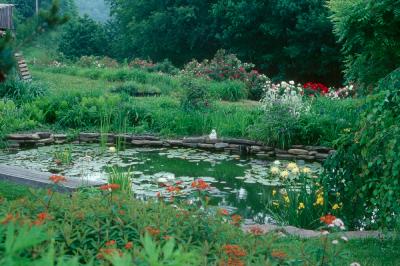
Photo by Mark Turner of the June garden at Sunshine Farm and Gardens
Sunshine Farm and Gardens is 60 acres of plantings located off a dirt road on what sounds like a cliff in West Virginia. In these 60 acres, besides the plants that Barry collects, (for example, he collects Jack-in-the-pulpits from all over the world) grows (including native plants) and sells. Sunshine Farms has an extraordinary sounding show garden. Barry calls himself a Flower Dreamer. And what a dream his nursery and gardens must be.
Every year I try to grow tons of cracker jack marigolds but they never seem to bloom well and do their best. I need a huge volume of flowers for the Hindu Fire Walking Festival, but still get let down at the last minute. What am I doing wrong? The Festival is on Good Friday towards the end of the South African Summer. Please advise.
It is difficult to determine your problems without seeing your plants. In the United States we have places we can take diseased or problem plants for the problem to be identified and hopefully corrected. These places are often part of the state agricultural extension office.
So let me give you a list of suggestions of things that could prevent the plants from blooming plus a suggestion to add flowers if all else is OK.
Valentine’s Day is coming up and TheGardenLady is sure that many of her readers are thinking about what to give your girlfriend, wife, mother or significant other.
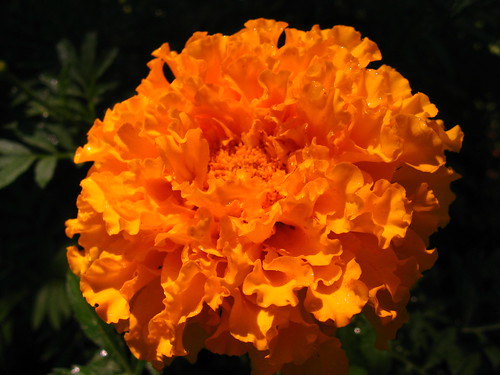
I have just bought a marigold plant which has a round orange flower. The flower has died in spite of its being kept in a sunny area. What should I do to get the plant back?
TheGardenLady is not quite clear about what died – was it the flower or
the entire plant?
If it was the round orange flower that died, just pinch off the flower. Pinching off the dead flower, which is called dead heading, encourages the plant to force at least one other flower. If you leave the dead flower to dry on the plant, you might not get many more flowers, but you will get seeds.
To get the seeds, you allow the flower to dry ON the plant and when it is really brown and completely dry, clip it off. Then when you want to plant more marigold plants, pull the dried petals out of the dried pod. Each seed is attached to a petal. Plant these seeds and you should get many more plants from all those seeds.
This is the time of year when everyone living in cold wintry areas want to rush the gardening season. To that end, to help with your dreams of your own gardens, there are Garden Shows coming up all over the country – and world. Plan your vacation around some of these Garden Shows. For example, the Philadelphia Flower Show in Philadelphia, PA and/or the Chelsea Flower Show in London, England are two flower shows everyone should attend at least once in your lifetime.
As garden lovers are sitting around their hearth dreaming of the gardens they want, many of us have to consider the deer that can decimate their plantings. To that end there is a new website listing 300 plants that seem to be deer proof. Of course, if the deer are starving, they seemingly will eat anything. This site is interactive in that they would like you to tell them if these plants really work or don’t work in your garden and yard. Here is their website.
The list is particularly good because it tells you much about the plant besides whether it is deer proof of not. For example, it tells you the color, where to plant – full sun or not – or height of the plant. Looking at the list superficially, TheGardenLady found that those plants that they said were deer proof were consistent with her findings. For example, TheGardenLady loves her Helleborus orientalis, Lenten Rose, Polemonium caeruleum, Jacob’s Ladder, Iris (several varieties tested), Lavandula angustifolia (‘Hidcote Blue’, ‘Munstead’, ‘Tucker’s Early Purple’ ) and English Lavender. They are among all the plants on the list. These plants are especially loved by TheGardenLady because they are never touched by deer on her property. And on this list they are listed as plants Never Browsed.
TheGardenLady also loves such plants as Hemerocallis (several varieties were tested) which is the day lilly. She knows how the deer love this plant so that if she wants it in her garden, she has to over spray it with a deer repellent or put a fence around the plants. This site tells you that Hemerocallis is FREQUENTLY Browsed. So, unless you like challenges when you create your garden, you won’t waste money buying Hemerocallis.
Check out this site which gives you other information about deer and their habits. For example, you can spray deer repellents on plants so that the deer learn to change their destructive path.
Every reader of TheGardenLady knows the importance of pollinators to pollinate (pol·li·nate- definition of the verb; To transfer pollen from an anther to the stigma of (a flower) flowers, vegetables and other plants, shrubs and trees.)
All agriculture depends on pollinators. “Pollinators are essential to Life.” We’ve read numerous articles about the problem called bee Colony Collapse Disorder (see here and here). Or the drastic decline, globally, of butterflies (see here and here). There is even a global bat decline (see here and here and here). All pollinators seem to be on the decline around the world.
TheGardenLady and her readers should try to do everything they can do to help the pollinators. One of the ways to do this is to grow plants that pollinators like and need. If the pollinator is an insect, the plants you grow should encourage insects from the egg stage through the end or their lives. If the pollinator is a bat, the plants that bats would need are crucial.
Toward that end, a new website is out there. This is a new Ecoregion planting guide to attract pollinators from www.pollinators.org. On the website, the co-founder of the Pollinator partnership says “Farming feeds the world and we must remember that pollinators are a critical link in our food systems.”
This website is for the US. TheGardenLady hopes that this type of website would expand for the rest of the globe. She wishes readers would let her know what similar websites are available in your part of the world.
Check out the website:Â www.pollinator.org/guides.htm for plants you can put in your garden or farm.
TheGardenLady had recently written a column about some of the benefits
of plants.
She recently read, in Science Daily, the results of a study done at Kansas State University published in the October 2008 HortTechnology that showed that hospital ” patients with plants in their rooms had significantly fewer intakes of pain medication, more positive physiological responses (lower blood pressure and heart rate), less pain, anxiety, and fatigue, and better overall positive and higher satisfaction with their recovery rooms than their counterparts in the control group.”
TheGardenLady feels that plants in one’s house or rooms has beneficial
effects on their owners and those living with them whether they have had surgery or not. So, bring potted plants into your rooms!
”]TheGardenLady received this question from Donna:
I have a that is turning yellow. I have had it for over ten years and it’s been in the same pot since. It has always done well, but here recently it is becoming sick. There hasn’t been any change to it to cause it. Any suggestions?
Since you say that you have had your Sansevieria Trifasciata plant, commonly called Mother-In-Laws Tongue or Snake plant, for over 10 years, I doubt that you have a gold variety like`Vandal Gold`, a Sansevieria that I have read about but do not know where to buy.
And I am amazed that you have a plant or anything that hasn’t had any change in all that time. There is nothing in TheGardenLady’s house that hasn’t changed in 10 years- including TheGardenLady.




![Sansevieria - Mother-in-law tongue or Snake Plant [Photo by Green Acres Nursery and Supply]](http://farm4.static.flickr.com/3282/2629831760_9308c4313e.jpg?v=0) TheGardenLady received this question from Donna:
TheGardenLady received this question from Donna: