How To Control Pests – Part II

This post is the second in a series of posts on the control of pests.

The second question a gardener has to ask when seeing pests or pest damage in the garden is: “Are the pests still actively damaging the plants or have they long since left or matured?”

Many pests have a brief lifespan. They do their damage and in a few weeks of damage their eating-part of their life cycle is finished. In that brief period when they are eating the plants they may do what seems like a lot of damage because they eat a large number of plants including flowers and herbs. Their damage is ugly. Then when the move on to another phase of their life cycle, they might not need to feed on the plant leaves or stems.

This spring the the four-lined plant bug did a job on my mint and my Russian sage. Almost all the leaves were eaten and affected. But I knew that when it was time for the flowers to emerge, they would not be eating and the flowers would look fine. My flowers and plants recovered. But I am not a farmer, so I can be tolerant. And in my garden the plants they ate were mostly weeds, so I did not have to be concerned.

Get to know the insects in your garden. By knowing about the the four-lined plant bug, I knew that in my garden I did not have to do anything drastic like use any strong pesticides (see here).

If you want to ID the insect and learn about it but cannot find the information online, take the insect in a closed jar to your local Master Gardener office or agriculture extension office. Do NOT squish the insect. To kill it put the closed jar into your freezer overnight.
How To Control Pests – Part I


One of the challenges of gardening is how to control the pests that like your garden as much if not more than you, the gardener. Some of these pests’ lives depend on your garden for their livelihood- literally eating to remain alive to repeat their own life cycle. So when you have insects on your plants you have to decide “How important is the damage to the overall appearance of the flower in my garden?”

Some insects that eat plants in the garden are good and helpful insects. We all know that bees are beneficial insects. Yes, they might sting us, but basically they are helping to pollinate the flowers or to get nectar to make honey. Without bees we wouldn’t have most plants. So we allow the bees to remain in our garden and don’t use insecticides to kill them.

But there are other equally good or beneficial insects that come to our plants that even do damage to the plants. But because we like these insects, we don’t want to kill them. For example, everyone seems to love butterflies and no one wants to kill them or eliminate butterflies from their gardens. But before they become the butterfly that we love, they were caterpillars that had to eat plants so that they could become (metamorphosis) that beautiful insect fluttering in our garden. Caterpillars need some of the plants that we grow and can become a pest especially if you are a farmer whose livelihood depends on your crops. For example, among the plants butterfly caterpillars need, depending on the type of butterfly, are parsley, or dill or fennel or even carrots or black-eyed-Susans.

Most of us are gardeners who do not rely on our crops for a living, so do we really care if caterpillars eat these plants in our gardens? To rephrase my original question: How much damage is being done by the insects in your garden and are you willing to live with that damage?


Helping a Languishing Maple Tree


TheGardenLady received the following question from Jean.

I live in a condo-type community and some of my yard is maintained by the management company. There is a maple tree that was planted about 8 years ago. It’s the third one in that spot because the first two died. After eight years, it doesn’t look much different than it did when they planted it. Every year, it hobbles along and the leaves turn before the surrounding trees, and fall off sooner. The bed it is planted in is sort of a high mound. It is watered with a sprinkle type irrigation system every few days. I haven’t fertilized it, and I’m not sure if the landscape company does. But I’m sure they treat it the same as everyone else’s trees. The other ones grow, and mine doesn’t. Do you have any suggestions?

You asked for some suggestions about the maple tree that does not look like it is thriving. I will give a few suggestions since it is difficult to give an accurate diagnosis without seeing the tree or at least some good photos of the tree.

First you did not mention if you checked to see if the tree has any visible diseases or pests that could cause problems. Maple trees, though hardy, do have some disease and pest problems. Check the tree carefully to see if you notice any problems. Some things to look for are on this website. I always recommend that you take some tree samples and photos to your nearest Master Gardener office or your state agricultural extension office for a diagnosis.
Continue reading “Helping a Languishing Maple Tree”

How To Choose The Perfect Pond Location

Ponds are a great addition to any garden and there is something ever so peaceful about looking out over the garden to your pond. Location, however, is one of the biggest factors when deciding whether to get a pond in the garden. Here is a short list of things to consider when placing that perfect pond.

Low and Wet

Ideally a pond does not want to be situated in the lowest point of your garden or in a location that is always wet. Placing a pond in the lowest point will encourage run off from the rest of the garden to head straight to the pond. This is turn can silt up the pond increasing the amount of maintenance that is needed to keep the pond healthy.

Under Trees

Whilst placing a pond under trees looks amazing, the trees reflected elegantly in the water, it is not usually a good idea. Trees, particularly deciduous trees, have a tendency to drop things into a pond such as pine needles, leaves, nuts and berries. Whilst this can be combatted with netting, it has to be cleared away nearly daily to prevent silting up. Placing a pond under trees will increase the amount of maintenance that needs to be performed.

Partial Sun

Ponds need sunlight for at least half of the day to encourage any plants to grow. Plants such as water lilies thrive in the sun. However too much sun can cause algae to grow, so it is always advisable to have plenty of pond cover with water lilies in the water and grasses around the edges.

Power Cords and Amenities

It is important to know the layout of the garden, and where electrical wires and other amenities run. The last thing anyone wants to do is put a spade through a power cord whilst digging the pond. In addition nobody wants to have to dig up all their wires and re-route them through the garden!

Level Ground

Whilst building a pond on level ground is not the biggest factor in pond location, it is fairly important if you do not want to have to create waterfalls and cascades which require extra work with pond pumps. These are readily available from aquatics shops and online such as at Swell UK. In addition to this non-level ponds end up with very deep and very shallow water, which have to be carefully planted.

Easily Seen

Of course one of the key things to consider is the fact that the pond needs to be seen from the house. Not only does this mean any potential problems can be spotted and acted on but looking out over the garden and seeing the pond is usually a key driving force for getting one in the first place, so make sure the view is not restricted and enjoyment can be had by all!

This article was written by David Wharton.

Taking Care of Your Fig Tree in the Winter

TheGardenLady received this question from Cheryl on the post “Buying a Fig Tree in New Jersey“.

I have a 15 year old turkey fig tree that I started from shoots. Last year I could not keep up with the amount of fruit growing on the tree. This May there are no leaves on the tips of the branches. The branches are red, turning to a deep gray almost black, which is different from the natural color of the tree bark. The branches snap in half and are not pliable. I cut a large branch. Inside the branch it is hard yellow in color with a white center. Has my tree died from the cold winter freezing? I have never covered it in the past. Was this winter too much for the tree? Help!

It was a really harsh winter through much of the US. This winter my fig tree froze and died. I was so disappointed. I understand your feelings. I lost a number of shrubs this winter.

Continue reading “Taking Care of Your Fig Tree in the Winter”

Plants for improving air quality

TheGardenLady received this question from Sarah.

At work, we just moved into a new building. I’ve gotten some headaches and felt nauseous. I wonder if “off gassing” is bothering me – if there are chemicals from new carpets, paints, etc, which are affecting me.  What are the best plants to clean the air?

In 1989 NASA did a study to see which plants were best in cleaning indoor air. They tested common houseplants bought in local nurseries in their area for the study, plants such as the Ficus plant or English Ivy. They kept the plants in the original pots they were in when they bought them and to keep the plants healthy they used Miracle-Gro fertilizer.

Continue reading “Plants for improving air quality”

Black Spot on Roses

Black spot of rose Scot Nelson

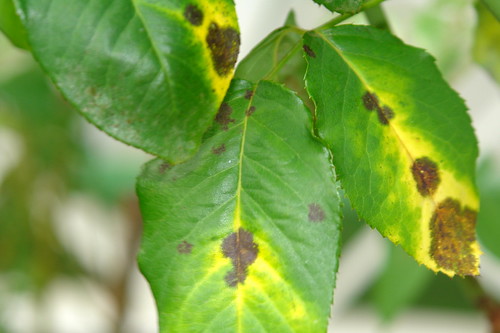
TheGardenLady wrote about the roses in her garden that get black spot.  Many roses, unfortunately, are affected by this disease. As I had written, one is never to water roses overhead. Mechanical watering devices that come on automatically at a set time are especially problematic in overhead watering. TheGardenLady has seen blackspot in some major rose gardens or botanical gardens that do overhead watering. Also, one should water in the early morning hours so that hopefully water will dry or evaporate from the leaves later in the day. Do not water in the afternoon. Always let the water run near the base of the rose. A soaker hose might be best.

But what should one do if it rains? Mother Nature sends the rain from above at any time of the day or night. And if it is a particularly rainy season, that is when you can usually see a lot of black spot on the rose leaves. Sometimes the black spot can get so bad that it can defoliate the roses to make the plant look unsightly even though the flowers look attractive.Then without leaves, the plant gets sickly and is susceptible to other disease or problems. So what should one do?

Continue reading “Black Spot on Roses”

Dubai Miracle Garden

The Huffington Post had an article about one of the world’s least known most impressive gardens of the world. The flowers look like annuals. So, if you are going to Dubai soon, don’t forget to visit the Dubai Miracle Garden.

Oriental Melons

Chinese melon by NomadicEntrepreneur

Yesterday was my most recent trip to an Asian supermarket where I found a variety of interesting melons that I have never eaten. I love melons so I wanted to try some new ones. I asked an Asian shopper who was buying them what they were like. She told me one was very sweet and the other crisp and not so sweet.

Most of the Oriental melons were very small, enough for one person, or for a light eater two could have a little half. So I bought the two different Oriental melons. I liked them, they could be nice serving “dishes” to fill the cavity with sorbets.

Continue reading “Oriental Melons”

Searching for the perfect garden hose

Garden Hose by MoHotta18

I wish I could use a drip hose. I think drip hoses are the best for two main reasons. One is that the water goes where you want it without wasting water through evaporation or spraying overhead water on plants that don’t like overhead watering. The second is that once you lay out the configuration of the hoses, you do not have to do anything more than turn on the water.

But my property does not allow for drip hoses. So I have to buy regular hoses. And the strange way my property is, I have to buy longer and longer hoses to reach all the plants on my uniquely shaped garden.

Continue reading “Searching for the perfect garden hose”