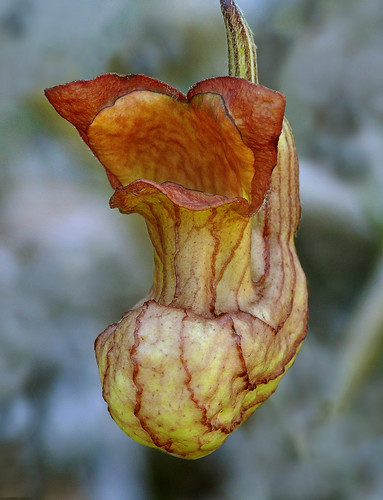
How to Propagate Dutchman’s Pipe

Aristolochia californica #2 by J.G. in S.F.

TheGardenLady received this question from Neil.

I have taken a shoot off an old vine where I grew up in CT. I want to plant in Georgia. It sits in a glass of water. Looks healthy. Have you any hints on how to get it to make roots for planting? Suggestions for planting? Incidentally, I nver remember seeing any fancy flowers on that vine, rather just green pipes. Could that nbe a matter of nutrition? Vine has been cut back near the grouns every year.

Perhaps you did not see flowers on your Dutchman’s pipe because some species have the flowers blooming under the leaves. Most find it easiest to propagate this plant by seed.

Though articles say that one should be able to propagate Dutchman’s Pipe -Aristolochia– by putting a shoot in water, many people have not had success doing so.

You should try rooting softwood cuttings of climbing Dutchman’s Pipe Vine in early spring. When rooting these vines, it is best to submerge at least three nodes under water. Plants root better in distilled or rain water.

Continue reading “How to Propagate Dutchman’s Pipe”

It Looks Like an Epiphyllum cactus or Orchid cactus

Epiphyllum – Susan Lynn by epiforums

TheGardenLady received this question from Linda.

I have a cactus plant with long flat ears. It sprouts little ones all along the sides. I am writing to you to ask if you might know the name of a cactus that looks like that.  Here is a photo of it.

From the photo it looks like an Epiphyllum cactus or Orchid cactus.

There is a Epiphyllum Society of America if you want to try to find your cultivar or variety or join to learn more about the plant.

It is considered a fairly easy care cactus.  (see here and here)


When To Plant Seedlings Outdoors

April 16th: Seedlings galore by flickrich

TheGardenLady received this question about starter planting.

We have plants that we started in the window and green beans are 4 in and our corn is right behind. We have other veggies that are a little slower. We live in Olathe Kansas. When can we put them all out?

People read the directions on packages of seeds and often it says to start the seeds by first planting them indoors a certain number of weeks before the last frost date and after that last frost to transplant the seedlings outdoors. The seed companies cannot tell you when to plant seeds outdoors because they have no idea where the purchaser lives.

Each temperature zone has a different last frost date – some Temp. zones don’t always get a frost some years. And even in the same Temp. zone no one knows exactly when the last frost date will be. Where you live might be warmer because you are near the ocean or colder because of various reasons. So how are you supposed to know?  (see here)

Continue reading “When To Plant Seedlings Outdoors”

Demilked.com: Design Milking Magazine

Designer: Kevin Hunt

TheGardenLady recently discovered a fun website called demilked.com that I thought gardeners might enjoy seeing. I have chosen the sections of this site that I thought gardeners might enjoy  (see here and here and here).

I love creativity and this website has many creative ideas to view but since TheGardenLady is a garden website, I am pointing you to the sites related to nature. But don’t stop there. You will love some of the art and design shown. Unfortunately I do not know where to purchase any of the interesting items.

TheGardenLady’s Spring Garden

This GardenLady loves Spring- when the world looks so lovely with all the flowers emerging from their sleep. l would like to share photos of some of the flowers that are in bloom in TheGardenLady’s spring garden.

(1) Hellebores with Brunnera and Greater Celandine (see here and here) Greater Celandine is becoming invasive in some areas (see here)

(2) Hellebores

(3) Korean Spice Bush or Mayflower Viburnum Viburnum Carlessi (see here)

(4) Virginia bluebells Mertensia virginica (see here)

Continue readingTheGardenLady’s Spring Garden”

Indoor Insect Killer that Kills Stinkbugs and More

How to Kill Stinkbugs, One of the Newest Pests in the U.S., Without Releasing Their Odor

Halyomorpha halys, or more commonly known as the stinkbug, is a fairly new pest to the United States. First appearing in September of 1998, it’s believed to have entered the country in packing crates from China or Japan. Since then, the stinkbug has multiplied at an astonishing rate, and the infestation is at critical levels throughout the Mid-Atlantic region. Many consumers are finding it hard to keep these pests out of their homes. These bugs can enter houses in a variety of ways … by hitching a ride in on clothes, crawling through unsealed cracks in doors, flying in through open doorways, and more.

As part of the Pentatomidae family, stinkbugs get their common name from the vile odor they emit through holes in their abdomen. This foul smell is a defense mechanism that makes the bug less appealing to birds and lizards. It also makes them especially nasty to get rid of. No matter how carefully you try to kill stinkbugs, any jostling, cornering, injuring or removing can “set them off”. As the infestation continues to rise, more and more people are looking for an effective way to kill stinkbugs. One of the best solutions is an indoor insect killer that can eliminate them on contact, without releasing the bugs’ odor.

Continue reading “Indoor Insect Killer that Kills Stinkbugs and More”

How to Eliminate the Stink Bug

Brown Marmorated Stink Bug by e_monk

Last week my son had lunch with a friend who is an emergency room doctor in a New York hospital. They got around to talking about some of the more numerous insects in New York. One of those insects seems to be found in nightmare numbers. But the interesting thing about this insect is that, though creepy and an insect that no one wants in their house or apartment, it is not known to cause any real diseases to people. It does bite people and can make you itch. Yet scientists have never found this insect to carry any disease. But this young doctor says he is seeing many people in the emergency room because of the insect. Why? Because people don’t want the insect and have been buying toxic chemicals to spray or spread in their apartments. The people are getting sick from the chemicals they are using to try to get rid of this insect. The saddest thing is that mostly all the chemicals that they are using that are poisoning them are ineffective in getting rid of the insect they want to kill. This young doctor told my son that he is seeing numerous cases of poisoned patients.

There is another insect that is considered benign that has been coming into people’s homes in great quantities to over winter. This is an insect in the stink bug family known by scientists as the Brown Marmorated Stink Bug – Halyomorpha halys (see here). Most other stink bugs overwinter in dead leaves, but the Brown Marmorated Stink Bug discovered that it can get into your house through numerous cracks or through window air conditioners and be comfortable hiding in a warm comfortable house. You really don’t see that many until it warms up outdoors and they want to leave in the spring because they are starving after a long winter of no food. Sometimes they are fooled into thinking that it is spring when lights are on indoors. Though this bug is considered a nuisance more than a disease carrier, no one likes finding them in the house. Have you ever been to a dinner party when they came out and in their confusion dive bombed the guests? TheGardenLady has and it wasn’t pleasant.

So how does one get rid of them?

Continue reading “How to Eliminate the Stink Bug”

An Organic Wasp Killer that Takes the Sting Out of the Great Outdoors

The Importance of Organic Wasp Killers for Backyards

Wasps can be very beneficial.

However, wasps elicit fear in many people, especially those who are severely allergic to them. Painful to humans, a wasp’s sting can vary greatly in toxicity.

For those without an allergy to wasp stings, they will experience varying degrees of burning, itching, redness, tenderness, and swelling that may last up to a week. These reactions can be treated easily with ice, meat tenderizer, or other commercial topical ointments.

Others may have an allergic reaction. An allergic reaction can include a rash, hives, headache, minor respiratory symptoms, and upset stomach. These reactions can be treated with an over-the-counter antihistamine.

For those rare individuals, a wasp sting can cause anaphylactic shock (fainting, difficulty breathing, swelling, and blockage in the throat) within minutes of being stung. These systemic allergic reactions may cause a person to die unless treated immediately with an epinephrine injection and a subsequent visit to the hospital. For individuals with allergies, a wasp killer becomes an important line of defense whenever spending time outdoors.

Continue reading “An Organic Wasp Killer that Takes the Sting Out of the Great Outdoors”

How Wasps Can be Beneficial in the Garden

wasps by myriorama

Everyone knows that honey bees or lady bugs are beneficial insects. But there are other beneficial insects in the garden that we often don’t think of as beneficial. These insects may be minor pollinators but the reason they are really beneficial is because they are predators of harmful insects. TheGardenLady is specifically thinking of insects in the wasp family. When people see wasps, they generally are fearful that the wasps will sting them or others on their property. But many of the wasps are so busy going about their work, they won’t sting unless they feel threatened.

There are predatory wasps that attack caterpillars and other soft-bodied insects and parasitic wasps that lay eggs in harmful insects and when the eggs hatch they eat the harmful insects.  See here.

One example of a beneficial wasp is the potter’s wasp which is a predator that gets rid of unwanted caterpillars.  See here.

Continue reading “How Wasps Can be Beneficial in the Garden”

Battling Animals in the Garden – Part II

Baby Groundhog #1 by Chiot’s Run

Besides battling the deer in my garden (see last post), I have rabbits. They could have eaten some of my plants. I haven’t seen any rabbits on my property so far this spring, so that was why I had not blamed them for this early spring eating. Liquid Fence supposedly guards against both rabbits and deer. So I hope they won’t eat what I have sprayed.

Then I have squirrels who have not vacationed over the winter. They may be digging up some of those acorns they planted last fall or some of the bulbs I planted, like crocus bulbs.

Or is it the resident groundhog (Marmota monax) also called a woodchuck that lives on my property who is eating everything? (There is probably a family living with him) Since I am not a Jane Goodall type who can tell one groundhog from another to be able to name them, I cannot discern how many waddling groundhogs are out and about each day. To my eye it seems to work solo.

Continue reading “Battling Animals in the Garden – Part II”